HiMedia Laboratories GmbH, Marie-Curie-Str. 3, 64683, Einhausen, Germany.

 Your enquiry has been submitted
Something problem with the server. Try again.
 Your enquiry has been submitted
Recommended for differentiation of gram- negative bacteria from clinical and non-clinical samples on the basis of fermentative and oxidative metabolism of carbohydrates.
| Ingredients | g / L |
|---|---|
| Tryptone | 2.000 |
| Sodium chloride | 5.000 |
| Dipotassium hydrogen phosphate | 0.300 |
| Bromo thymol blue | 0.080 |
| Agar | 2.000 |
Final pH ( at 25°C): 6.8±0.2
**Formula adjusted, standardized to suit performance parameters
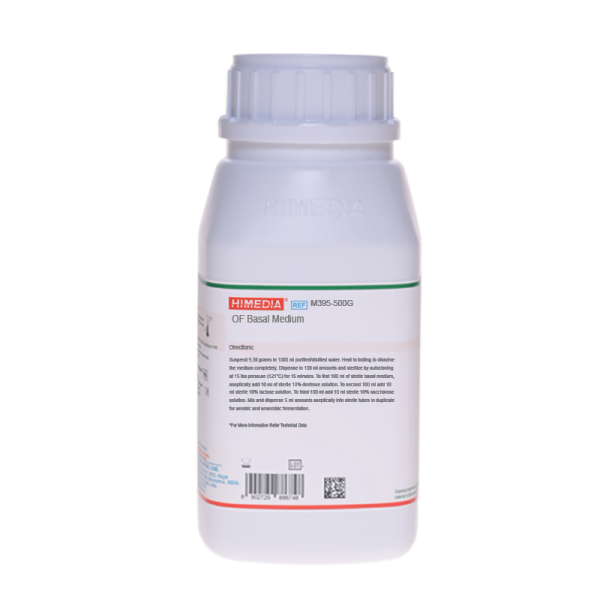
Suspend 9.38 grams in 1000 ml purified/distilled water. Heat to boiling to dissolve the medium completely. Dispense in 100 ml amounts and sterilize by autoclaving at 15 lbs pressure (121°C) for 15 minutes. To first 100 ml of sterile basal medium, aseptically add 10 ml of sterile 10% dextrose solution. To second 100 ml add 10 ml sterile 10% lactose solution. To third 100 ml add 10 ml sterile 10% saccharose solution. Mix and dispense 5 ml amounts aseptically into sterile tubes in duplicate for aerobic and anaerobic fermentation.
Hugh and Leifson developed OF Medium to study oxidative and fermentative metabolism of carbohydrates by gram-negative bacteria. This criterion is used during taxonomic studies of Enterobacteriaceae (1). Tryptone in the medium provides the necessary carbon and nitrogen, vitamins etc. required for bacterial growth.
A carbohydrate whose fermentation reaction is to be studied is added separately. Phosphate buffers the medium and the low agar concentration determines motility and dispersion of the acid produced on the surface (2). Bromothymol blue acts as the pH indicator. The low concentration of agar permits the determination of motility and aids in the even distribution of any acid produced at the surface of the medium (3). Motility is observed as diffused zone of flaring out from the line of inoculation. Non-motile organisms grow along the line of inoculation.
Dextrose is the most important carbohydrate for use in OF Basal Medium. However, certain organisms may metabolize other carbohydrates even if they are unable to utilize dextrose. Degradation of the carbohydrate to acid is indicated by the pH indicator bromothymol blue which changes its colour to yellow. Oxidative utilization takes place when the medium is exposed to air while fermentative utilization occurs under exclusion of air.
The authors Hugh and Leifson showed that when a gram-negative organism is inoculated in this medium containing a carbohydrate in duplicate, of which one tube is covered with mineral oil to exclude oxygen and the second tube is uncovered; reactions of differential value can be observed. Fermentative organisms will produce an acid reaction in both the covered and uncovered medium. Oxidative organisms will produce an acid reaction in the uncovered medium and give slight growth without change in the covered medium. Organisms which are not classified either as oxidative or fermentative show no change in the covered medium and an alkaline reaction in the uncovered medium (3). Prepare the medium with 1% dextrose and without 1% dextrose. Two tubes of each carbohydrate are used per organism and inoculated by stabbing. One of the inoculated tubes of each carbohydrate medium is covered with 2 ml of sterile mineral oil and the other is left uncovered. The tubes are incubated at 35-37°C for 18-48 hours or longer. The results are read after 48 hours.
The acidic reaction of oxidative organisms is more apparent at the surface of the medium that gradually spreads throughout the medium. If the oxidation reaction is weak or slow, an initial alkaline reaction at the surface of the uncovered tube may persist for several days and eventually convert to an acid reaction.
OF Basal Medium can be supplemented with 2% serum or yeast extract (0.1%) to make the medium more nutritious for the growth of bacteria (4).
Isolated Microorganism from clinical and non-clinical samples.
For clinical samples follow appropriate techniques for handling specimens as per established guidelines (5,6). For food and dairy samples, follow appropriate techniques for sample collection and processing as per guidelines(7,8). After use, contaminated materials must be sterilized by autoclaving before discarding.
In Vitro diagnostic use. For professional use only. Read the label before opening the container. Wear protective gloves/protective clothing/eye protection/face protection. Follow good microbiological lab practices while handling specimens and culture. Standard precautions as per established guidelines should be followed while handling clinical specimens. Safety guidelines may be referred in individual safety data sheets.
Performance of the medium is expected when used as per the direction on the label within the expiry period when stored at recommended temperature.
Appearance: Cream to greenish yellow homogeneous free flowing powder
Gelling: Semisolid, comparable with 0.2% Agar gel.
Colour and Clarity of Prepared medium: Green coloured clear to slightly opalescent gel forms in tubes.
Reaction: Reaction of 0.94% w/v aqueous solution at 25°C. pH : 6.8±0.2
pH: 6.60-7.00
Cultural Response: Cultural characteristics observed after an incubation at 35-37°C for 18-48 hours.
| Organism | Only Basal Medium (aerobic) | Only Basal Medium (overlayed with mineral oil) | w/ Dextrose (aerobic) | w/ Dextrose (overlayed with mineral oil) |
|---|---|---|---|---|
| Acinetobacter baumannii ATCC 19606 | alkaline reaction, green colour of the medium | alkaline reaction, green colour of the medium | acidic reaction, yellowing of the medium | alkaline reaction, green colour of the medium |
| Alcaligenes faecalis ATCC 87500 | alkaline reaction, green colour of the medium | alkaline reaction, green colour of the medium | alkaline reaction, green colour of the medium | alkaline reaction, green colour of the medium |
| Escherichia coli ATCC 25922 (00013*) | alkaline reaction, green colour of the medium | alkaline reaction, green colour of the medium | acidic reaction, yellowing of the medium with gas formation | acidic reaction, yellowing of the medium with gas formation |
| # Klebsiella aerogenes ATCC 13048 (00175*) | alkaline reaction, green colour of the medium | alkaline reaction, green colour of the medium | acidic reaction, yellowing of the medium with gas formation | acidic reaction, yellowing of the medium with gas formation |
| ^ Pseudomonas aeruginosa ATCC 9027 (00026*) | alkaline reaction, green colour of the medium | alkaline reaction, green colour of the medium | acidic reaction, yellowing of the medium | alkaline reaction, green colour of the medium |
| Salmonella Enteritidis ATCC 13076 (00030*) | alkaline reaction, green colour of the medium | alkaline reaction, green colour of the medium | acidic reaction, yellowing of the medium with gas formation | acidic reaction, yellowing of the medium with gas formation |
| Shigella flexneri ATCC 12022 (00126*) | alkaline reaction, green colour of the medium | alkaline reaction, green colour of the medium | acidic reaction, yellowing of the medium | acidic reaction, yellowing of the medium |
| Vibrio cholerae ATCC 15748 | alkaline reaction, green colour of the medium | alkaline reaction, green colour of the medium | acidic reaction, yellowing of the medium | acidic reaction, yellowing of the medium |
Key : * Corresponding WDCM numbers
# Formerly known as Enterobacter aerogenes
^ Formerly known as Pseudomonas aeruginosa
Store between 10-30°C in a tightly closed container and the prepared medium at 2-8°C. Use before expiry date on the label. On opening, product should be properly stored dry, after tightly capping the bottle in order to prevent lump formation due to the hygroscopic nature of the product. Improper storage of the product may lead to lump formation. Store in dry ventilated area protected from extremes of temperature and sources of ignition Seal the container tightly after use. Product performance is best if used within stated expiry period.
User must ensure safe disposal by autoclaving and/or incineration of used or unusable preparations of this product. Follow established laboratory procedures in disposing of infectious materials and material that comes into contact with clinical sample must be decontaminated and disposed of in accordance with current laboratory techniques (5,6).
| Product Name | OF Basal Medium |
|---|---|
| SKU | M395 |
| Product Type | Regular |
| Physical Form | Powder |
| Origin | Animal |
| Packaging type | HDPE |
| References | 1. Sandholzer and Winter, 1946, Commercial Fisheries Leaflet T1a . 2.Eaton A. D., Clesceri L. S. and Greenberg A. E., (Ed.), 1998, Standard Methods for the Examination of Water and Wastewater, 20th Ed., American Public Health Association, Washington, D.C. |
| Customized Product Available | No |