Plot No. C40, Road No. 21Y, MIDC, Wagle Industrial Estate, Thane(W)-400604, MH, India


 Your enquiry has been submitted
Something problem with the server. Try again.
 Your enquiry has been submitted
For the isolation and differentiation of Gram-negative enteric bacteria from clinical and non-clinical specimens.
| Ingredients | g / L |
|---|---|
| Peptone | 10.000 |
| Dipotassium hydrogen phosphate | 2.000 |
| Lactose | 5.000 |
| Saccharose (Sucrose) | 5.000 |
| Eosin - Y | 0.400 |
| Methylene blue | 0.065 |
| Agar | 13.500 |
Final pH (at 25°C): 7.2±0.2
**Formula adjusted, standardized to suit performance parameters
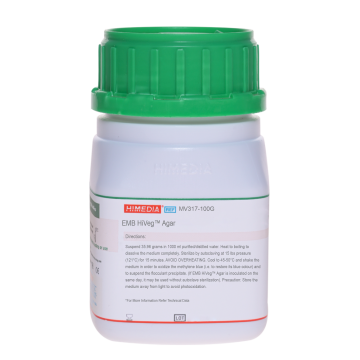
Suspend 35.96 grams in 1000 ml purified / distilled water. Mix until suspension is uniform. Heat to boiling to dissolve the medium completely. Sterilize by autoclaving at 15 lbs pressure (121°C) for 15 minutes. AVOID OVERHEATING. Cool to 45-50°C and shake the medium in order to oxidize the methylene blue (i.e. to restore its blue colour) and to suspend the flocculent precipitate. (If EMB Agar is inoculated on the same day, it may be used without autoclave sterilization).
Precaution : Store the medium away from light to avoid photooxidation.
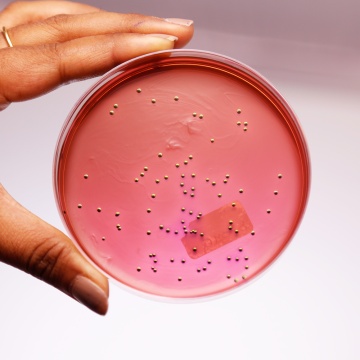
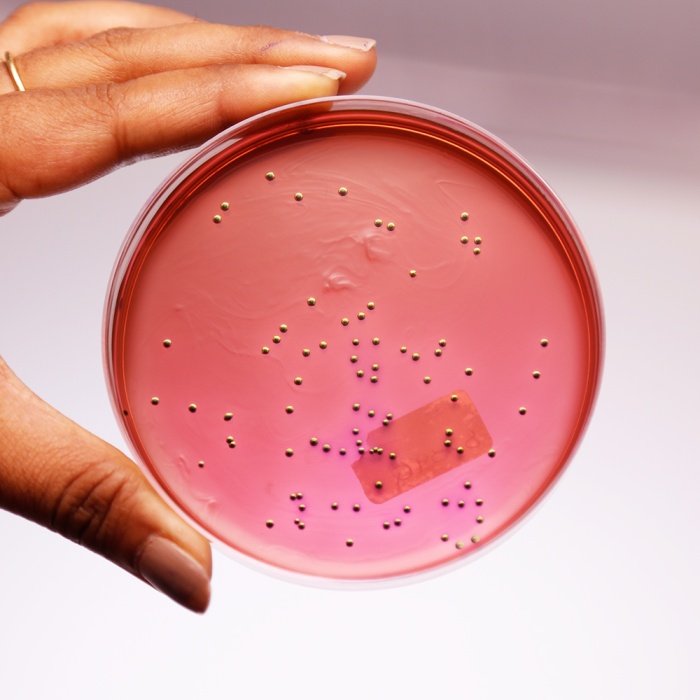
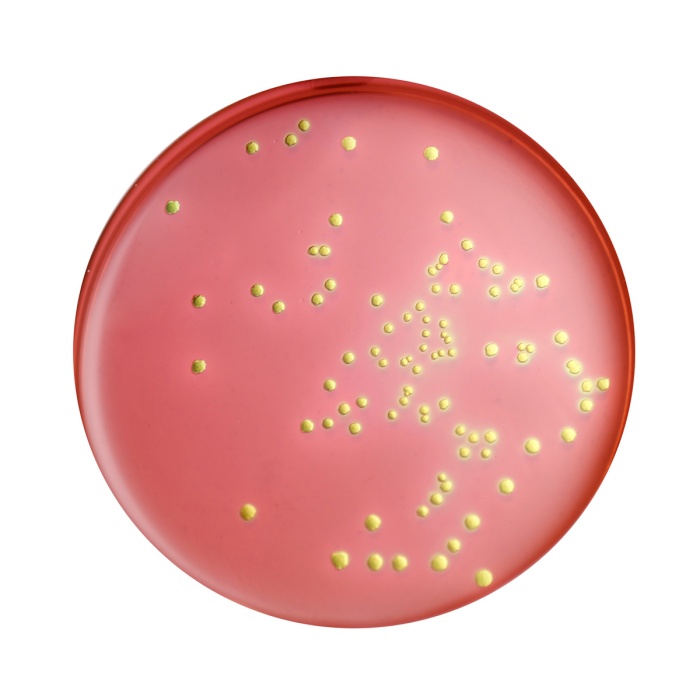
Eosin Methylene Blue (EMB) Agar was originally devised by Holt-Harris and Teague (1) and further modified by Levine (2). The above medium is a combination of the Levine and Holt-Harris and Teague formulae which contains peptone and phosphate as recommended by Levine and two carbohydrates as suggested by Holt-Harris and Teague. Methylene blue and Eosin-Y inhibit gram-positive bacteria to a limited degree. These dyes serve as differential indicators in response to the fermentation of carbohydrates. The ratio of eosin and methylene blue is adjusted approximately to 6:1. Sucrose is added to the medium as an alternative carbohydrate source for typically lactose-fermenting, gram-negative bacilli, which on occasion do not ferment lactose or do so slowly. The coliforms produce purplish black colonies due to taking up of methylene blue-eosin dye complex, when the pH drops. The dye complex is absorbed into the colony. Nonfermenters probably raise the pH of surrounding medium by oxidative deamination of protein, which solubilizes the methylene blue-eosin complex resulting in colourless colonies (3). Some strains of Salmonella and Shigella species do not grow in the presence of eosin and methylene blue. Further tests are required to confirm the isolates.
Peptone serves as source of carbon, nitrogen, and other essential growth nutrients. Lactose and sucrose are the sources of energy by being fermentable carbohydrates. Eosin-Y and methylene blue serve as differential indicators. Phosphate buffers the medium.
The test sample can be directly streaked on the medium plates. Inoculated plates should be incubated, protected from light. However standard procedures should be followed to obtain isolated colonies. A non-selective medium should be inoculated in conjunction with EMB Agar. Confirmatory tests should be further carried out for identification of isolated colonies.
Clinical samples- Faecal samples, Food samples, Water samples
For clinical samples follow appropriate techniques for handling specimens as per established guidelines (4,5).
For food samples, follow appropriate techniques for sample collection and processing as per guidelines (6).
For water samples, follow appropriate techniques for sample collection, processing as per guidelines and local standards (7).
After use, contaminated materials must be sterilized by autoclaving before discarding.
In Vitro diagnostic use. For professional use only. Read the label before opening the container. Wear protective gloves/protective clothing/eye protection/face protection. Follow good microbiological lab practices while handling specimens and culture. Standard precautions as per established guidelines should be followed while handling clinical specimens. Safety guidelines may be referred in individual safety data sheets.
Performance of the medium is expected when used as per the direction on the label within the expiry period when stored at recommended temperature.
Appearance: Light pink to purple homogeneous free flowing powder
Gelling: Firm, comparable with 1.35% Agar gel.
Colour and Clarity of prepared medium: Reddish purple coloured, opalescent gel with greenish cast and finely dispersed precipitate forms in Petri plates
Reaction: Reaction of 3.6% w/v aqueous solution at 25°C. pH : 7.2±0.2
pH: 7.00-7.40
Cultural Response: Cultural characteristics observed after an incubation at 35 - 37°C for 18 - 24 hours
| Organism | Inoculum (CFU) | Growth | Recovery | Colour of colony |
|---|---|---|---|---|
| # Klebsiella aerogenes ATCC 13048 (00175*) | 50-100 | good | 40-50% | pink, without sheen |
| Escherichia coli ATCC 25922 (00013*) | 50-100 | luxuriant | >=50% | purple with black centre and green metallic sheen |
| Klebsiella pneumoniae ATCC 13883 (00097*) | 50-100 | good | 40-50% | pink, mucoid |
| Proteus mirabilis ATCC 25933 | 50-100 | luxuriant | >=50% | colourless |
| Salmonella Typhimurium ATCC 14028 (00031*) | 50-100 | luxuriant | >=50% | colourless |
| Staphylococcus aureus subsp. aureus ATCC 25923 (00034*) | >=104 | inhibited | 0% |
Key : (*) Corresponding WDCM numbers. (#) Formerly known as Enterobacter aerogenes
Store between 10-30°C in a tightly closed container and the prepared medium at 20-30°C. Use before expiry date on the label. On opening, product should be properly stored dry, after tightly capping the bottle in order to prevent lump formation due to the hygroscopic nature of the product. Improper storage of the product may lead to lump formation. Store in dry ventilated area protected from extremes of temperature and sources of ignition. Seal the container tightly after use. Product performance is best if used within stated expiry period.
User must ensure safe disposal by autoclaving and/or incineration of used or unusable preparations of this product. Follow established laboratory procedures in disposing of infectious materials and material that comes into contact with clinical sample must be decontaminated and disposed of in accordance with current laboratory techniques (4,5).
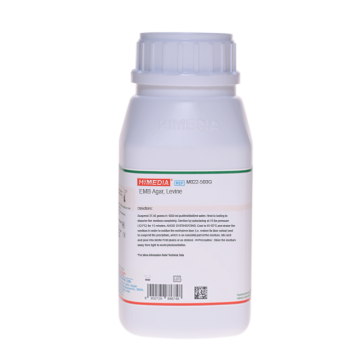
| Product Name | EMB Agar |
|---|---|
| SKU | M317 |
| Product Type | Regular |
| Physical Form | Powder |
| Origin | Animal |
| Packaging type | HDPE |
| References | 1. Moffett M., Young J. and Stuart R. D., 1948, Brit. Med. J., 2:241. 2.Stuart R. D., Toshach S. R. and Patsula T. M., 1954, Can. J. Public Health, 45:73. 3.Amies C. S., 1967, Can. J. Public Health, 58:296. |