HiMedia Laboratories GmbH, Marie-Curie-Str. 3, 64683, Einhausen, Germany.

 Your enquiry has been submitted
Something problem with the server. Try again.
 Your enquiry has been submitted
Recommended for the isolation of the Bifidobacterium species from faeces or stool specimens.
| Ingredients | g / L |
|---|---|
| Peptone special | 22.220 |
| Corn starch | 0.970 |
| Sodium chloride | 4.830 |
| Dextrose (Glucose) | 2.500 |
| Lactulose | 2.500 |
| L-Cysteine hydrochloride monohydrate | 0.500 |
| Riboflavin (Vitamin B2) | 0.010 |
| Agar | 14.490 |
Final pH ( at 25°C) 5.5±0.2
**Formula adjusted, standardized to suit performance parameters
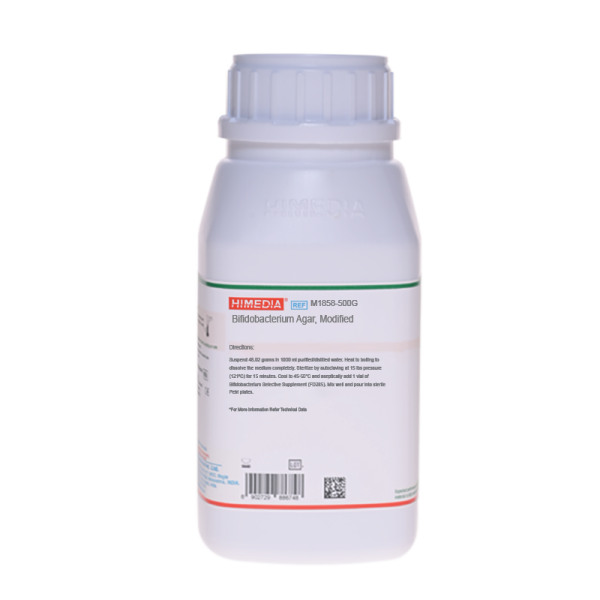
Suspend 48.02 grams in 1000 ml purified / distilled water. Heat to boiling to dissolve the medium completely. Sterilize by autoclaving at 15 lbs pressure (121ºC) for 15 minutes. Cool to 45-50°C and aseptically add 1 vial of PAc Selective Supplement (FD285). Mix well and pour into sterile Petri plates.
The genus Bifidobacterium is the third most numerous bacterial populations found in the human intestine after Bacteroides and Eubacterium. It is an anaerobic bacteria that makes up the gut microbial flora. It can be isolated from a variety of materials such as human and animal feces, sewage and from the oral cavity. Their main habitat in humans is the large intestine where they are among the major groups of normal intestinal bacteria. It resides in the colon and have health benefits for their hosts. Bifidobacteria are also associated with lower incidences of allergies (1,2). Since their pathogenicity is low, bifidobacteria and lactobacilli are used as probiotics to improve the composition of the intestinal flora in case of disorders. Additionally, use of probiotics has been discussed to improve certain extraintestinal disorders or syndromes, e.g. vaginitis, Helicobacter pylori infection, and cystic fibrosis (3).
Beerens described Bifidobacterium Medium which is based on Columbia Agar base. The medium is also supplemented with propionic acid, and the pH of the medium is 5.0 (4). Propionic acid is inhibitory to fungi and many bacteria other than Bifidobacteria, such as intestinal Bacteroides and Enterobacteriacea. The low pH of the medium further contributes to inhibit other predominating organisms of human feces, such as Bacteroides and Eubacterium species. Cysteine is a reducing agent. Bifidobacterium Agar, Modified is a slight modification of the original medium. It contains lactulose, a sugar used as a prebiotic that is preferably fermented by Bifidobacteria. Glucose is a carbon source. Riboflavin is a vitamin for many Bifidobacteria (5).
Clinical samples - faeces or stool, oral cavity
For clinical samples follow appropriate techniques for handling specimens as per established guidelines (6,7). After use, contaminated materials must be sterilized by autoclaving before discarding.
In Vitro diagnostic Use only. For professional use only. Read the label before opening the container. Wear protective gloves/protective clothing/eye protection/ face protection. Follow good microbiological lab practices while handling specimens and culture. Standard precautions as per established guidelines should be followed while handling clinical specimens. Safety guidelines may be referred in individual safety data sheets.
Performance of the medium is expected when used as per the direction on the label within the expiry period when stored at recommended temperature.
Appearance: Cream to yellow coloured homogeneous free flowing powder
Gelling: Firm, comparable with 1.45% Agar gel
Colour and Clarity of prepared medium: Amber coloured clear to slightly opalescent gel forms in Petri plates
Reaction: Reaction of 4.80% w/v aqueous solution at 25°C. pH : 5.5±0.2
pH: 5.30-5.70
Cultural Response: Cultural characteristics observed with added PAc Selective Supplement (FD285) after an incubation at 35-37°C for 24-48 hours in an anaerobic conditions.
| Organism | Inoculum (CFU) | Growth | Recovery |
|---|---|---|---|
| Bifidobacterium bifidum ATCC 15696 | 50-100 | luxuriant | >=50% |
| Bacteroides fragilis ATCC 23745 | 50-100 | none-poor | <=10% |
| Bifidobacterium infantis ATCC 25962 | 50-100 | luxuriant | >=50% |
| Lactobacillus acidophilus ATCC 4356 (00098*) | 50-100 | none-poor | <=10% |
| Escherichia coli ATCC 25922 (00013*) | 50-100 | none-poor | <=10% |
| Bifidobacterium breve ATCC 15698 | 50-100 | luxuriant | >=50% |
Key : (*) Corresponding WDCM numbers.
Store between 10-30°C in a tightly closed container and the prepared medium at 2-8°C. Use before expiry date on the label. On opening, product should be properly stored dry, after tightly capping the bottle in order to prevent lump formation due to the hygroscopic nature of the product. Improper storage of the product may lead to lump formation. Store in dry ventilated area protected from extremes of temperature and sources of ignition. Seal the container tightly after use. Product performance is best if used within stated expiry period.
User must ensure safe disposal by autoclaving and/or incineration of used or unusable preparations of this product. Follow established laboratory procedures in disposing of infectious materials and material that comes into contact with clinical sample must be decontaminated and disposed of in accordance with current laboratory techniques (6,7).
| Product Name | Bifidobacterium Agar, Modified |
|---|---|
| SKU | M1858 |
| Product Type | Regular |
| Physical Form | Powder |
| Origin | Animal |
| Packaging type | HDPE |
| References | 1.Björkstén B., Sepp E., Julge K., Voor T., and Mikelsaar M., 2001, J. Allergy Clin. Microbiol., Volume 108, Issue 4, 516-520.2.Guarner F., and Malagelada J. R., 2003, The Lancet, Vol. 361, Issue 9356, 8 February 2003, 512-519.3.Gorbach, S.L. 200 |
| Customized Product Available | No |