HiMedia Laboratories GmbH, Marie-Curie-Str. 3, 64683, Einhausen, Germany.

 Your enquiry has been submitted
Something problem with the server. Try again.
 Your enquiry has been submitted
Recommended for enumeration of presumptive Bifidobacteria by colony count technique from milk products.
| Ingredients | Gms / Litre |
|---|---|
| Tryptone | 10.000 |
| Yeast extract | 1.000 |
| Potassium dihydrogen phosphate | 3.000 |
| Dipotassium hydrogen phosphate | 4.800 |
| Ammonium sulphate | 3.000 |
| Magnesium sulphate heptahydrate | 0.200 |
| L-Cysteine HCl monohydrate | 0.500 |
| Sodium propionate | 15.000 |
| Galactooligosaccharide | 10.000 |
| Agar | 15.000 |
Final pH (at 25°C): 6.3±0.2
**Formula adjusted, standardized to suit performance parameters
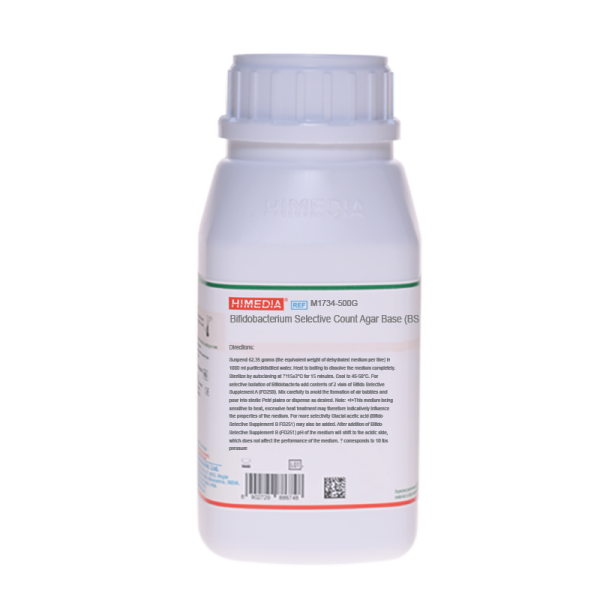
Suspend 62.35 grams (the equivalent weight of dehydrated medium per litre) in 1000 ml purified / distilled water. Heat to boiling to dissolve the medium completely. Sterilize by autoclaving at (115±3°C) for 15 minutes. Cool to 45-50°C. For selective isolation of Bifidobacteria add contents of 2 vials of Mup Selective Supplement (FD250). Mix carefully to avoid the formation of air bubbles and pour into sterile Petri plates or dispense as desired.
Note: This medium being sensitive to heat, excessive heat treatment may therefore indicatively influence the properties of the medium. For more selectivity Glacial acetic acid (1% glacic Selective Supplement B FD251) may also be added. After addition of 1% glacic Selective Supplement (FD251) pH of the medium will shift to the acidic side, which does not affect the performance of the medium.
Bifidobacteria Selective Count Agar Base is specifically prepared for selective enumeration of Bifidobacteria in fermented milks and fermented milk drinks living together with lactic acid bacteria.
Bifidobacteria Selective Count Agar Base contains highly purified Galactooligosaccharides, which is one of the most excellent Bifidobacteria growth substances. Cysteine hydrochloride helps in creating reduced conditions required for the growth of Bifidobacteria. Tryptone acts as rich nitrogen source.
The antibiotic mupirocin inhibits the growth of most lactic acid bacteria commonly used in fermented and non-fermented dairy products. Freshly prepared culture media not exposed to direct sunlight is recommended (2).
Test Procedure: Before opening the sample container, clean the external surface surrounding of the area from which the test sample is to be taken, in order to remove any material that might contaminate the sample. Weigh 90 gm of diluent in each of the 250 ml pre-sterilized bottles. Close the bottles. Weigh 10 gm of the test sample directly into the bottle with the diluent at 45°C. To dissolve the test sample, swirl slowly to wet the powder. The time between ending the preparation of the primary dilution until addition of culture medium shall not exceed 15 min.. Immediately after solidification of the medium, invert all Petri dishes in the anaerobic culture jar or anaerobic incubator at 37°C for 72 hrs ± 3 hrs. Count the colonies after incubation. Bifidobacterial colonies are recognized by their whitish colour and acetic acid odour. Some of the bifidobacterial strains may appear in different colony size as well as colony appearance on the same plate (2).
Dairy samples
For dairy samples, follow appropriate techniques for sample collection and processing as per guidelines (1,6). After use, contaminated materials must be sterilized by autoclaving before discarding.
Read the label before opening the container. Wear protective gloves/protective clothing/eye protection/ face protection. Follow good microbiological lab practices while handling specimens and culture. Standard precautions as per established guidelines should be followed while handling specimens. Safety guidelines may be referred in individual safety data sheets.
Performance of the medium is expected when used as per the direction on the label within the expiry period when stored at recommended temperature.
Appearance: Cream to yellow homogeneous free flowing powder
Gelling: Firm, comparable with 1.5% Agar gel
Colour and Clarity of Prepared medium: Yellow coloured opalescent gel forms in Petri plates
Reaction: Reaction of 6.20% w/v aqueous solution at 25°C. pH : 6.3±0.2
pH: 6.10-6.50
Cultural Response: Cultural characteristics observed with added Bifido Selective Supplement A under anaerobic conditions, after an incubation at 35-37°C for 48-72 hours.
| Organism | Inoculum (CFU) | Growth | Growth with FD250 |
|---|---|---|---|
| Bifiobacterium breve ATCC 15100 | 50-100 | luxuriant | Good-luxuriant |
| Lactococcus lactis ATCC 19435 (00016*) | 50-100 | good-luxuriant | inhibited |
| Lactococcus cremoris ATCC 19257 | 50-100 | good-luxuriant | inhibited |
| Lactobacillus acidophilus ATCC 4356 (00098*) | 50-100 | good | inhibited |
Key : (*) Corresponding WDCM numbers.
Store between 10-30°C in a tightly closed container and the prepared medium at 2-8°C. Use before expiry date on the label. On opening, product should be properly stored dry, after tightly capping the bottle in order to prevent lump formation due to the hygroscopic nature of the product. Improper storage of the product may lead to lump formation. Store in dry ventilated area protected from extremes of temperature and sources of ignition. Seal the container tightly after use. Product performance is best if used within stated expiry period.
User must ensure safe disposal by autoclaving and/or incineration of used or unusable preparations of this product. Follow established laboratory procedures in disposing of infectious materials and material that comes into contact with sample must be decontaminated and disposed of in accordance with current laboratory techniques (3,4).
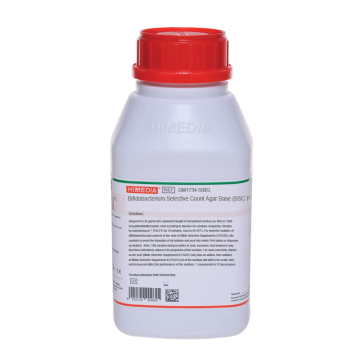
| Product Name | Bifidobacterium Selective Count Agar Base (BSC Propionate Agar Base) |
|---|---|
| SKU | M1734 |
| Product Type | Regular |
| Physical Form | Powder |
| Origin | Animal |
| Packaging type | HDPE |
| References | 1.American Public Health Association, Standard Methods for the Examination of Dairy Products, 1978, 14th Ed., Washington D.C. |
| Customized Product Available | No |