HiMedia Laboratories GmbH, Marie-Curie-Str. 3, 64683, Einhausen, Germany.

 Your enquiry has been submitted
Something problem with the server. Try again.
 Your enquiry has been submitted
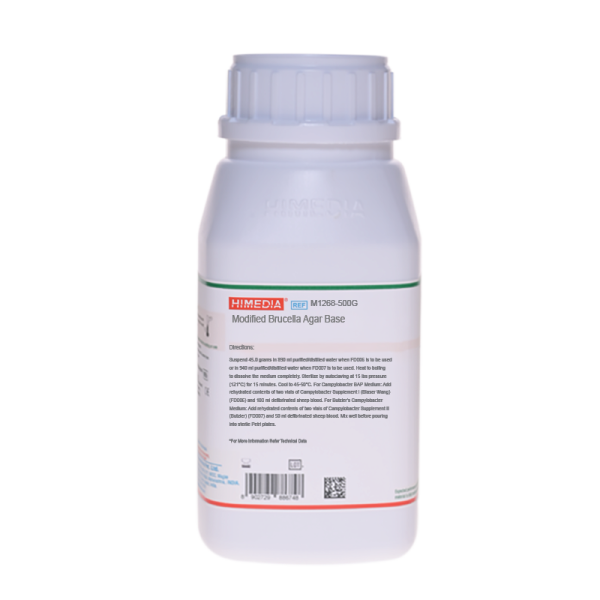
Modified Brucella Agar Base with the added selective supplements is used for the selective isolation and cultivation of thermotolerant Campylobacter species.
| Ingredients | Gms/Litre |
|---|---|
| Casein enzymic hydrolysate | 10.000 |
| Peptic digest of animal tissue | 5.000 |
| Sodium chloride | 5.000 |
| Glucose | 10.000 |
| Agar | 15.000 |
Final pH (at 25°C): 7.5±0.2
Formula adjusted, standardized to suit performance parameters
Suspend 45 grams in 890 ml distilled water when FD006 is to be added, or in 940 ml distilled water when FD007 is to be used. Heat to boiling to dissolve the medium completely. Sterilize by autoclaving at 15 lbs pressure (121°C) for 15 minutes. Cool to 45-50°C.
For Campylobacter BAP Medium: Add rehydrated contents of 2 vials of Campylobacter Supplement I (Blaser Wang) (FD006) and 100 ml v/v defibrinated sheep blood to the basal medium. For Butzlers Campylobacter Medium: Add rehydrated contents of 2 vials of Campylobacter Supplement II (Butzler) (FD007) and 50 ml v/v defibrinated sheep blood to the basal medium. Mix well before pouring into sterile Petri plates.
Dekeyser et al isolated Campylobacter jejuni from the faeces of patients with diarrhea and acute gastroenteritis using a filtration technique and a blood-containing selective medium with antibiotics to suppress the normal enteric flora (1). In 1978, Blaser et al reported the isolation of C. jejuni with a medium containing antibiotics incorporated into Brucella Agar supplemented with defibrinated sheep blood (8, 3).
Modified Brucella Agar is formulated as per APHA (2) for the isolation and cultivation of Campylobacter species. Modified Brucella Agar Base is used as a basal medium for preparation of Campylobacter BAP Medium or Blasers Agar or Butzlers Campylobacter Medium. Blaser et al (4) suggested the use of four antibiotics as amphotericin B, polymyxin B, trimethoprim and vancomycin for isolation of C. jejuni
Vancomycin is a glycopeptide antibiotic that inhibits many species of gram-positive bacteria. Amphotericin B is an antifungal agent. C. jejuni is thermophilic, therefore it is important to incubate the plates at 42°C; deviation will result in delayed growth. Also higher temperature improves selection by inhibiting the normal flora.
Later on Blaser et al (3, 4, 8) added a fifth antibiotic Cephalothin in it to inhibit non-pathogenic Campylobacter fetus species. In the Butzlers formulation (5, 6), cefoperazone, rifampicin, colistin and amphotericin B are added to the basal medium.
Casein enzymic hydrolysate, peptic digest of animal tissue provide essential growth nutrients as nitrogenous compounds, sulphur, carbon and trace elements. Glucose is the energy source. Sodium chloride maintains the osmotic equilibrium. The different antibiotics make the medium selective. After the medium is poured into plate, do not excessively expose it to the light (7) and dry the agar surface to limit moisture before streaking. C. jejuni produces two types of colonies. One is small, raised, grayish- brown, smooth and glistening with an entire translucent edge. The other is flat, mucoid, translucent, grayish and has an irregular edge.
Appearance: Cream to yellow homogeneous free flowing powder
Gelling: Firm, comparable with 1.5% Agar gel
Colour and Clarity of prepared medium: Basal medium: Yellow coloured clear to slightly opalescent gel forms in Petri plates. On addition of blood: cherry-red coloured opaque gel forms in Petri plates
Reaction: Reaction of 4.5% w/v aqueous solution at 25°C. pH: 7.5±0.2
pH: 7.30-7.70
Cultural characteristics observed after an incubation at 42°C for 48 hours in microaerobic atmosphere (5% O2, 10% Carbon dioxide (CO2) and 85% N2).
| Organism | Growth (w/ addition of FD006) | Growth (w/ addition of FD007) |
|---|---|---|
| Campylobacter coli ATCC 33559 | good-luxuriant | good-luxuriant |
| Campylobacter jejuni ATCC 29428 | luxuriant | luxuriant |
| Escherichia coli ATCC 25922 | inhibited | inhibited |
| Salmonella Typhi ATCC 6539 | inhibited | inhibited |
Store below 30°C in tightly closed container and the prepared medium at 2-8°C. Use before expiry date on the label.
| Product Name | Modified Brucella Agar Base |
|---|---|
| SKU | M1268 |
| Product Type | Regular |
| Physical Form | Powder |
| Origin | Animal |
| Packaging type | HDPE |
| References | 1. Eaton A. D., Clesceri L. S. and Greenberg A. E., (Ed.), 1998, Standard Methods for the Examination of water and Wastewater,19th Ed., American Public Health Association, Washington, D.C. |
| Customized Product Available | No |