 HiMedia Laboratories GmbH, Marie-Curie-Str. 3, 64683, Einhausen, Germany.

 Your enquiry has been submitted
Something problem with the server. Try again.

Recommended for culturing marine bacteria.
| Ingredients | Gms / Litre |
|---|---|
| Sodium chloride | 24.600 |
| Potassium chloride | 0.670 |
| Calcium chloride, 2H2O | 1.360 |
| Magnesium sulphate, 7H2O | 6.290 |
| Magnesium chloride, 6H2O | 4.660 |
| Sodium bicarbonate | 0.180 |
Final pH ( at 25°C): 7.5±0.5
**Formula adjusted, standardized to suit performance parameters
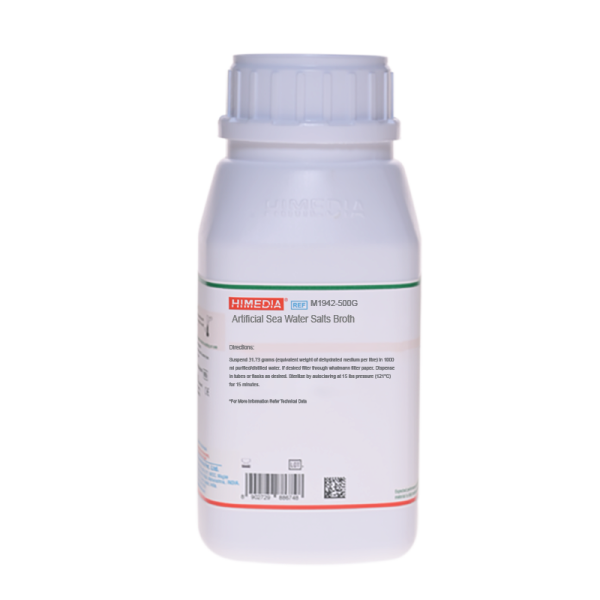
Suspend 31.73 grams (the equivalent weight of dehydrated medium per litre) in 1000 ml purified / distilled water. If desired filter through whatmann filter paper. Dispense as desired and sterilize by autoclaving at 15 lbs pressure (121°C) for 15 minutes.
Artificial sea water is primarily used in marine biology and allows the easy preparation of media appropriate for marine organisms. Marine artificial media are used when critical studies cannot be conducted using a natural seawater base, so artificial seawater medium is used to minimize or exclude known contaminants for the purpose of studying trace elements. The Artificial sea water recipe consists of mineral salts, some anhydrous salts that can be weighed out, and some hydrous salts that should be added to the artificial seawater as a solution (3). There are many formulas, each with its own characteristics. The quality of a brand of sea salt is dependent on the formula, the quality of the raw materials and the uniformity of the blending. The salinity is the sum of all of the dissolved ions (4). All the salts present in the medium provides organic source of growth nutrients. Vibrio and Halobacterium are common survivals, under conditions of hyper osmolarity.
Marine water samples
For marine water samples, follow appropriate techniques for sample collection, processing as per guidelines and local standards (3).
After use, contaminated materials must be sterilized by autoclaving before discarding.
Read the label before opening the container. Wear protective gloves/protective clothing/eye protection/ face protection. Follow good microbiological lab practices while handling specimens and culture. Standard precautions as per established guidelines should be followed while handling specimens. Safety guidelines may be referred in individual safety data sheets.
Performance of the medium is expected when used as per the direction on the label within the expiry period when stored at recommended temperature.
Appearance: White to cream homogeneous free flowing powder
Colour and Clarity of prepared medium: Colourless clear solution without any precipitate
Reaction: Reaction of 3.17% w/v aqueous solution at 25°C. pH : 7.5±0.5
pH: 7.00-8.00
Cultural Response: Cultural characteristics observed after an incubation at 35-37°C for 18-24 hours.
| Organism | Inoculum (CFU) | Growth |
|---|---|---|
| Halobacterium salinarium ATCC 33171 | 50-100 | luxuriant |
| Halococcus morrhuae ATCC 17082 | 50-100 | luxuriant |
Store between 10-30°C in a tightly closed container and the prepared medium at 20-30°C. Use before expiry date on the label. On opening, product should be properly stored dry, after tightly capping the bottle in order to prevent lump formation due to the hygroscopic nature of the product. Improper storage of the product may lead to lump formation. Store in dry ventilated area protected from extremes of temperature and sources of ignition. Seal the container tightly after use. Product performance is best if used within stated expiry period.
User must ensure safe disposal by autoclaving and/or incineration of used or unusable preparations of this product. Follow established laboratory procedures in disposing of infectious materials and material that comes into contact with clinical sample must be decontaminated and disposed of in accordance with current laboratory techniques (1,2).
| Product Name | Artificial Sea Water Salts Broth |
|---|---|
| SKU | M1942 |
| Product Type | Regular |
| Physical Form | Powder |
| Origin | Chemically defined |
| Packaging type | HDPE |
| References | 1. Kester, D. R., Duedall, I. W., Connors, D. N. and Pytkowicz, R. M. (1967). Preparation of Artificial Seawater. Limnology& Oceanography 12, 176—17 |
| Customized Product Available | No |