HiMedia Laboratories GmbH, Marie-Curie-Str. 3, 64683, Einhausen, Germany.

 Your enquiry has been submitted
Something problem with the server. Try again.

For identification of Vibrio in accordance with FDA BAM, 1998.
| Ingredients | g / L |
|---|---|
| Peptone | 15.000 |
| Yeast extract | 4.000 |
| Sodium chloride | 5.000 |
Final pH ( at 25°C) 7.4±0.2
**Formula adjusted, standardized to suit performance parameters
Suspend 24.0 gms in 970ml purified / distilled water. Heat if necessary to dissolve the medium completely. Sterilise by autoclaving at 15 lbs pressure (121°C ) for 15 minutes. Cool to 45-50°C and add 30ml of freshly prepared, filter sterilised NaHCO3 and mix. Adjust the final pH 7.4 ± 0.2. Dispense aseptically into screw capped tubes.
V. cholerae, the type species of the genus Vibrio, is the causative agent of cholera outbreaks and epidemics. Cholera enterotoxin (CT) is the primary virulence factor of these organisms(1,2). Most strains of V. cholerae isolated from foods or environment do not produce choleare toxin and are not considered to be virulent. Various biochemical properties and antigenic types are used to characterize the species. V. mimicus has been associated with diarrhoea following consumption of raw or undercooked seafood. Hence isolates of Vibrio should be tested for the production of CT or CTX gene. AKI medium is used for the serological identification of CT of these organisms in accordance with FDA BAM, 1998 (3). After enrichment plating, screening and confirmation of the toxins can be done by Y-1 mouse adrenal cell assay and immunoassay methods. Peptone and Yeast extract provide necessary nutrients and Sodium chloride maintains the osmotic equilibrium of the medium.
Blend the food sample to be analysed with Alkaline peptone water (APW) in appropriate ratio and incubate as per the recommendation by FDA BAM. Pure cultures can be isolated from APW by plating a loopful of the inoculums into TCBS agar. Crowded colonies are separated using Tryptone salt agar, w/ 1% NaCl (M1877). For immuno assays, Inoculate test cultures into AKI medium and incubate at 35 ±2°C 18 h with shaking at 100 rpm. Centrifuge 5 to 7 ml of culture at 8,000 x g for 10 min. Filter sterilize the supernatant through a 0.2 µm filter or used as is for immunological assays for the presence of cholera toxin (CT) .
Food and dairy samples.
For food and dairy samples, follow appropriate techniques for sample collection and processing as per guidelines (4,5,6). After use, contaminated materials must be sterilized by autoclaving before discarding.
Read the label before opening the container. Wear protective gloves/protective clothing/eye protection/ face protection. Follow good microbiological lab practices while handling specimens and culture. Standard precautions as per established guidelines should be followed while handling specimens. Safety guidelines may be referred in individual safety data sheets.
Performance of the medium is expected when used as per the direction on the label within the expiry period when stored at recommended temperature.
Appearance: Cream to yellow homogeneous free flowing powder
Colour and Clarity of prepared medium: Light yellow coloured clear solution without any precipitate
Reaction: Reaction of 2.4% w/v aqueous solution at 25°C. pH : 7.4±0.2
pH: 7.20-7.60
Cultural characteristics observed after an incubation at 35-37°C for 24-48 hours
| Organism | Inoculum (CFU) | Growth |
|---|---|---|
| Vibrio cholerae ATCC 14035 | 50-100 | luxuriant |
| Vibrio parahaemolyticus ATCC 17802 (00037*) | 50-100 | luxuriant |
Key : (*) Corresponding WDCM numbers.
Store between 10-30°C in a tightly closed container and the prepared medium at 15-25°C. Use before expiry date on the label. On opening, product should be properly stored dry, after tightly capping the bottle in order to prevent lump formation due to the hygroscopic nature of the product. Improper storage of the product may lead to lump formation. Store in dry ventilated area protected from extremes of temperature and sources of ignition. Seal the container tightly after use. Product performance is best if used within stated expiry period.
User must ensure safe disposal by autoclaving and/or incineration of used or unusable preparations of this product. Follow established laboratory procedures in disposing of infectious materials and material that comes into contact with sample must be decontaminated and disposed of in accordance with current laboratory techniques (7,8).
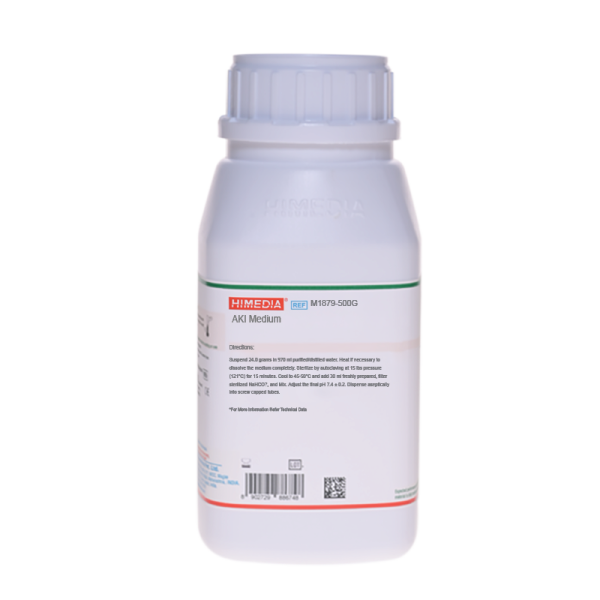
| Product Name | AKI Medium |
|---|---|
| SKU | M1879 |
| Product Type | Regular |
| Physical Form | Powder |
| Origin | Animal |
| Packaging type | HDPE |
| References | 1.Spira, W. M . and Fedorka-Cray, P.J. 198 |
| Customized Product Available | No |