HiMedia Laboratories GmbH, Marie-Curie-Str. 3, 64683, Einhausen, Germany.

 Your enquiry has been submitted
Something problem with the server. Try again.

Recommended for identification of Vibrio in accordance with FDA BAM, 1998.
| Ingredients | Gms / Litre |
|---|---|
| Peptone | 20.000 |
| Sodium Chloride | 30.000 |
| Cellobiose | 10.000 |
| Bromothymol blue | 0.060 |
| Agar | 25.000 |
Final pH ( at 25°C) 8.20±0.2
**Formula adjusted, standardized to suit performance parameters
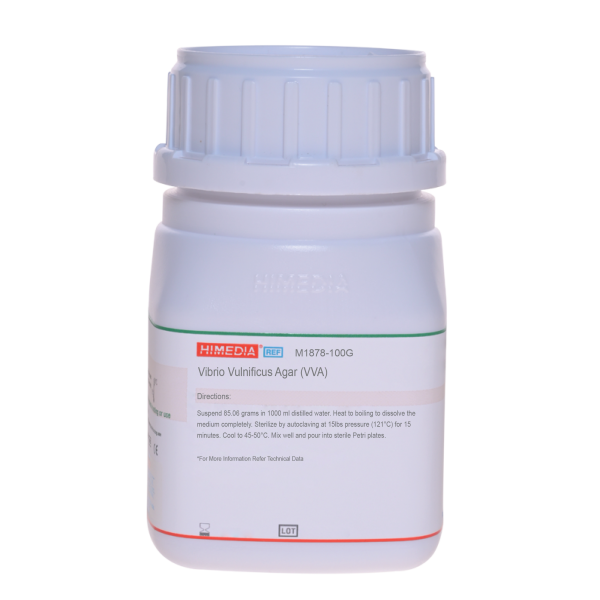
Suspend 85.06 grams in 1000 ml purified / distilled water. Heat to boiling to dissolve the medium completely. Sterilize by autoclaving at 15lbs pressure (121°C) for 15 minutes. Cool to 45-50°C. Mix well and pour into sterile Petri plates.
V. vulnificus has been reported to be an important cause of death due to seafood consumption or after wound infections originating from marine environment. Vibrio species in general are alkalophilic and grow well in the presence of relatively high levels of bile salts. This necessitates the used of formulations with alkaline pH for their isolation and identification. Different methods used for the confirmation of Vibrio species include physical, biochemical and serological assays(6). V.vulnificus resembles V. parahaemolyticus on TCBS agar, but can be differentiated by several biochemical reactions, including beta-galactosidase activity. Identification using oligo nucleotides have also been recommented for the specific identification of the species (3). The oligonucleotide scheme includes both MPN and direct plating methods followed by hybridization with DNA probes for colony identification. CPC Agar Base (M1241F), Alkaline peptone water (M618) and TCBS Agar (M870S) are the most used formulations for the isolation of Vibrios.
Vibrio vulnificus Agar is used for the identification of Vibrio vulnificus from food samples through oligonucleotide analysis in accordance with FDA BAM, 1998 (2). Peptone provides necessary nitrogenous compounds to the medium. Cellobiose acts as the fermentable carbon source. Sodium chloride maintains the osmotic equilibrium of the medium. Bromothymol blue acts as the indicator dye and agar as the solidifying agent.
Prepare a 1:10 dilution of the sample in phosphate buffered saline (PBS) dilution water. Blend it for 60 sec. Prepare appropriate dilutions of the sample (if required) and pipet 0.1ml of the respective dilutions onto labeled VVA plates. Incubate the plates for 18-24 h at 35 ±2°C. Relatively large (1-2 mm) yellow opaque colonies (fried egg appearance) are typical of V. vulnificus on VVA. These colonies can be proceeded for Enumeration of V. vulnificus by DNA gene probe(2).
Food and dairy samples.
For food and dairy samples, follow appropriate techniques for sample collection and processing as per guidelines (1,7,8). After use, contaminated materials must be sterilized by autoclaving before discarding.
Read the label before opening the container. Wear protective gloves/protective clothing/eye protection/ face protection. Follow good microbiological lab practices while handling specimens and culture. Standard precautions as per established guidelines should be followed while handling specimens. Safety guidelines may be referred in individual safety data sheets.
Performance of the medium is expected when used as per the direction on the label within the expiry period when stored at recommended temperature.
Appearance: Cream to light green homogeneous free flowing powder
Gelling: Firm, comparable with 2.5% Agar gel
Colour and Clarity of Prepared Medium: Green coloured clear to slightly opalescent gel forms in Petri plates
Reaction: Reaction of 8.51% w/v aqueous solution at 25°C. pH : 8.20±0.2
pH: 8.00-8.40
Cultural characteristics observed after an incubation at 35-37°C for 18-24 hours.
| Organism | Inoculum (CFU) | Growth | Recovery | Colour of colony |
|---|---|---|---|---|
| Vibrio vulnificus ATCC 29306 | 50-100 | luxuriant | >=50% | Yellow opaque colonies (fried egg appearance) |
Store between 10-30°C in a tightly closed container and the prepared medium at 20-30°C. Use before expiry date on the label. On opening, product should be properly stored dry, after tightly capping the bottle in order to prevent lump formation due to the hygroscopic nature of the product. Improper storage of the product may lead to lump formation. Store in dry ventilated area protected from extremes of temperature and sources of ignition Seal the container tightly after use. Product performance is best if used within stated expiry period.
User must ensure safe disposal by autoclaving and/or incineration of used or unusable preparations of this product. Follow established laboratory procedures in disposing of infectious materials and material that comes into contact with clinical sample must be decontaminated and disposed of in accordance with current laboratory techniques (4,5).
| Product Name | Vibrio Vulnificus Agar (VVA) |
|---|---|
| SKU | M1878 |
| Product Type | Regular |
| Physical Form | Powder |
| Origin | Animal |
| Packaging type | HDPE |
| References | 1.McPherson, V. L., Watts, J. A., Simpson, L. M . and Oliver, J. D. 1991. Microbios, 67: 141-149.2.Hill, W. E., Keasler, S.P., Trucksess, M.W., Feng, P ., Kaysner, C.A. and Lampel, K.A. 1991. Appl. Environ. Microbiol,57: 707-7 |
| Customized Product Available | No |