HiMedia Laboratories GmbH, Marie-Curie-Str. 3, 64683, Einhausen, Germany.

 Your enquiry has been submitted
Something problem with the server. Try again.
 Your enquiry has been submitted
Recommended for the differentiation of organisms, especially the Enterobacteriaceae on the basis of urease production.
| Ingredients | g / L |
|---|---|
| Yeast extract | 0.100 |
| Urea | 20.000 |
| Potassium dihydrogen phosphate | 0.091 |
| Disodium hydrogen phosphate | 0.095 |
| Phenol red | 0.010 |
Final pH ( at 25°C) 6.8±0.2
**Formula adjusted, standardized to suit performance parameters
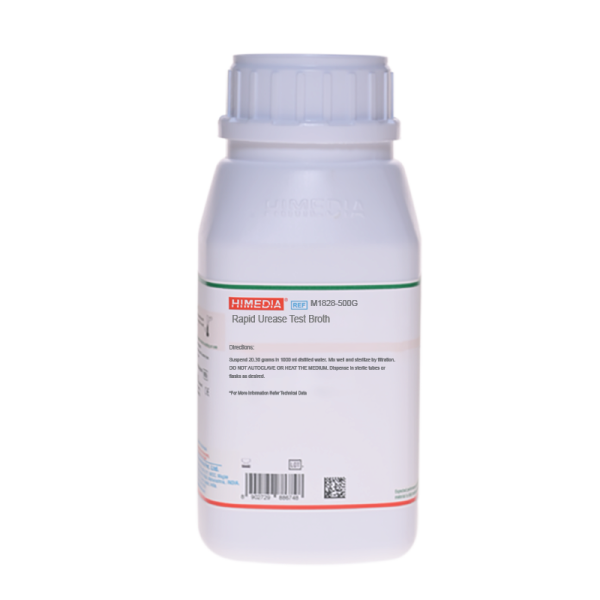
Suspend 20.30 grams in 1000 ml purified / distilled water. Mix well and sterilize by filtration. DO NOT AUTOCLAVE OR HEAT THE MEDIUM. Dispense in sterile tubes or flasks as desired.
In Rapid Urease test Broth the urease reaction given by H. pylori, occurs more quickly than that seen by other organisms which may split urea. As a result, it is an effective presumptive test for the presence of H. pylori. It is also used for the rapid detection of urease activity in bacteria such as Proteus spp., or in yeast, (such as Cryptococcus neoformans).
Helicobacter pylori is a gram negative, curved, microaerophilic and motile organism with multiple polar flagella. Helicobacter pylori is a spiral urease producing organism that lies in the interface between gastric epithelial cell surface and the overlying mucus gel (1). It resides in the stomach of man and other primates, lining up the gastric mucus secreting cells. Rapid urease test is one of the invasive tests. This method has been used to help simplify the diagnosis of H. pylori, especially those specimens originating from duodenal and gastric ulcers, and chronic antral gastritis (type B).
This medium is develop as per McFaddin (2). Urease activity can be described as the splitting of urea via hydrolysis by a urease enzyme. The end products from this reaction yield ammonium carbonate and ammonia, which are alkaline in nature. The consequent rise in the pH of the medium is detected by phenol red indicator. The test is non-toxic, and the pH change that occurs from accumulation of alkaline end products is detected by a pH indicator in the media (3). Helicobacter pylori is an organism that may be easily identified by this test because of its very high endogenous urease activity. Yeast extract which provides nitrogen and vitamin required for growth. Phosphates serve to buffer the medium.
Isolated Microorganism from clinical and non-clinical samples
For isolated Microorganism, follow appropriate techniques for sample collection, processing as per guidelines and local standards(4,5). After use, contaminated materials must be sterilized by autoclaving before discarding.
In Vitro diagnostic use. For professional use only. Read the label before opening the container. Wear protective gloves/protective clothing/eye protection/ face protection. Follow good microbiological lab practices while handling specimens and culture. Standard precautions as per established guidelines should be followed while handling specimens. Safety guidelines may be referred in individual safety data sheets.
Performance of the medium is expected when used as per the direction on the label within the expiry period when stored at recommended temperature.
Appearance Light yellow to light pink homogeneous free flowing powder
Colour and Clarity of prepared medium Yellowish orange coloured clear solution in tubes.
Reaction Reaction of basal medium (1.87gm in 100ml distilled water) at 25°C. pH : 6.8±0.2
pH 6.60-7.00
Cultural Response Cultural characteristics observed after an incubation at 35-37°C for 4-18 hours.
| Organism | Inoculum (CFU) | Urease |
|---|---|---|
| # Klebsiella aerogenes ATCC 13048 (00175*) | 50-100 | negative reaction, no change |
| Escherichia coli ATCC 25922 (00013*) | 50-100 | negative reaction, no change |
| ## Proteus hauseri ATCC 13315 | 50-100 | positive reaction, cerise colour |
| Salmonella Typhimurium ATCC 14028 (00031*) | 50-100 | negative reaction, no change |
| Helicobacter pylori ATCC 43504 | 50-100 | positive reaction, cerise colour |
| Klebsiella pneumoniae ATCC 10031 | 50-100 | weak positive reaction |
Key : (*) Corresponding WDCM numbers. (#) Formerly known as Enterobacter aerogenes ## Formerly known as Proteus vulgaris
Store dehydrated and the prepared medium at 2-8°C. Use before expiry date on the label. On opening, product should be properly stored dry, after tightly capping the bottle in order to prevent lump formation due to the hygroscopic nature of the product. Improper storage of the product may lead to lump formation. Store in dry ventilated area protected from extremes of temperature and sources of ignition. Seal the container tightly after use. Product performance is best if used within stated expiry period.
User must ensure safe disposal by autoclaving and/or incineration of used or unusable preparations of this product. Follow established laboratory procedures in disposing of infectious materials and material that comes into contact with clinical sample must be decontaminated and disposed of in accordance with current laboratory techniques (4,5).
| Product Name | Rapid Urease Test Broth |
|---|---|
| SKU | M1828 |
| Product Type | Regular |
| Physical Form | Powder |
| Origin | Animal Free (Microbial) |
| Packaging type | HDPE |
| References | 1.Tianyan Song, Claudia Toma, Noboru Nakasone and Masaaki Iwanaga. (2004). Aerolysin is activated by metalloprotease inAeromonas veronii biovar sobria J Med Microbiol 53, 477-482 |
| Customized Product Available | No |