HiMedia Laboratories GmbH, Marie-Curie-Str. 3, 64683, Einhausen, Germany.

 Your enquiry has been submitted
Something problem with the server. Try again.
 Your enquiry has been submitted
Recommended for detection of urease production, dextrose and mannitol fermentation for primary isolation of Salmonella and Shigella species.
| Ingredients | Gms / Litre |
|---|---|
| Proteose peptone | 15.000 |
| HM peptone B# | 2.000 |
| Yeast extract | 2.000 |
| Dextrose (Glucose) | 1.000 |
| Mannitol | 10.000 |
| Bromothymol blue | 0.025 |
| Cresol red | 0.008 |
| Thymol blue | 0.020 |
| Agar | 16.000 |
Final pH (at 25°C): 7.2±0.2
**Formula adjusted, standardized to suit performance parameters
# Equivalent to Beef Extract
Suspend 46.05 grams in 1000 ml purified / distilled water. Heat to boiling to dissolve the medium completely. Sterilize by autoclaving at 115°C (10 lbs pressure) for 15 minutes. Cool to 45-50°C and aseptically add 25 ml of sterile 40% urea solution (FD048). Mix well and dispense in tubes. Cool in a slanted position to form slants with generous butts.
Enterobacteriaceae genera consist of gram-negative bacilli and are widely distributed in nature. It includes pathogens such as Salmonella, Shigella, Yersinia, diarrheagenic E.coli and others. These bacteria cause multitude of diseases in humans and are frequently isolated from clinical specimens. Detection and identification of the bacteria are of importance both from clinical and epidemiological point of view. The other enterobacteria are essentially commensals or saprophytes (1). Gillies Agar No. 1 (2), a modification of Kohns Medium (5) is recommended for detection of urease production and dextrose and mannitol fermentation. This medium is a reliable substitute for the conventional method of determining the biochemical identity of non-lactose fermenting colonies prior to confirmation by serological typing (1).
Fermentation of dextrose is indicated by the butt changing colour from deep green to yellow and that of mannitol by the development of a yellow slant. Gas production during fermentation, appears in varying degrees from a slight splitting along the wire track to disruption of the medium. Urease production produces a deep blue colour throughout the medium.
HM peptone B, proteose peptone and yeast extract serve as sources of essential nutrients for bacterial growth. Yeast extract additionally serves as a source of B complex vitamins. Dextrose and mannitol are the fermentable carbohydrates, with bromothymol blue, cresol red and thymol blue forming the indicator mixture.
The specimen is inoculated into a preliminary enrichment medium such as Fluid Tetrathionate Broth Base (M032). After incubation at 35-37°C for 18-24 hours, this enriched culture is subcultured on a differential media such as Wilson and Blair Medium (M331) or MacConkey Agar (M081). Presumptive colonies are purified and pure cultures are used to inoculate the tubes of Gillies Agar No.1. The medium is inoculated by both smearing the slant and then stabbing to the base of the butt.
Food samples
For food samples, follow appropriate techniques for sample collection and processing as per guidelines (6). After use, contaminated materials must be sterilized by autoclaving before discarding.
Read the label before opening the container. Wear protective gloves/protective clothing/eye protection/ face protection. Follow good microbiological lab practices while handling specimens and culture. Standard precautions as per established guidelines should be followed while handling specimens. Safety guidelines may be referred in individual safety data sheets.
1. This medium is general purpose medium and may not support the growth of fastidious organisms.
Performance of the medium is expected when used as per the direction on the label within the expiry period when stored at recommended temperature.
Appearance: Light yellow to greenish yellow homogeneous free flowing powder
Gelling: Firm, comparable with 1.6% Agar gel
Colour and Clarity of prepared medium: Green coloured, clear to slightly opalescent gel forms in tubes as slants
Reaction: Reaction of 4.6% w/v aqueous solution at 25°C. pH : 7.2±0.2
pH: 7.00-7.40
Cultural Response Cultural characteristics observed after an incubation at 35-37°C for 18-24 hours.
| Organism | Inoculum (CFU) | Growth | Dextrose/ Mannitol | Urea |
|---|---|---|---|---|
| # Klebsiella aerogenes ATCC 13048 (00175*) | 50-100 | luxuriant | positive reaction, yellow butt/slant | negative reaction |
| Escherichia coli ATCC 25922 (00013*) | 50-100 | luxuriant | positive reaction, yellow butt/slant | negative reaction |
| Klebsiella pneumoniae ATCC 13883 (00097*) | 50-100 | luxuriant | positive reaction, yellow butt/slant | positive reaction, deep blue colour |
| Salmonella Typhi ATCC 6539 | 50-100 | luxuriant | positive reaction, yellow butt/slant | negative reaction |
Key : *Corresponding WDCM numbers.
Store between 10-30°C in a tightly closed container and the prepared medium at 15-25°C. Use before expiry date on the label. On opening, product should be properly stored dry, after tightly capping the bottle in order to prevent lump formation due to the hygroscopic nature of the product. Improper storage of the product may lead to lump formation. Store in dry ventilated area protected from extremes of temperature and sources of ignition. Seal the container tightly after use. Use before expiry date on the label. Product performance is best if used within stated expiry period.
User must ensure safe disposal by autoclaving and/or incineration of used or unusable preparations of this product. Follow established laboratory procedures in disposing of infectious materials and material that comes into contact with sample must be decontaminated and disposed of in accordance with current laboratory techniques (3,4).
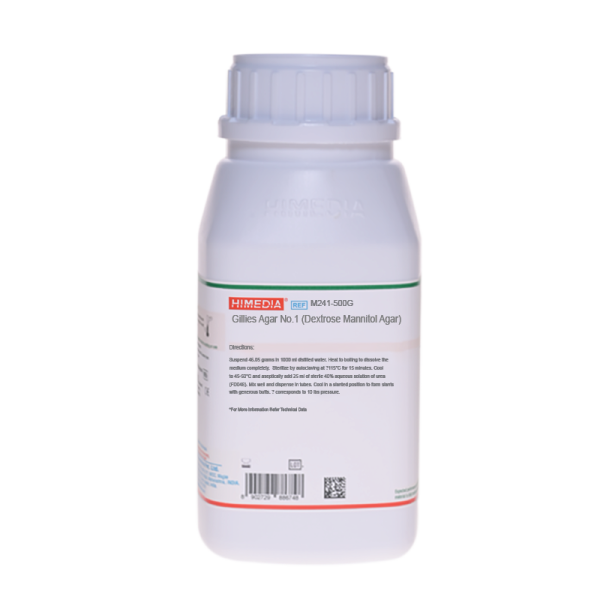
| Product Name | Dextrose Mannitol Agar (Gillies Agar No. 1) |
|---|---|
| SKU | M241 |
| Product Type | Regular |
| Physical Form | Powder |
| Origin | Animal |
| Packaging type | HDPE |
| References | 1.Cruickshank R., Duguid J. P. Marmion B. P., Swain R. H. A., (Eds.), 1975, Medical Microbiology, 12th Edition, Vol. II,Churchill Livingstone. 2.Gillies R. R., 1956, J. Clin. Pathol., 9, 368. 3.Kohn J., 1953, J. Clin. Path., 6, 249. |
| Customized Product Available | No |