HiMedia Laboratories GmbH, Marie-Curie-Str. 3, 64683, Einhausen, Germany.

 Your enquiry has been submitted
Something problem with the server. Try again.
 Your enquiry has been submitted
Recommended for determination of lysine decarboxylase activity of lactose non fermenting members of Enterobacteriaceae especially Salmonellae.
| Ingredients | Gms / Litre |
|---|---|
| Gelatin peptone # | 5.000 |
| Yeast extract | 3.000 |
| Dextrose (Glucose) | 1.000 |
| L-Lysine | 5.000 |
| Lactose | 10.000 |
| Bromocresol purple | 0.020 |
| Final pH ( at 25°C) | 6.8±0.2 |
**Formula adjusted, standardized to suit performance parameters
# Equivalent to Pancreatic digest of gelatin
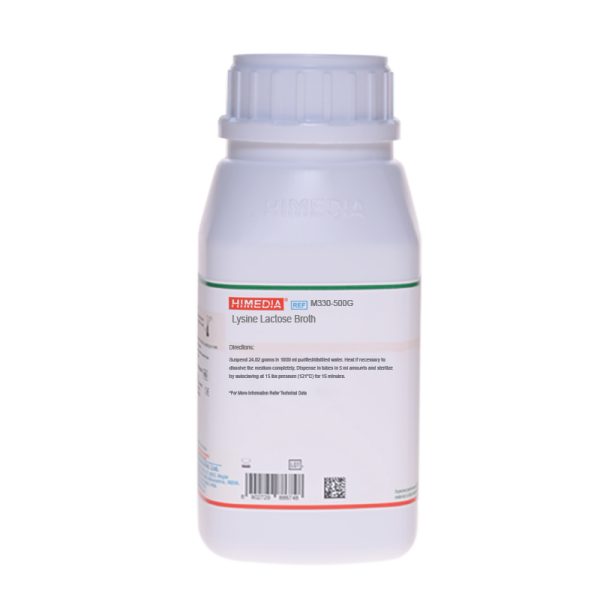
Suspend 24.02 grams in 1000 ml purified/distilled water. Heat if necessary to dissolve the medium completely. Dispense in tubes in 5 ml amounts and sterilize by autoclaving at 15 lbs pressure (121°C) for 15 minutes.
The family Enterobacteriaceae consists of gram-negative facultatively anaerobic non-spore forming bacteria. These grow well on peptone meat extract media. However, several other factors have influenced the development of media for detection, isolation and enumeration of members of the Enterobacteriaceae. Decarboxylases are the enzymes that remove a molecule of CO2 from an amino acid to form alkaline-reacting amines. Cadaverine is the amine degradation product of lysine. Many non-fermenters display only weak decarboxylase activity and many produce insufficient amines to convert the pH indicator system. This can be overcome by using only small quantities of substrates and heavy inoculum of pre-grown organisms in which a high concentration of enzymes has already accumulated. Overlaying the culture medium with 4 mm of petrolatum increases the sensitivity of detection. The initial conversion of the medium to a yellow colour, as acids accumulate from small amounts of glucose in the medium, is seen in case of the fermenters but not with the non-fermenters. The end point reactions are read comparing the strong alkaline purple colour reactions with the lighter bluish purple hue of the controls. Tubes should be incubated at 35°C for upto 5 days before interpreting the reactions as negative. Falkow (2) formulated Lysine Broth (It is also named as Falkow Lysine Broth) for detection of lysine decarboxylase by means of a colour reaction in enteric bacilli. Gelatin peptone and yeast extract provide nitrogenous and carbonaceous nutrients. Dextrose and lactose are the fermentable sugars. L-Lysine is the substrate that is decarboxylated due to decarboxylase enzyme activity. Bromocresol purple acts as the pH indicator. The enteric bacilli produce acid in an initial fermentation (lactose). Lactose non-fermenters produce acid from dextrose resulting in the formation of yellow colour. Subsequently L-Lysine is decarboxylated to form cadaverine resulting in an alkaline reaction and the broth reverts to purple colour.
Food samples; Water samples.
For food samples, follow appropriate techniques for sample collection and processing as per guidelines (5). For water samples, follow appropriate techniques for sample collection, processing as per guidelines and local standards (1). After use, contaminated materials must be sterilized by autoclaving before discarding.
Read the label before opening the container. Wear protective gloves/protective clothing/eye protection/face protection. Follow good microbiological lab practices while handling specimens and culture. Standard precautions as per established guidelines should be followed while handling specimens. Safety guidelines may be referred in individual safety data sheets.
Performance of the medium is expected when used as per the direction on the label within the expiry period when stored at recommended temperature.
Appearance Cream to light green homogeneous free flowing powder
Colour and Clarity of prepared medium Purple coloured clear solution without any precipitate
Reaction Reaction of 2.40% w/v aqueous solution at 25°C. pH : 6.8±0.2
pH 6.60-7.00
Cultural characteristics observed after an incubation at 35-37°C for 24 hours.
| Organism | Inoculum (CFU) | Colour of medium | Lactose Fermentation | Lysine decarboxylation |
|---|---|---|---|---|
| Escherichia coli ATCC 25922 (00013*) | 50-100 | yellow | positive reaction, yellow colour | negative reaction |
| Proteus vulgaris ATCC 13315 | 50-100 | bluish green | negative reaction | delayed positive reaction bluish green |
| Salmonella Typhimurium ATCC 14028 (00031*) | 50-100 | blue-purple | negative reaction | positive reaction, purple colour |
| Salmonella Enteritidis ATCC 13076 (00030*) | 50-100 | blue-purple | negative reaction | positive reaction, purple colour |
| Serratia marcescens ATCC 8100 | 50-100 | blue-purple | negative reaction | positive reaction, purple colour |
Key : (*) Corresponding WDCM numbers.
Store between 10-30°C in a tightly closed container and the prepared medium at 15-25°C. Use before expiry date on the label. On opening, product should be properly stored dry, after tightly capping the bottle in order to prevent lump formation due to the hygroscopic nature of the product. Improper storage of the product may lead to lump formation. Store in dry ventilated area protected from extremes of temperature and sources of ignition. Seal the container tightly after use. Product performance is best if used within stated expiry period.
User must ensure safe disposal by autoclaving and/or incineration of used or unusable preparations of this product. Follow established laboratory procedures in disposing of infectious materials and material that comes into contact with sample must be decontaminated and disposed of in accordance with current laboratory techniques (3,4).
| Product Name | Lysine Lactose Broth |
|---|---|
| SKU | M330 |
| Product Type | Regular |
| Physical Form | Powder |
| Origin | Animal |
| Packaging type | HDPE |
| References | 1. Downes F. P. and Ito K., (Ed.), 2001, Compendium of Methods for the Microbiological Examination of Foods, 4th Ed., American Public Health Association, Washington, D.C. 2.Horwitz (Ed.), 2000, Official Methods of Analysis of the AOAC International , 17th Ed., Gaithersburg. |
| Customized Product Available | No |