Plot No. C40, Road No. 21Y, MIDC, Wagle Industrial Estate, Thane(W)-400604, MH, India

 Your enquiry has been submitted
Something problem with the server. Try again.

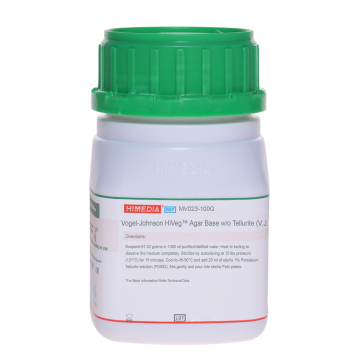
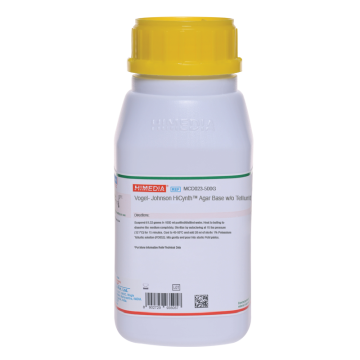
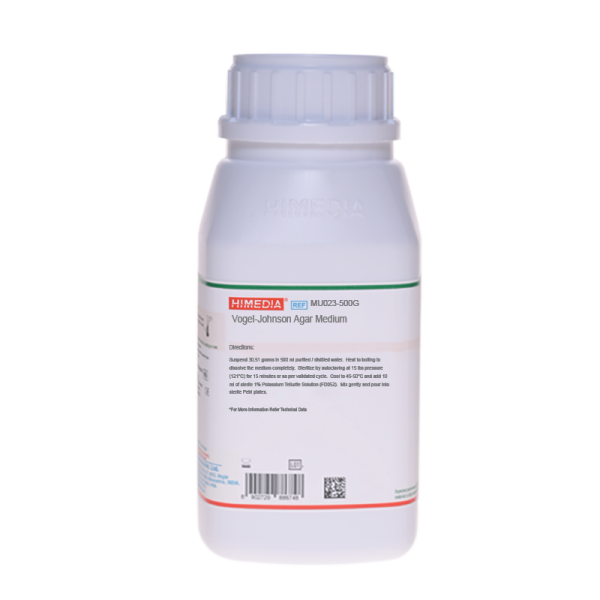
Vogel-Johnson Agar Medium with addition of potassium tellurite is used for selective isolation of coagulase positive, mannitol fermenting Staphylococcus aureus from heavily contaminated food specimens in accordance with United States Pharmacopoeia.
| Ingredients | g/L |
|---|---|
| Tryptone # | 10.000 |
| Yeast extract | 5.000 |
| Mannitol | 10.000 |
| Dipotassium hydrogen phosphate | 5.000 |
| Lithium chloride | 5.000 |
| Glycine | 10.000 |
| Phenol red | 0.025 |
| Agar | 16.000 |
| pH after sterilization (at 25°C) | 7.2±0.2 |
**Formula adjusted, standardized to suit performance parameters
# Pancreatic digest of Casein
Suspend 30.51 grams in 500 ml purified / distilled water. Heat to boiling to dissolve the medium completely. Sterilize by autoclaving at 15 lbs pressure (121°C) for 15 minutes or as per validated cycle. Cool to 45-50°C and add 10 ml of sterile PTe 1% Selective Supplement (1 ml per vial) (FD052). Mix gently and pour into sterile Petri plates.
Vogel-Johnson Agar Medium is prepared according to the formula of Vogel and Johnson (1) and is recommended for the microbial limit test (pharmaceutical testing) in USP (2). Originally it was developed by Zebovitz (3) as a Tellurite Glycine Agar, a selective medium for the detection of coagulase positive Staphylococci. This medium is used to detect Staphylococcus in pharmaceutical and cosmetics products (4). Staphylococcus in prevalent pathogen in food borne poisoning due to its enterotoxin production. It is commensal found on skin and scalp of human body. Vogel-Johnson modified the medium by adding phenol red as a pH indicator and increased the mannitol quantity. Tryptone and yeast extract provide nitrogenous and carbonaceous compounds, long chain amino acids, vitamin B complex and other growth nutrients. Dibasic potassium phosphate gives buffering capacity to the medium. During first 24 hours of incubation, contaminating organisms are almost inhibited by tellurite, lithium chloride and high glycine content. Staphylococcus aureus may be inhibited by these inhibitors but get compensated by mannitol and glycine. Coagulase-positive Staphylococci reduce potassium tellurite to metallic free tellurium and thus produce black colonies surrounded by yellow zones. This yellow colour is due to phenol red indicator, which turns yellow in acidic condition by the fermentation of mannitol. Prolonged incubation may result in the growth of black coagulase negative colonies.
Food samples; Pharmaceutical samples
For pharmaceutical samples, follow appropriate techniques for handling specimens as per established guidelines (2).
For food samples, follow appropriate techniques for sample collection and processing as per guidelines (4,5).
After use, contaminated materials must be sterilized by autoclaving before discarding.
User must ensure safe disposal by autoclaving and/or incineration of used or unusable preparations of this product. Follow established laboratory procedures in disposing of infectious materials and material that comes into contact with sample must be decontaminated and disposed of in accordance with current laboratory techniques (6,7).
Read the label before opening the container. Wear protective gloves/protective clothing/eye protection/ face protection. Follow good microbiological lab practices while handling specimens and culture. Standard precautions as per established guidelines should be followed while handling specimens. Safety guidelines may be referred in individual safety data sheets.
Performance of the medium is expected when used as per the direction on the label within the expiry period when stored at recommended temperature.
Appearance
Light yellow to pink homogeneous free flowing powder
Gelling
Firm, comparable with 1.6% Agar gel.
Colour and Clarity of prepared medium
Red coloured clear to slightly opalescent gel forms in Petri plates.
pH
7.00-7.40
Growth Promotion Test
In accordance with the method of USP.
Cultural characteristics observed with added 1% Potassium Tellurite solution (FD052), after an incubation at 30-35°C for 18-48 hours.
| Organism | Inoculum (CFU) | Growth | Recovery | Colour of colony | Incubation period |
|---|---|---|---|---|---|
| Test for specified microorganisms | |||||
| Staphylococcus aureus subsp. aureus ATCC 6538 (00032*) | 50-100 | luxuriant | >=50% | black colony surrounded by yellow zone | 18-48 hrs |
| Additional Microbiological testing | |||||
| Staphylococcus aureus subsp. aureus ATCC 25923 (00034*) | 50-100 | luxuriant | >=50% | black surrounded by yellow zone | 18-48 hrs |
| Staphylococcus epidermidis ATCC 12228 (00036*) | 50-100 | fair - good | 30-40% | translucent to blackish yellow | 18-48 hrs |
| Proteus mirabilis ATCC 25933 | 50-100 | none-poor | 0-10% | yellow | 18-48 hrs |
| Escherichia coli ATCC 8739>=10³ (00012*) | inhibited | 0% | >=48 hrs | ||
Key: (*) Corresponding WDCM numbers.
Store between 10-30°C in a tightly closed container and the prepared medium at 2-8°C. Use before expiry date on the label. On opening, product should be properly stored dry, after tightly capping the bottle in order to prevent lump formation due to the hygroscopic nature of the product. Improper storage of the product may lead to lump formation. Store in dry ventilated area protected from extremes of temperature and sources of ignition Seal the container tightly after use. Product performance is best if used within stated expiry period.
| Product Name | Vogel-Johnson Agar Medium |
|---|---|
| SKU | MU023 |
| Product Type | Regular |
| Physical Form | Powder |
| Origin | Animal |
| Packaging type | HDPE |
| References | 1. Vogel R. A. and Johnson M. J., 1960, Public Health Lab. 18:131. 2.United States Pharmacopeia, 200 3.Zebovitz E., Evans J. B. and Niven C. F., 1955, J. Bacteriol., 70:686. 4.FDA Bacteriological Analytical Manual, 2005, 18th Ed., AOAC, Washington, D.C. 5.MacFaddin J. F., 1985, Media for Isolation-Cultivation-Identification-Maintenance of Medical Bacteria, Vol. 1, Williams& Wilkins, Baltimore, Md. 6.Curry A. S., Graf J. G. and McEwen G. M., (Eds.), 1993, CTFA Microbiology Guidelines, The Cosmetic, Toiletry andFragrance Association, Washington, D.C. |