 Plot No. C40, Road No. 21Y, MIDC, Wagle Industrial Estate, Thane(W)-400604, MH, India

 Your enquiry has been submitted
Something problem with the server. Try again.

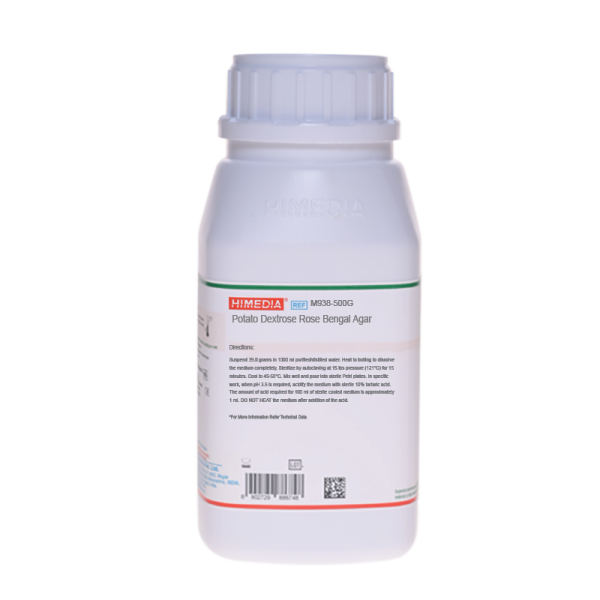
Potato Dextrose Rose Bengal Agar is used for promoting ascospore production.
| Ingredients | Gms / Litre |
|---|---|
| Potatoes, infusion from | 200.000 |
| Dextrose | 20.000 |
| Rose Bengal | 0.0084 |
| Agar | 15.000 |
| Final pH (at 25°C) | 5.6±0.2 |
**Formula adjusted, standardized to suit performance parameters
Suspend 39 grams in 1000 ml distilled water. Heat to boiling to dissolve the medium completely. Sterilize by autoclaving at 15 lbs pressure (121°C) for 15 minutes. Mix well before dispensing. In specific work, when pH 3.5 is required, acidify the medium with sterile 10% tartaric acid. The amount of acid required for 100 ml. of sterile, cooled medium is approximately 1 ml. Do not heat the medium after addition of the acid.
Potato Dextrose media are recommended by APHA (1) and F.D.A. (2) for plate counts of yeasts and moulds in the examination of foods and dairy products (3). Potato Dextrose Agar is used for stimulating sporulation, for maintaining stock cultures of certain dermatophytes and for differentiation of typical varieties of dermatophytes on the basis of pigment production (4). Potato Dextrose Rose Bengal Agar enhances ascospore production (5).
Potato infusion and dextrose promote luxuriant fungal growth. Acidifying the medium to pH 3.5 by tartaric acid inhibits bacterial growth. Heating the medium after acidification should be avoided as it may hydrolyse the agar, which can render the agar unable to solidify. Rose bengal is the eosin-related dye which inhibits the spreading of some rapidly growing fungi and has antibacterial properties as well
Appearance: Light yellow to pink homogeneous free flowing powder
Gelling: Firm, comparable with 1.5% Agar gel
Colour and Clarity of prepared medium: Pink coloured clear to slightly opalescent gel forms in Petri plates
Reaction: Reaction of 3.9% w/v aqueous solution at 25°C. pH: 5.6±0.2
pH: 5.40-5.80
Cultural characteristics observed after an incubation at 22-25°C for 4-5 days.
| Organism | Inoculum (CFU) | Growth | Ascospore formation | Recovery |
|---|---|---|---|---|
| *Aspergillus brasiliensis ATCC 16404 | 50-100 | luxuriant | negative | |
| Candida albicans ATCC 10231 | 50-100 | luxuriant | negative | >=70% |
| Saccharomyces cerevisiae ATCC 9763 | 50-100 | luxuriant | positive | >=70% |
Key: * - Formerly known as Aspergillus niger
Store below 30°C in tightly closed container and the prepared medium at 2 - 8°C. Use before expiry date on the label.
| Product Name | Potato Dextrose Rose Bengal Agar |
|---|---|
| SKU | M938 |
| Product Type | Regular |
| Physical Form | Powder |
| Origin | Animal Free (Veg) |
| Packaging type | HDPE |
| References | 1. Downes F. P. and Ito K., (Eds.), 2001, Compendium of Methods for the Microbiological Examination of Foods, 4th Ed.,APHA, Washington, D.C. |