 Plot No. C40, Road No. 21Y, MIDC, Wagle Industrial Estate, Thane(W)-400604, MH, India


 Your enquiry has been submitted
Something problem with the server. Try again.
 Your enquiry has been submitted
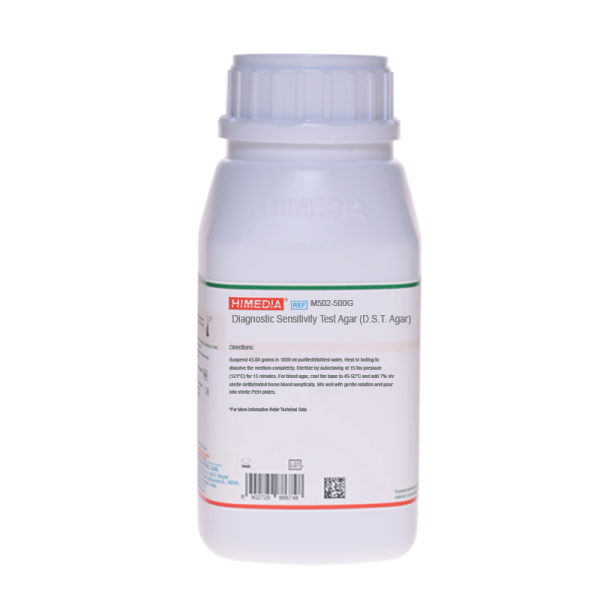
Diagnostic Sensitivity Test Agar (D.S.T. Agar) is used as an antibiotic sensitivity-testing medium for antibiotic sensitivity testing of fastidious pathogens such as Neisseria, Streptococcus and Haemophilus species with blood enrichment from clinical samples.
| Ingredients | g/L |
|---|---|
| Proteose peptone | 10.000 |
| HMV infusion solids | 10.000 |
| Dextrose (Glucose) | 2.000 |
| Sodium chloride | 3.000 |
| Disodium hydrogen phosphate | 2.000 |
| Sodium acetate | 1.000 |
| Adenine sulphate | 0.010 |
| Guanine hydrochloride | 0.010 |
| Uracil | 0.010 |
| Xanthine | 0.010 |
| Aneurine | 0.00002 |
| Agar | 15.000 |
Final pH (at 25°C): 7.4±0.2
Formula adjusted, standardized to suit performance parameters
Equivalent to Veal infusion solids
Suspend 43.04 grams in 1000 ml purified / distilled water. Heat to boiling to dissolve the medium completely. Sterilize by autoclaving at 15 lbs pressure (121°C) for 15 minutes. For blood agar, cool the base to 45-50°C and add 7% v/v sterile defibrinated horse blood aseptically. Mix well with gentle rotation and pour into sterile Petri plates.
Diagnostic Sensitivity Test Agar is recommended for diagnostic as well as testing susceptibility of organisms to antibiotics and chemotherapeutic agents such as Sulfonamides. The latter produce well defined zones due to the absence of interfering substances.
The medium is nutritionally rich due to presence of amino acid bases and glucose. The salts present, helps in avoiding sudden pH shifts due to acid production, which might affect the susceptibility test and haemolytic reactions (1) and the MIC values of pH susceptible antimicrobials (2). Aneurine acts as vitamin source which improves the growth of several organisms especially Staphylococci. The agar used in the formulation has been specially processed to allow unimpeded diffusion of antimicrobials from discs (3). Addition of the bases like adenine, guanine, uracil and xanthine improve the antibiotic testing performance of the medium.
The reactive levels of thymidine and thymine must be sufficiently reduced to avoid antagonism of trimethoprim and sulfonamides which is an essential requirement for satisfactory antimicrobial susceptibility media. The requirement is achieved by addition of lysed horse blood to Diagnostic Sensitivity Testing medium. The level of thymidine is further reduced due to the action of thymidine phosphorylase, released from lysed horse erythrocytes (1). Thymidine-dependent organisms will not grow in absence of thymidine or will grow poorly in media containing reduced levels (4).
For less demanding organisms like Micrococci, Salmonella, Shigella coliform bacteria and Proteus species, this medium can be used without blood. For fastidious organisms like Haemophilus influenzae, Neisseria meningitides, alpha and beta haemolytic Streptococci blood enrichment is necessary.
Antibiotic susceptibility test is performed as follows: Suspension of test organisms is spread on the surface of the medium. Sensitivity discs (5) are equally spaced on the seeded medium surface and incubated at 37°C for 18 hours. The zones of inhibition obtained are recorded. This medium has reduced thymidine activity and this will affect its performance as a primary isolation medium.
Clinical samples: Isolated samples from Blood, urine, respiratory samples, and other clinical material.
For clinical samples follow appropriate techniques for handling specimens as per established guidelines (6,7).
After use, contaminated materials must be sterilized by autoclaving before discarding.
In Vitro diagnostic use only. For professional use only. Read the label before opening the container. Wear protective gloves/protective clothing/eye protection/face protection. Follow good microbiological lab practices while handling specimens and culture. Standard precautions as per established guidelines should be followed while handling clinical specimens. Safety guidelines may be referred in individual safety data sheets.
Performance of the medium is expected when used as per the direction on the label within the expiry period when stored at recommended temperature.
Appearance: Cream to yellow homogeneous free flowing powder.
Gelling: Firm, comparable with 1.5% Agar gel.
Colour and Clarity of prepared medium:
Basal medium: Light amber coloured, clear to slightly opalescent gel forms. After addition of 7%w/v sterile defibrinated blood: Cherry red coloured, opaque gel forms in Petri plates.
Reaction: Reaction of 4.3% w/v aqueous solution at 25°C. pH: 7.4±0.2
pH: 7.20-7.60
Cultural characteristics observed after an incubation at 35-37°C for 18-24 hours.
| Organism | Inoculum (CFU) | Growth | Recovery |
|---|---|---|---|
| Staphylococcus aureus subsp. aureus ATCC 25923 (00034*) | 50-100 | luxuriant | >=70% |
| Escherichia coli ATCC 25922 (00013*) | 50-100 | luxuriant | >=70% |
| Enterococcus faecalis ATCC 29212 (00087*) | 50-100 | luxuriant | >=70% |
| Neisseria meningitidis ATCC 13090 | 50-100 | luxuriant | >=70% |
| Proteus mirabilis ATCC 25933 | 50-100 | luxuriant | >=70% |
| Micrococcus luteus ATCC 10240 | 50-100 | luxuriant (with the addition of blood) | >=70% |
| Salmonella Typhi ATCC 6539 | 50-100 | luxuriant | >=70% |
| Streptococcus pneumoniae ATCC 6305 | 50-100 | luxuriant(with the addition of blood) | >=70% |
| Streptococcus pyogenes ATCC 19615 | 50-100 | luxuriant (with the addition of blood) | >=70% |
| Shigella flexneri ATCC 12022 (00126*) | 50-100 | luxuriant | >=70% |
Key: Corresponding WDCM numbers.
Store between 10-30°C in a tightly closed container and the prepared medium at 2-8°C. Use before expiry date on the label. On opening, product should be properly stored dry, after tightly capping the bottle in order to prevent lump formation due to the hygroscopic nature of the product. Improper storage of the product may lead to lump formation. Store in dry ventilated area protected from extremes of temperature and sources of ignition Seal the container tightly after use. Use before expiry date on the label. Product performance is best if used within stated expiry period.
User must ensure safe disposal by autoclaving and/or incineration of used or unusable preparations of this product. Follow established laboratory procedures in disposing of infectious materials and material that comes into contact with clinical sample must be decontaminated and disposed of in accordance with current laboratory techniques (6,7).
| Product Name | Diagnostic Sensitivity Test Agar (D.S.T. Agar) |
|---|---|
| SKU | M502 |