 Plot No. C40, Road No. 21Y, MIDC, Wagle Industrial Estate, Thane(W)-400604, MH, India


 Your enquiry has been submitted
Something problem with the server. Try again.
 Your enquiry has been submitted
Recommended for propagation of pure cultures of Neisseria gonorrhoeae and other fastidious organisms.
| Ingredients | Gms / Litre |
|---|---|
| Proteose peptone | 15.000 |
| Dextrose (Glucose) | 2.000 |
| Starch, soluble | 10.000 |
| Sodium chloride | 5.000 |
| Disodium hydrogen phosphate | 3.000 |
| Gelatin | 20.000 |
| Agar | 10.000 |
Final pH ( at 25°C): 7.3±0.2
**Formula adjusted, standardized to suit performance parameters
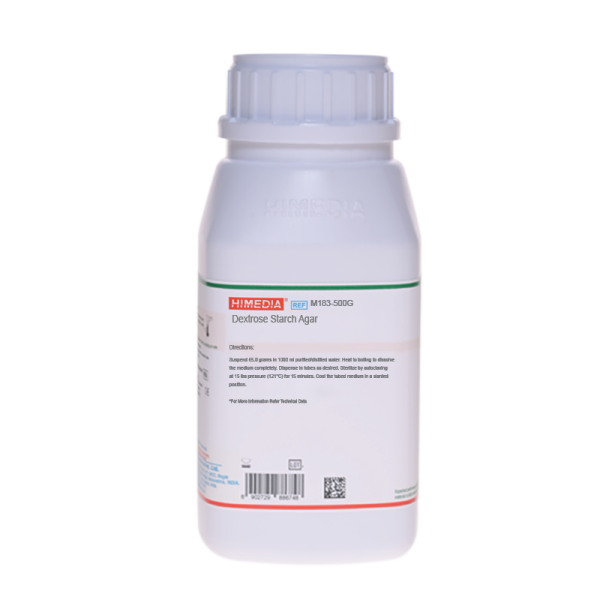
Suspend 65 grams in 1000 ml purified / distilled water. Heat to boiling to dissolve the medium completely. Dispense in tubes as desired. Sterilize by autoclaving at 15 lbs pressure (121°C) for 15 minutes. Cool the tubed medium in a slanted position.
Neisseria is a large group of gram-negative proteobacteria. Neisseria meningitidis, the causative agent of meningitis, is responsible for a large amount of morbidity and mortality throughout the world while Neisseria gonorrhoeae is the causative agent of the sexually transmitted disease gonorrhea that is second in cases reported only to chlamydia (CDC). These fastidious organisms can be cultivated on Dextrose Starch Agar. The medium is highly nutritious and supports the luxuriant growth of various fastidious organisms like N. meningitidis, Streptococcus pyogenes and Streptococcus pneumoniae without the need of supplementation with additives. Organisms lacking the ability of starch hydrolysis can be maintained on this medium. However when used as a stock culture agar for maintenance, the medium should be taken in half concentrations. Organism capable of hydrolyzing starch will create acidic conditions thereby making it unsuitable for maintenance.
Dextrose Starch Agar was used to test the activity of various antibiotics against Neisseria species by the agar dilution technique as demonstrated by Wilkins, Lewis and Barbiers (4). N. meningitidis grow luxuriantly on this medium, when the plates are kept in 4-6%CO2 environment or in the presence of abundant moisture. Swancara (3) has described a method of obtaining partial carbon-dioxide tension and this can be used for incubation of Dextrose Starch Agar plates inoculated with N. meningitidis. Proteose peptone and gelatin serve as sources of nitrogen and carbon essential for microbial growth. Dextrose serves as the energy source. Starch neutralizes toxic fatty acids that may be present in the agar. Sodium chloride maintains the osmotic balance and buffering is achieved by inclusion of disodium phosphate.
Dextrose Starch Agar prepared in half strength is a good medium for maintaining stock cultures of gonococci. The medium normally contains a flocculent precipitate, which does not affect the nutritive value of the medium. It is necessary to have the incubation atmosphere saturated with moisture while cultivating gonococci. Suitable conditions can be achieved, if the plates are incubated in a closed container containing cotton or towel saturated with water. Best results are obtained on a solid medium with a moist surface.
Pure isolate of Neisseria gonorrhoeae
For pure isolate samples, follow appropriate techniques for sample collection, processing as per guidelines and local standards (4). After use, contaminated materials must be sterilized by autoclaving before discarding.
Read the label before opening the container. Wear protective gloves/protective clothing/eye protection/ face protection. Follow good microbiological lab practices while handling specimens and culture. Standard precautions as per established guidelines should be followed while handling specimens. Safety guidelines may be referred in individual safety data sheets.
Performance of the medium is expected when used as per the direction on the label within the expiry period when stored at recommended temperature.
Appearance: Cream to yellow homogeneous free flowing powder
Gelling: Firm, comparable with 1.0% Agar gel and 2.0% gelatin.
Colour and Clarity of prepared medium: Light amber coloured, opalescent gel with flocculent precipitate forms in tubes as slants
Reaction: Reaction of 6.5% w/v aqueous solution at 25°C. pH : 7.3±0.2
pH: 7.10-7.50
Cultural Response: Cultural characteristics observed after an incubation at 35-37°C for 18-48 hours in an anaerobic conditions.
| Organism | Inoculum (CFU) | Growth |
|---|---|---|
| Neisseria gonorrhoeae ATCC 19424 | 50-100 | luxuriant |
| Neisseria meningitidis ATCC 13090 | 50-100 | luxuriant |
| Streptococcus pneumoniae ATCC 6303 | 50-100 | luxuriant |
| Streptococcus pyogenes ATCC 19615 | 50-100 | luxuriant |
Store between 10-30°C in a tightly closed container and the prepared medium at 20-30°C. Use before expiry date on the label. On opening, product should be properly stored dry, after tightly capping the bottle in order to prevent lump formation due to the hygroscopic nature of the product. Improper storage of the product may lead to lump formation. Store in dry ventilated area protected from extremes of temperature and sources of ignition. Seal the container tightly after use. Product performance is best if used within stated expiry period.
User must ensure safe disposal by autoclaving and/or incineration of used or unusable preparations of this product. Follow established laboratory procedures in disposing of infectious materials and material that comes into contact with clinical sample must be decontaminated and disposed of in accordance with current laboratory techniques (1,2).
| Product Name | Dextrose Starch Agar |
|---|---|
| SKU | M183 |
| Product Type | Regular |
| Physical Form | Powder |
| Origin | Animal |
| Packaging type | HDPE |
| References | 1. Journal of Clinical Microbiology, February 2007, Page 501-505, Vol. 45, No. 2 |