 Plot No. C40, Road No. 21Y, MIDC, Wagle Industrial Estate, Thane(W)-400604, MH, India


 Your enquiry has been submitted
Something problem with the server. Try again.
 Your enquiry has been submitted
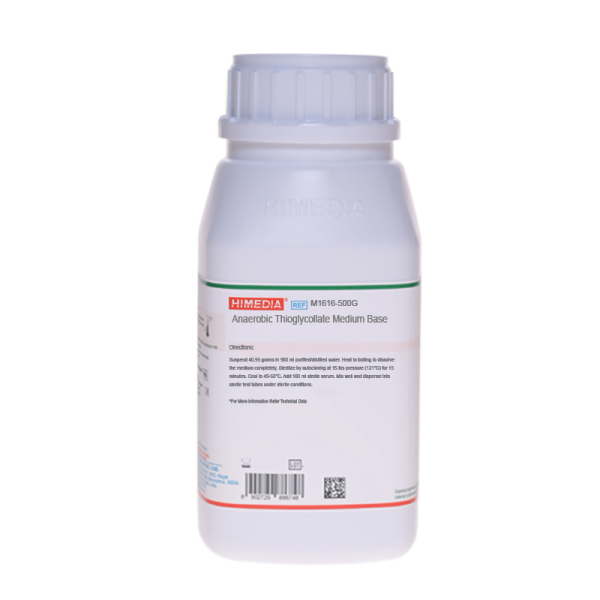
Anaerobic Thioglycollate Medium is used for the cultivation of anaerobes.
| Ingredients | Gms / Litre |
|---|---|
| Casein enzymic hydrolysate | 17.000 |
| Papaic digest of soyabean meal | 3.000 |
| Meat extract | 7.500 |
| Liver hydrolysate | 3.000 |
| D-Glucose | 6.000 |
| Sodium chloride | 2.500 |
| Sodium thioglycollate | 0.500 |
| L-Cysteine | 0.250 |
| Sodium sulphite | 0.100 |
| Agar | 0.700 |
Final pH ( at 25°C): 7.3±0.2
**Formula adjusted, standardized to suit performance parameters
Suspend 40.55 grams in 900 ml distilled water. Heat to boiling to dissolve the medium completely. Sterilize by autoclaving at 15 lbs pressure (121°C) for 15 minutes. Cool to 45-50°C. Add 100 ml sterile serum. Mix well and dispense into sterile test tubes under sterile conditions.
During the past few years the importance of anaerobic microorganisms as pathogenic agents responsible for infectious diseases and the role they play in the microbial spoilage of food have been better appreciated. Clostridial species are one of the major causes of food poisoning or gastrointestinal illnesses. Anaerobic microorganisms have long been known as constituents of the normal bacterial flora of human and animals. Both their pathogenic significance in medicine and their important role in food hygiene have, however, long been underestimated.
Anaerobic Thioglycollate Medium is used for the cultivation of anaerobes as described by Caselitz and Freitag (1). Anaerobes, which are very particular in regard to the nutrient quality of the substrate, grow very well in this medium. It has been proved to be of use in determining the resistance of anaerobes to various antibiotics in the serial dilution procedure (2).
Casein enzymic hydrolysate, papaic digest of soyabean meal, meat extract and liver hydrolysate in the medium provides nitrogen, carbon and other nutrients necessary to support bacterial growth. Glucose is the fermentable carbohydrate. Sodium chloride provides essential ions and maintains osmotic balance of the medium. Sodium thioglycollate and L-cysteine act as reducing agents and maintain a low oxygen tension in the medium. This enables the obligate anaerobes to multiply. The small amount of agar helps in anaerobiosis.
For determining the resistance of anaerobes to various antibiotics, aliquot 4.8 ml of the medium into sterile test tubes containing 0.1ml of serially diluted antibiotic. These tubes are then inoculated with 0.1ml of an adjusted suspension of pure culture of the test bacteria. The lowest antibiotic concentration, which shows no visible growth, is taken as the minimum inhibitory concentration (MIC) of the antibiotic.
Appearance: Cream to yellow homogeneous free flowing powder
Gelling: Semisolid, comparable with 0.07% Agar gel
Colour and Clarity of prepared medium: Amber to dark amber coloured clear to slightly opalescent gel
Reaction: Reaction of 4.05% w/v aqueous solution at 25°C. pH : 7.3±0.2
pH: 7.10-7.50
M1616: Cultural characteristics observed with added sterile serum after an incubation at 35-37°C for 18- 24 hours.
| Organism | Inoculum (CFU) | Growth |
|---|---|---|
| Escherichia coli ATCC 25922 | 50-100 | good |
| Bacteroides fragilis ATCC 25285 | 50-100 | good |
| Bacteroides vulgatus ATCC 8482 | 50-100 | fair |
| Clostridium perfringens ATCC 13124 | 50-100 | good |
| Clostridium sporogenes ATCC 11437 | 50-100 | good |
| Clostridium septicum ATCC 12464 | 50-100 | good |
Store below 30°C in tightly closed container and the prepared medium at 2 - 8°C. Use before expiry date on the label.
| Product Name | Anaerobic Thioglycollate Medium Base |
|---|---|
| SKU | M1616 |