Plot No. C40, Road No. 21Y, MIDC, Wagle Industrial Estate, Thane(W)-400604, MH, India


 Your enquiry has been submitted
Something problem with the server. Try again.
 Your enquiry has been submitted
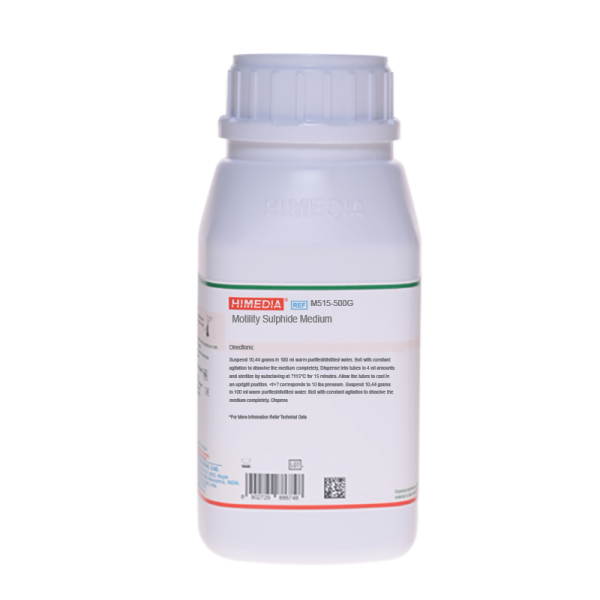
Recommended for detection of motility and hydrogen sulphide production by pure cultures.
| Ingredients | g/L |
|---|---|
| Proteose peptone | 10.000 |
| HM peptone B # | 3.000 |
| L-Cystine | 0.200 |
| Ferric ammonium citrate | 0.200 |
| Sodium citrate | 2.000 |
| Sodium chloride | 5.000 |
| Gelatin | 80.000 |
| Agar | 4.000 |
Final pH (at 25°C): 7.3±0.2
**Formula adjusted, standardized to suit performance parameters
# Equivalent to Beef extract
Suspend 10.44 grams in 100 ml warm purified/distilled water. Heat to boiling with constant agitation to dissolve the medium completely. Dispense in tubes in 4 ml amounts and sterilize by autoclaving at 115°C (10 lbs pressure) for 15 minutes. Allow the tubed medium to cool in an upright position.
Motility Sulphide Medium was originally formulated by Edwards and Bruner (1) and further modified by Hajna (2) for the determination of motility and hydrogen sulphide production. The medium is also used for indirect evidence of motility by non-fermenting gram-negative bacilli. Proteose peptone and HM peptone B provide nitrogen compounds, carbon, sulphur and trace elements essential for bacterial growth. L-cystine and ferric ammonium citrate are the H2S indicators. Ferric ammonium citrate also provides extra nutrients for citrate-utilizing bacteria. Agar and gelatin preserve an intact stab line. Motile organisms grow away from stab line showing diffused growth while non-motile organisms grow along the stab line. Hydrogen sulphide production is indicated by the blackening of the medium. Due to the free L-cystine, generally negative organisms may give a positive reaction (3). After observing motility and H2S production, same medium can be utilized to detect urea hydrolysis. The culture in the medium is overlaid with 1 ml of Urea Broth (M111A) and incubated at 35°C for upto 6 hours. A urease positive reaction is observed as a reddish-purple colour formation in the Urea Broth.
Isolated Microorganism
With inoculating needle, stab centre of medium to approximately one-half of depth.(3)
After use, contaminated materials must be sterilized by autoclaving before discarding.
Read the label before opening the container. Wear protective gloves/protective clothing/eye protection/face protection. Follow good microbiological lab practices while handling specimens and culture. Standard precautions as per established guidelines should be followed while handling specimens. Safety guidelines may be referred in individual safety data sheets.
Performance of the medium is expected when used as per the direction on the label within the expiry period when stored at recommended temperature.
Appearance
Cream to yellow homogeneous coarse powder
Gelling
Semisolid, comparable with 0.4% Agar gel and 8.0% Gelatin gel.
Colour and Clarity of prepared medium
Yellow clear to slightly opalescent gel forms in tubes as butts
Reaction
Reaction of 10.44% w/v aqueous solution at 25°C. pH: 7.3±0.2
pH
7.10-7.50
Cultural Response
Cultural characteristics observed after an incubation at 35 - 37°C for 18 - 24 hours
| Organism | Growth | Motility | H2S | Urease |
|---|---|---|---|---|
| Escherichia coli ATCC 8739 (00012*) | luxuriant | Positive, growth away from stabline causing turbidity | Negative,no blackening of medium | Negative reaction,no change |
| # Klebsiella aerogenes ATCC 13048 (00175*) | luxuriant | positive, growth away from stabline causing turbidity | Negative,no blackening of medium | Negative reaction,no change |
| Proteus mirabilis ATCC 25933 | luxuriant | motility is temperature dependent. It is more pronounced at 20°C and almost absent at 35°C | Positive, blackening of medium | Positive reaction, cerise colour |
| Salmonella Typhimurium ATCC 14028 (00031*) | luxuriant | Positive,growth away from stabline causing turbidity | Positive, blackening of medium | Negative reaction,no change |
| Shigella sonnei ATCC 25931 | luxuriant | negative, growth along the stabline, surrounding medium remains clear | Negative,no blackening of medium | Negative reaction,no change |
| Staphylococcus aureus subsp. aureus ATCC 25923 (00034*) | luxuriant | negative, growth along the stabline, surrounding medium remains clear | Negative,no blackening of medium | Negative reaction,no change |
Key: (*) Corresponding WDCM numbers. (#) Formerly known as Enterobacter aerogenes
Store between 10-30°C in a tightly closed container and the prepared medium at 15-30°C. Use before expiry date on the label. On opening, product should be properly stored dry, after tightly capping the bottle in order to prevent lump formation due to the hygroscopic nature of the product. Improper storage of the product may lead to lump formation. Store in dry ventilated area protected from extremes of temperature and sources of ignition. Seal the container tightly after use. Product performance is best if used within stated expiry period.
User must ensure safe disposal by autoclaving and/or incineration of used or unusable preparations of this product. Follow established laboratory procedures in disposing of infectious materials and material that comes into contact with sample must be decontaminated and disposed of in accordance with current laboratory techniques (4,5).
| Product Name | WL Nutrient Medium |
|---|---|
| SKU | M515 |
| Product Type | Regular |
| Physical Form | Powder |
| Origin | Animal |
| Packaging type | HDPE |
| References | 1. Edwards P. R. and Brunner D. W., 1942, Circulation of the Kentucky Agricultural Experimental Station, No. 54. 2.Hajna A. A., 1950, Public Health Lab., 8:36. 3.MacFaddin J. F., 1985, Media for Isolation-Cultivation-Identification-Maintenance of Medical Bacteria, Vol. 1, Williamsand Wilkins, Baltimore. |