Plot No. C40, Road No. 21Y, MIDC, Wagle Industrial Estate, Thane(W)-400604, MH, India


 Your enquiry has been submitted
Something problem with the server. Try again.
 Your enquiry has been submitted
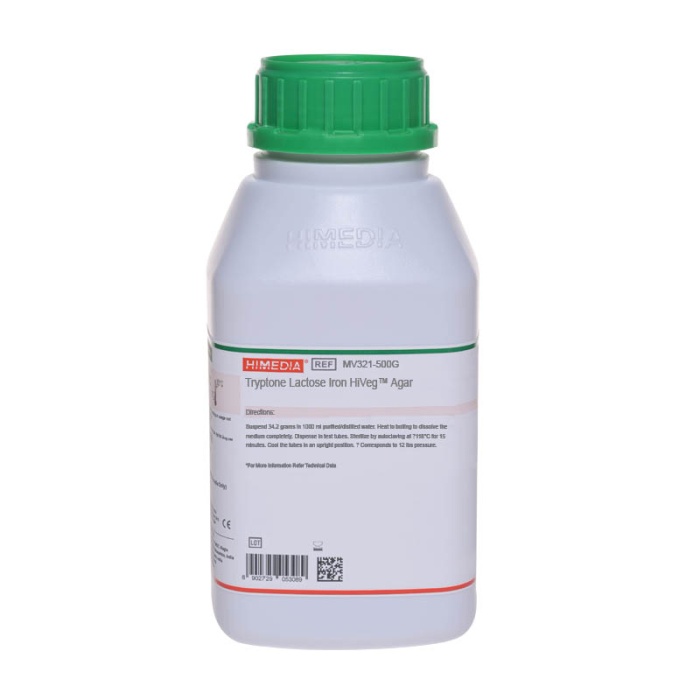
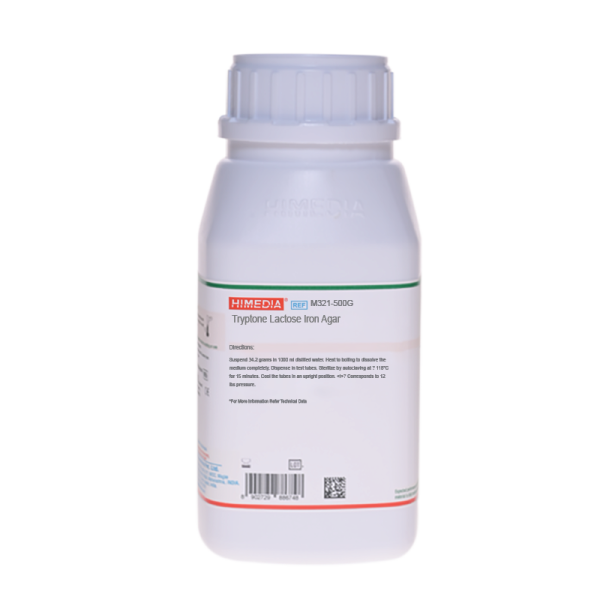
Tryptone Lactose Iron Agar is used for identification of anaerobes on the basis of motility, hydrogen sulphide production and lactose fermentation.
| Ingredients | Gms / Litre |
|---|---|
| Casein enzymic hydrolysate | 20.000 |
| Lactose | 10.000 |
| Ferrous sulphate | 0.200 |
| Sodium sulphite | 0.400 |
| Sodium thiosulphate | 0.080 |
| Phenol red | 0.020 |
| Agar | 3.500 |
Final pH ( at 25°C): 7.3±0.2
**Formula adjusted, standardized to suit performance parameters
Suspend 34.2 grams in 1000 ml distilled water. Heat boiling to dissolve the medium completely. Dispense in test tubes. Sterilize by autoclaving at * 118°C for 15 minutes. Cool the tubes in an upright position.
* -corresponds to 12lbs pressure.
Tryptone Agar was developed by Vera (1) for the accurate differentiation and identification of aerobes and anaerobes by means of motility and fermentation reactions. Tryptone Lactose Iron Agar medium is recommended to study motility of organism and simultaneous sulphite reduction in acidic environment. Due to presence of phenol red in the medium, on fermentation of lactose the medium turns yellow due to production of acid and gas (2). The ability of an organism to produce H2S is a consistent characteristics and an H2S producer usually produce gas (CO2 + H2) in carbohydrate media (2) which is visualized as air bubbles in the medium.
Casein enzymic hydrolysate provides essential growth nutrients to support the growth of organisms. Phenol red is the pH indicator. Even small amount of agar renders it suitable for study of motility. Small amounts of acid produced do not readily get dispersed throughout the medium and hence positive reaction can be more quickly determined in this medium than in liquid medium. Lactose is the fermentable carbohydrate.
H2S production takes place in the presence of R1-SH group provided by cystine present in casein enzymic hydrolysate or through reduction of an inorganic sulphur source such as thiosulphate. H2S is a colourless gas, which upon contact with ferrous salt produces ferrous sulphide, a black precipitate indicated by a visible black reaction (3-6). Sodium sulphite at a concentration less than 0.05% is not inhibitory to Clostridium sporogenes (7).
Appearance Light yellow to light pink homogeneous free flowing powder
Gelling Semisolid, comparable with 0.35% Agar gel.
Colour and Clarity of prepared medium Red coloured clear to slightly opalescent gel forms in tubes as butts.
Reaction Reaction of 3.4% w/v aqueous solution at 25°C. pH : 7.3±0.2
pH 7.10-7.50
Cultural characteristics observed when incubated anerobically, after an incubation at 35-37°C for 18-48 hours.
| Organism | Inoculum (CFU) | Growth | Acid | H2S | Motility |
|---|---|---|---|---|---|
| Clostridium perfringens ATCC 13124 | 50-100 | luxuriant | positive reaction, yellow colour | positive, blackening of medium | positive, growth away from stabline causing turbidity |
| Clostridium sporogenes ATCC 11437 | 50-100 | luxuriant | positive reaction, yellow colour | negative, no blackening of medium | positive, growth away from stabline causing turbidity |
Store below 30°C in tightly closed container and the prepared medium at 2 - 8°C. Use before expiry date on the label.
| Product Name | Tryptone Lactose Iron Agar |
|---|---|
| SKU | M321 |
| Product Type | Regular |
| Physical Form | Powder |
| Origin | Animal |
| Packaging type | HDPE |
| References | 1. Vera, 1944, J. Bact., 47:455. 2.MacFaddin J., 1985, Media for Isolation-Cultivation-Identification-Maintenance of Medical Bacteria, Vol. I, Williams and Wilkins, Baltimore. |