Plot No. C40, Road No. 21Y, MIDC, Wagle Industrial Estate, Thane(W)-400604, MH, India


 Your enquiry has been submitted
Something problem with the server. Try again.
 Your enquiry has been submitted
Used for differentiation of Trichophyton species.
| Ingredients | g/L |
|---|---|
| Vitamin free acicase# | 2.500 |
| Dextrose (Glucose) | 40.000 |
| Potassium dihydrogen phosphate | 1.800 |
| Magnesium sulphate | 0.100 |
| Inositol | 0.050 |
| Agar | 15.000 |
Final pH (at 25°C): 6.8±0.2
**Formula adjusted, standardized to suit performance parameters
# Equivalent to Vitamin free casein acid hydrolysate
Suspend 59.45 grams in 1000 ml purified/distilled water. Heat to boiling to dissolve the medium completely. Dispense in test tubes. Sterilize by autoclaving at 15 lbs pressure (121°C) for 15 minutes. Allow the tubes to cool in slanted position.
Nutritional tests were originally described by George and Camp (1) as an aid in the routine identification of Trichophyton species that seldom produce conidia or that resemble each other morphologically (1). Certain species have distinctive nutritional requirements, whereas others do not.
The method employs a casein basal medium that is vitamin-free (Trichophyton Agar-1, M531) to which different vitamins are added i.e. inositol (Trichophyton Agar-2, M532), thiamine and inositol (Trichophyton Agar-3, M533), thiamine (Trichophyton Agar-4) (M534) and nicotinic acid (Trichophyton Agar-5) (M535). The method also employs an ammonium nitrate basal medium (Trichophyton Agar-6, M536) to which histidine is added (Trichophyton Agar-7, M152) (2). The various additives added help to determine the specific vitamin and amino acid requirements of the isolates. Trichophyton Agar-2 contains added inositol. This medium is used along with Trichophyton Agar-1 to determine the inositol requirement of an isolate.
Nutritional requirements are determined by inoculating a control medium and a medium enriched with a specific vitamin or amino acid with Trichophyton isolates that have been presumptively identified by gross colony characteristics and microscopic morphology (1,3,4,5,6). Moderate to heavy growth in the vitamin or amino acid-enriched medium compared to little or no growth in the basal medium indicates that the isolate requires that nutrient.
Isolated Microorganism from clinical sample
For clinical samples follow appropriate techniques for handling specimens as per established guidelines (7,8).
After use, contaminated materials must be sterilized by autoclaving before discarding.
In Vitro diagnostic Use only. For professional use only. Read the label before opening the container. Wear protective gloves/protective clothing/eye protection/ face protection. Follow good microbiological lab practices while handling specimens and culture. Standard precautions as per established guidelines should be followed while handling clinical specimens. Safety guidelines may be referred in individual safety data sheets.
Performance of the medium is expected when used as per the direction on the label within the expiry period when stored at recommended temperature.
Appearance
White to light yellow homogeneous free flowing powder
Gelling
Firm, comparable with 1.5% Agar gel
Colour and Clarity of prepared medium
Light amber coloured clear to slightly opalescent gel forms in tubes as slants
Reaction
Reaction of 5.94% w/v aqueous solution at 25°C. pH: 6.8±0.2
pH
6.60-7.00
Cultural Response
Cultural characteristics observed after an incubation at 25-30°C for upto 1 week
| Organism | Growth |
|---|---|
| Trichophyton mentagrophytes ATCC 9533 | luxuriant |
| Trichophyton rubrum ATCC 28191 | luxuriant |
Store between 10-30°C in a tightly closed container and the prepared medium at 20-30°C. Use before expiry date on the label. On opening, product should be properly stored dry, after tightly capping the bottle in order to prevent lump formation due to the hygroscopic nature of the product. Improper storage of the product may lead to lump formation. Store in dry ventilated area protected from extremes of temperature and sources of ignition. Seal the container tightly after use. Product performance is best if used within stated expiry period.
User must ensure safe disposal by autoclaving and/or incineration of used or unusable preparations of this product. Follow established laboratory procedures in disposing of infectious materials and material that comes into contactwith clinical sample must be decontaminated and disposed of in accordance with current laboratory techniques (3,4).
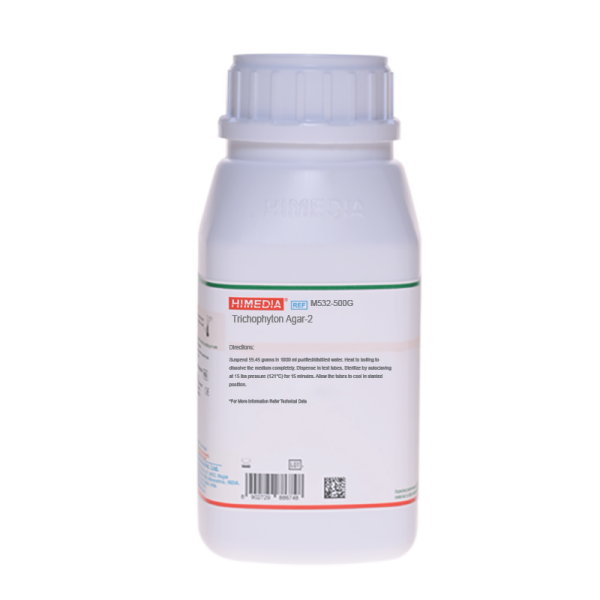
| Product Name | Trichophyton Agar-2 |
|---|---|
| SKU | M532 |
| Product Type | Regular |
| Physical Form | Powder |
| Origin | Animal |
| Packaging type | HDPE |
| References | 1. Murray P. R., Baron E. J., Jorgensen J. H., Pfaller M. A., Yolken R. H., (Eds.), 8th Ed., 2003, Manual of ClinicalMicrobiology, ASM, Washington, D.C. 2.George L. K., Camp L. B., 1957, J. Bacteriol., 74:113. 3.Roberts G. D., 1985, In Washington (Ed.), Laboratory Procedures in Clinical Microbiology, 2nd Ed., Springer- Verlag, NewYork, N.Y. 4.Weitzman I., Rosenthal S. A. and Silva-Hutner M., 1988, In Wentworth (Eds.), Diagnostic Procedures for Mycotic andParasitic Infections, 7th Ed., American Public Health Association, Washington, D.C. 5.Haley L. D., Trandel J. and Coyle M. B., 1980, Cumitech 11, Practical methods for culture and identification of fungi in theclinical mycology laboratory, Coord. Ed., Sherris, American Society for Microbiology, Washington, D.C. 6.McGinnis M. R. and Pasarell L., 1992, In Isenberg (Ed.), Clinical Microbiology Procedures Handbook, Vol. 1, AmericanSociety for Microbiology, Washington, D.C. |