Plot No. C40, Road No. 21Y, MIDC, Wagle Industrial Estate, Thane(W)-400604, MH, India

 Your enquiry has been submitted
Something problem with the server. Try again.

| Ingredients | Gms / Litre |
|---|---|
| Casein enzymic hydrolysate | 17.000 |
| Peptic digest of animal tissue | 3.000 |
| Yeast extract | 5.000 |
| Bile salts | 10.000 |
| Sodium chloride | 5.000 |
| Sodium citrate | 1.000 |
| Esculin | 1.000 |
| Ferric ammonium citrate | 0.500 |
| Sodium azide | 0.250 |
| Agar | 15.000 |
| Final pH (at 25°C) | 7.1±0.2 |
Formula adjusted, standardized to suit performance parameters
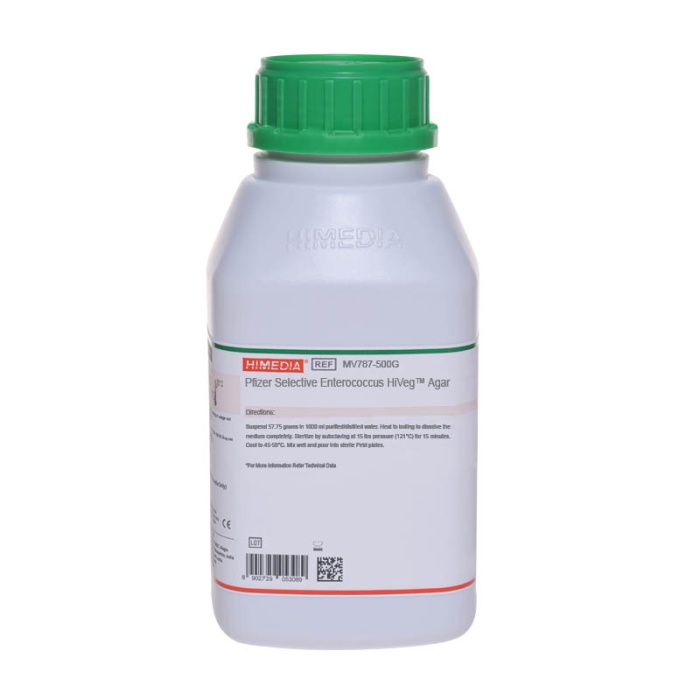
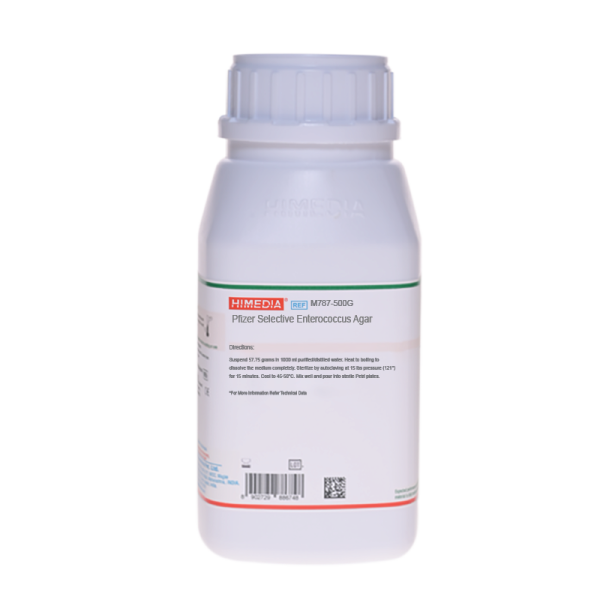
Suspend 57.75 grams in 1000 ml distilled water. Heat to boiling to dissolve the medium completely. Dispense as desired and sterilize by autoclaving at 15 lbs pressure (121°C) for 15 minutes. Mix well and pour into Petri plates
Warning: Sodium azide has a tendency to form explosive metal azides with plumbing materials. It is advisable to use enough water to flush off the disposables.
Enterococci may be considered an essential part of the autochthonous microflora of humans and animals. Because of its wide distribution,,,Enterococci can also occur in different food commodities, especially those of animal origin (1, 2). A wide variety of selective media for Enterococcus has been recommended and used. Pfizer Selective Enterococcus Agar is used for the selective isolation and cultivation of Enterococci. This medium is formulated as per Isenberg, Goldberg and Sampson (4) by reducing the concentration of bile salts and sodium azide from the original formulation. The importance of esculin hydrolysis in differentiating Enterococci and streptococci was first reported by Rochaix as streptococci do not exhibit esculin hydrolysis (3).
Casein enzymic hydrolysate, peptic digest of animal tissue and yeast extract provide nutrients like nitrogenous compounds, carbon, sulphur, vitamin B complex and trace ingredients for the growth of Enterococci. Esculin, a glycoside, is hydrolyzed by Enterococci to esculetin and dextrose. Esculetin reacts with ferric ammonium citrate to form a dark brown to black coloured complex (6). Bile salts and sodium azide inhibit gram-positive (except Enterococci and gram-negative bacteria respectively. Pfizer Selective Enterococcus Agar is better used as selective primary medium (5).
Appearance
Light yellow to pale green homogeneous free flowing powder
Gelling
Firm, comparable with 1.5% Agar gel
Colour and Clarity of prepared medium
Light amber coloured clear to slightly opalescent gel with a bluish tinge forms in Petri plates.
Reaction
Reaction of 5.8% w/v aqueous solution at 25°C. pH: 7.1±0.2
pH
6.90-7.30
Cultural characteristics observed after an incubation at 35-37°C for 18-24 hours.
| Organism | Inoculum (CFU) | Growth | Recovery | Esculin hydrolysis |
|---|---|---|---|---|
| Enterobacter aerogenes ATCC 13048 | >=10³ | inhibited | 0% | |
| Escherichia coli ATCC 25922 | >=10³ | inhibited | 0% | |
| Staphylococcus aureus ATCC 25923 | 50-100 | fair-good | 30-40% | negative reaction |
| Enterococcus faecalis ATCC 29212 | 50-100 | good-luxuriant | >=50% | positive reaction, blackening around the colony |
| Streptococcus pyogenes ATCC 19615 | 50-100 | Good-luxuriant | >=50% | Negative reaction |
Store below 30°C in tightly closed container and the prepared medium at 2 - 8°C. Use before expiry date on the label.
| Product Name | Pfizer Selective Enterococcus Agar |
|---|---|
| SKU | M787 |
| Product Type | Regular |
| Physical Form | Powder |
| Origin | Animal |
| Packaging type | HDPE |
| References | 1. Belzer R., Vergleichende Untersuchungen von Enterokokkenselektivnährböden. Inaug. Dissert., Univ. München, 1983. |