HiMedia Laboratories GmbH, Marie-Curie-Str. 3, 64683, Einhausen, Germany.

 Your enquiry has been submitted
Something problem with the server. Try again.
 Your enquiry has been submitted
Recommended for selective isolation and cultivation of Listeria monocytogenes .
| Ingredients | g/L |
|---|---|
| HiVeg® hydrolysate | 5.000 |
| HiVeg® peptone No. 3 | 5.000 |
| HiVeg® extract | 5.000 |
| Yeast extract | 5.000 |
| Sodium chloride | 20.000 |
| Potassium dihydrogen phosphate | 1.350 |
| Disodium hydrogen phosphate | 12.000 |
| Esculin | 1.000 |
| Final pH (at 25°C) | 7.4±0.2 |
**Formula adjusted, standardized to suit performance parameters
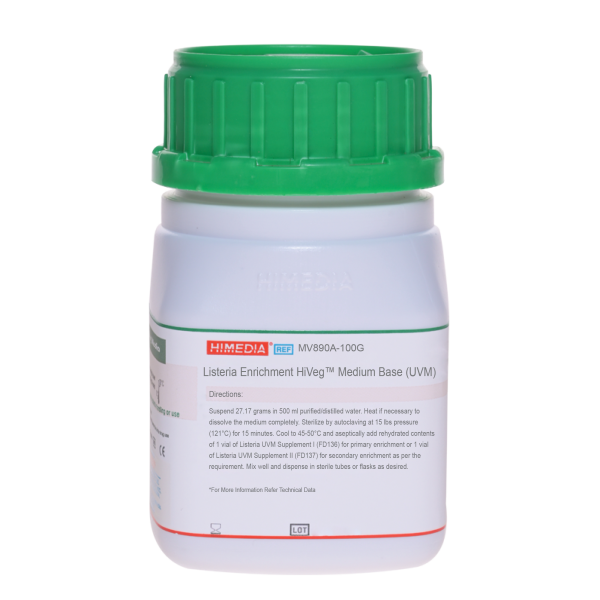
Suspend 27.17 grams in 500 ml purified/distilled water. Heat if necessary to dissolve the medium completely. Sterilize by autoclaving at 15 lbs pressure (121°C) for 15 minutes. Cool to 45-50°C and aseptically add rehydrated contents of 1 vial of UVM Selective Supplement I (FD136) for primary enrichment or 1 vial of UVM Selective Supplement II (FD137) for secondary enrichment as per the requirement. Mix well and dispense in sterile tubes or flasks as desired.
Listeriosis is caused by Listeria monocytogenes, a short gram-positive non-sporulating rod. The bacilli are commonly found in soil and in the intestines of many animals including birds, fish, barnyard animals, dairy cattle and household pets. It is transmitted to humans by foods contaminated with faecal matter, as well as by the consumption of animal foods contaminated with the bacilli (1). Listeria Enrichment Medium Base is used for the selective cultivation and isolation of L. monocytogenes from clinical samples. The medium was originally formulated by Donnelly and Baigent (3). It was later modified by decreasing the nalidixic acid concentration in the selective supplements and subsequently increasing the acriflavin concentration (6). University of Vermont Modification Medium (UVM) used a two-step selective enrichment medium resulting in a higher isolation rate of L.monocytogenes from meat products within 3-4 days. This UVM Broth is recommended as a primary enrichment broth for recovery of heat injured Listeria (2). Listeria Enrichment HiVeg® Medium Base (UVM) is prepared by using vegetable peptones in place of animal based peptones which make the media free of BSE/TSE risks. HiVeg® hydrolysate, HiVeg® peptone No. 3, HiVeg® extract and yeast extract provide nitrogenous and carbonaceous compounds, long chain amino acids and other necessary nutrients while esculin offers differential properties to the medium. Nalidixic acid and acriflavin hydrochloride together with higher concentration of phosphate render the medium selective for Listeria. Gram-negative and gram-positive organisms are inhibited by nalidixic acid and acriflavin hydrochloride respectively. The two-step selective enrichment method developed (3) results in a higher detection rate of L.monocytogenes from specimens and has the added advantage of only taking 3-4 days. For primary isolation inoculate 25 gm or 25 ml specimen in 225 ml Listeria Enrichment Medium Base with added UVM Selective Supplement I (FD136). After 24 hours incubation, spread 0.2 ml of this medium on Listeria Selective HiVeg®TM Agar (MV567) plate. Simultaneously transfer 0.1 ml of Enrichment broth to 10 ml of fresh Listeria Enrichment Medium Base with added UVM Selective Supplement II (FD137). For secondary enrichment after 24 hours spread 0.2 ml of this medium on Listeria Selective HiVeg® Agar (MV567) plate. Note: Broth cultures of Listeria are more dangerous than colonies on agar plates, so proper precautions should be taken while handling.
Please add specimens
After use, contaminated materials must be sterilized by autoclaving before discarding.
Read the label before opening the container. Wear protective gloves/protective clothing/eye protection/ face protection. Follow good microbiological lab practices while handling specimens and culture. Standard precautions as per established guidelines should be followed while handling specimens. Safety guidelines may be referred in individual safety data sheets.
Performance of the medium is expected when used as per the direction on the label within the expiry period when stored at recommended temperature.
Appearance
Cream to light tan homogeneous free flowing powder
Colour and Clarity of prepared medium
Medium amber coloured, slightly opalescent solution with a bluish tinge
Reaction
Reaction of 5.43% w/v aqueous solution at 25°C. pH: 7.4±0.2
pH
7.20-7.60
Cultural Response
Cultural characteristics observed after an incubation at 35-37°C for 24-48 hours
| Organism | Inoculum (CFU) | Growth(On addition of FD136 or FD137) |
|---|---|---|
| Escherichia coli ATCC 25922 (00013*) | 50-100 | none to poor |
| Listeria monocytogenes ATCC 19111 (00020*) | 50-100 | good-luxuriant |
| Listeria monocytogenes ATCC 19112 | 50-100 | good-luxuriant |
| Listeria monocytogenes ATCC 19117 | 50-100 | good-luxuriant |
| Listeria monocytogenes ATCC 19118 | 50-100 | good-luxuriant |
| Staphylococcus aureus subsp. aureus ATCC 25923 (00034*) | 50-100 | none to poor |
Key: *Corresponding WDCM numbers.
Store between 10-30°C in a tightly closed container and the prepared medium at 2-8°C. Use before expiry date on the label. On opening, product should be properly stored dry, after tightly capping the bottle in order to prevent lump formation due to the hygroscopic nature of the product. Improper storage of the product may lead to lump formation. Store in dry ventilated area protected from extremes of temperature and sources of ignition Seal the container tightly after use. Product performance is best if used within stated expiry period.
User must ensure safe disposal by autoclaving and/or incineration of used or unusable preparations of this product. Follow established laboratory procedures in disposing of infectious materials and material that comes into contact with sample must be decontaminated and disposed of in accordance with current laboratory techniques (5,6).
| Product Name | Listeria Enrichment HiVeg® Medium Base (UVM) |
|---|---|
| SKU | MV890A |
| Product Type | HiVeg™ |
| Physical Form | Powder |
| Origin | Animal Free (Veg) |
| Packaging type | HDPE |
| References | 1. Alcamo E. I., 2001, Fundamentals of Microbiology, 6th Edition, Jones and Bartlett publishers 2.Bailey J. S., Fletcher D. L. and Cox N. A., 1990, J. Food Prot.,53:47 |