HiMedia Laboratories GmbH, Marie-Curie-Str. 3, 64683, Einhausen, Germany.

 Your enquiry has been submitted
Something problem with the server. Try again.
 Your enquiry has been submitted
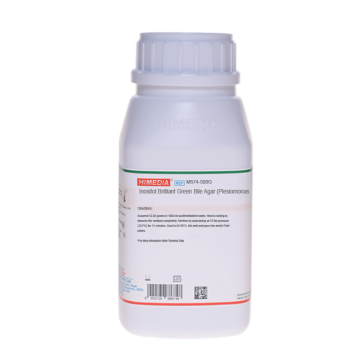
Recommended for selective isolation of Plesiomonas shigelloides and Aeromonas species.
| Ingredients | g/L |
|---|---|
| HiVeg® peptone No. 3 | 15.000 |
| HiVeg® extract No. 1 | 6.500 |
| Meso-Inositol | 10.000 |
| Synthetic detergent no. 1 | 2.000 |
| Sodium chloride | 5.000 |
| Brilliant green | 0.00033 |
| Neutral red | 0.025 |
| Agar | 13.500 |
| Final pH (at 25°C) | 7.2±0.2 |
**Formula adjusted, standardized to suit performance parameters
Suspend 52.03 grams in 1000 ml purified/distilled water. Heat to boiling to dissolve the medium completely. Sterilize by autoclaving at 15 lbs pressure (121°C) for 15 minutes. Cool to 45-50°C. Mix well and pour into sterile Petri plates.
Plesiomonas shigelloides is an opportunistic pathogen. Ferguson and Henderson (1947) first isolated this organism on MacConkey Agar from faecal specimen. P. shigelloides has been isolated from fresh water, freshwater fish, shell fish and from many types of animals. Human infections from P. shigelloides are mostly waterborne. The organism may be present in unsanitary water, which has been used as drinking water, recreational water, or water used to rinse foods that are consumed without cooking or heating. P.shigelloides has been implicated in gastroenteritis. Its significance as an enteric (intestinal) pathogen is presumed because of its predominant isolation from stools of patients with diarrhea. It is identified by common bacteriological analysis, serotyping, and antibiotic sensitivity testing (1). Other organisms implicated in human waterborne diarrhoea include Aeromonas species. Inositol Brilliant Green Bile Agar is a medium described by Schubert (2) and is recommended for selective isolation of P.shigelloides (an opportunistic pathogen) and Aeromonas species from faeces and other foodstuffs (3).
Several media and methods have been designed to selectively isolate P.shigelloides. Strains of P.shigelloides grow in the presence of brilliant green and are also resistant to bile salts that are usually incorporated in media to inhibit gram-positive bacteria. Most bacterial species do not ferment meso- inositol, but almost all strains of P.shigelloides ferment this to naturally occurring cyclic polyhydroxyl alcohol. Schubert (2) took advantage of the three properties as discussed above and designed Inositol Brilliant Green HiVeg® Agar (Plesiomonas Differential HiVeg®Agar).
Inositol Brilliant Green HiVeg® Agar (Plesiomonas Differential HiVeg®Agar) is prepared by completely replacing animal based peptone with vegetable peptones to avoid BSE/TSE risks associate with animal peptones. It is a differential medium for inositol utilizers and non-utilizers. HiVeg® peptone No. 3 and HiVeg® extract No. 1 supply nitrogenous nutrients required for the growth of organisms. Synthetic detergent no. 1 and brilliant green inhibit all gram-positive bacteria and most of the gram-negative bacilli, other than coliforms respectively. Meso-inositol is a fermentable carbohydrate source in the medium while neutral red is the pH indicator.
Plesiomonas may be misidentified as a member of the Enterobacteriaceae, if oxidase test is not performed during the identification procedure (4,5).
Samples, depending upon consistency and expected numbers are diluted and directly streaked on PL HiVeg® Agar (MV1173) and Plesiomonas Differential HiVeg® Agar (MV574) (2). Another 10 grams of the sample is inoculated into 90 ml of Tetrathionate HiVeg® Broth Base (w/o Iodine and BG) (MV032). Plates are incubated at 35-37°C and broth at 40°C. Following an incubation of 24 hours, presumptive P. shigelloides colonies are inoculated into Triple Sugar Iron HiVeg® Agar (MV021) and Inositol Gelatin Medium Butts (M1161). Growth from MV032 is streaked onto PL HiVeg® Agar (MV1173) and Inositol Brilliant Green HiVeg® Agar (Plesiomonas Differential HiVeg® Agar) (MV574)
Food samples; Water samples
For food samples, follow appropriate techniques for sample collection and processing as per guidelines (6). For water samples, follow appropriate techniques for sample collection, processing as per guidelines and local standards.(7) After use, contaminated materials must be sterilized by autoclaving before discarding.
Read the label before opening the container. Wear protective gloves/protective clothing/eye protection/ face protection. Follow good microbiological lab practices while handling specimens and culture. Standard precautions as per established guidelines should be followed while handling specimens. Safety guidelines may be referred in individual safety data sheets.
Performance of the medium is expected when used as per the direction on the label within the expiry period when stored at recommended temperature.
Appearance
Light yellow to pinkish beige homogeneous free flowing powder
Gelling
Firm, comparable with 1.35% Agar gel.
Colour and Clarity of prepared medium
Reddish orange coloured, clear to slightly opalescent gel forms in Petri plates
Reaction
Reaction of 5.2% w/v aqueous solution at 25°C. pH : 7.2±0.2
pH
7.00-7.40
Cultural characteristics observed after an incubation at 35-37°C for 18-24 hours.
| Organism | Inoculum (CFU) | Growth | Recovery | Colour of colony |
|---|---|---|---|---|
| Aeromonas hydrophila ATCC 7966 (00063*) | 50-100 | luxuriant | >=50% | colourless |
| Klebsiella pneumoniae ATCC 13883 (00097*) | 50-100 | good | 40-50% | pink |
| Plesiomonas shigelloides ATCC 14029 | 50-100 | luxuriant | >=50% | pink |
| Staphylococcus aureus subsp. aureus ATCC 25923 (00034*) | >=104 | inhibited | 0% |
Key: *Corresponding WDCM numbers.
Store between 10-30°C in a tightly closed container and the prepared medium at 20-30°C. Use before expiry date on the label. On opening, product should be properly stored dry, after tightly capping the bottle in order to prevent lump formation due to the hygroscopic nature of the product. Improper storage of the product may lead to lump formation. Store in dry ventilated area protected from extremes of temperature and sources of ignition. Seal the container tightly after use. Product performance is best if used within stated expiry period.
User must ensure safe disposal by autoclaving and/or incineration of used or unusable preparations of this product. Follow established laboratory procedures in disposing of infectious materials and material that comes into contact with sample must be decontaminated and disposed of in accordance with current laboratory techniques (8,9).
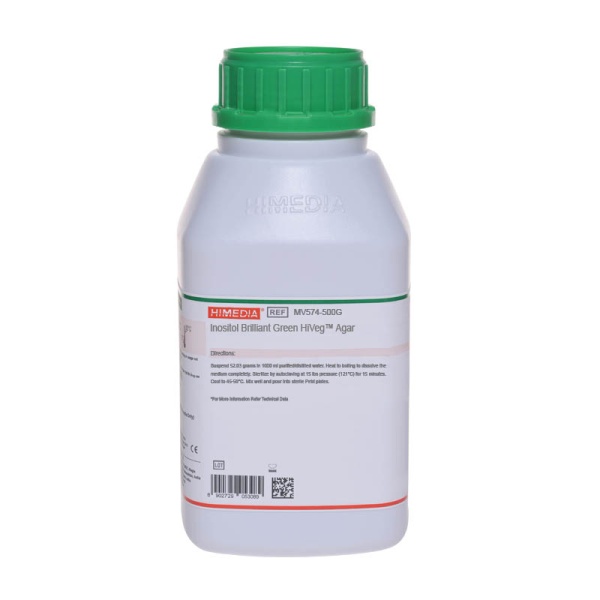
| Product Name | Inositol Brilliant Green HiVeg® Agar (Plesiomonas Differential HiVeg® Agar) |
|---|---|
| SKU | MV574 |
| Product Type | HiVeg™ |
| Physical Form | Powder |
| Origin | Animal Free (Veg) |
| Packaging type | HDPE |
| References | 1.Foodborne Pathogenic Microorganisms and Natural Toxins Handbook Centre for Food Safety and Applied Nutrition, USFood and Drug Administration. 2.Cooper R. G., and Brown G. W., 1968, Plesiomonas shigelloides Schubert R. H. W., 1977, Ueber den Nachweis vonPlesiomonas shigelloides Habs and Schubert, 1962, und ein Elektivmedium, den Inositol-Brilliantgrun-Gallesalz-Agar. ErnstRodenwaldt Arch. 4:97-103. 3.Appelbaum D. C., Bowen A. J., Adhikari M., et al, 1978, J. Pediatr., 92:676. 4.Bhat P., Shanthakumari S. and Rajan D., 1974, Ind. J. Med. Res. ,62:1051. 5.MacFaddin J. F., 1985, Media for Isolation-Cultivation-Identification-Maintenance of Medical Bacteria, Vol. I, Williamsand Wilkins, Baltimore. |
| Customized Product Available | No |