HiMedia Laboratories GmbH, Marie-Curie-Str. 3, 64683, Einhausen, Germany.

 Your enquiry has been submitted
Something problem with the server. Try again.

Gluconate Test HiVeg® Medium is used to check the ability of bacteria to oxidize gluconates to alpha keto-gluconate.
| Vegetable based (Code MV) | Animal based (Code M) |
|---|---|
| MV483 | M483 |
| HiVeg® peptone | Peptic digest of animal tissue |
| Ingredients | Grams/Litre |
|---|---|
| HiVeg® peptone | 1.50 |
| Yeast extract | 1.00 |
| Dipotassium hydrogen phosphate | 1.00 |
| Potassium gluconate | 40.00 |
Final pH (at 25°C) 7.0± 0.2
** Formula adjusted, standardized to suit performance parameters
Reconstitution: 43.5 g/l
Quantity on preparation (500g): 11.49 L
pH (25°C): 7.0± 0.2
Supplement: None
Sterilization: 121°C / 15 minutes.
Storage: Dry Medium - Below 30°C, Prepared Medium 2-8°C.
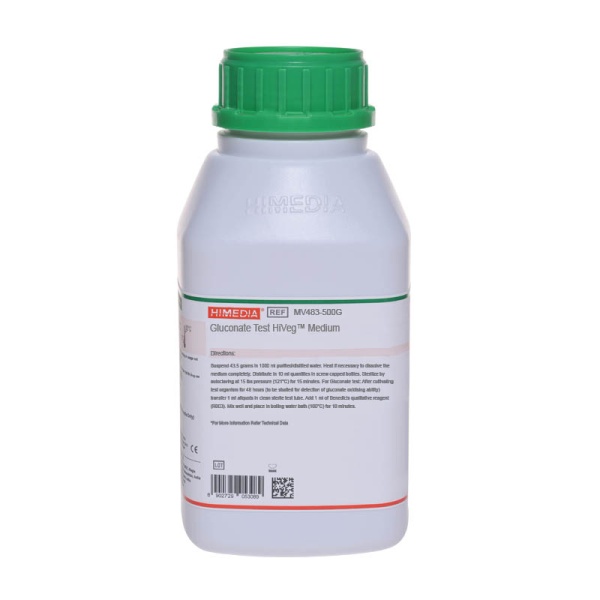
Suspend 43.5 grams in 1000 ml distilled water. Heat if necessary to dissolve the medium completely. Distribute in 10 ml quantities in screw capped bottles and sterilize by autoclaving at 15 lbs pressure (121°C) for 15 minutes.
For Gluconate test:
After cultivating test organism for 48 hours (to be studied for detection of gluconate oxidizing ability) transfer 1 ml aliquots in clean sterile test tube. Add 1 ml of Benedicts qualitative reagent (R003). Mix well and place in boiling water bath (100°C) for 10 minutes.
Gluconate Test HiVeg® Medium is a modification of Gluconate Test Medium prepared by replacing Peptic digest of animal tissue with HiVeg® peptone. Therefore this medium is free of TSE/BSE risk. Besides HiVeg® peptone, yeast extract in the medium also serves as supplier of nitrogen, vitamins and other essential growth nutrients. Dipotassium hydrogen phosphate helps in buffering the medium. Potassium salt of gluconate in media serves as a readily available sole carbon source for the organism to be tested for gluconate metabolism.
This medium is used to check the ability of an organism to oxidize gluconates to alpha keto-gluconate which subsequently accumulates in the medium (1). Pseudomonas aeruginosa is known to accumulate atleast 50% of ketogluconate after 48 hrs of incubation (2). The basis of the Gluconate test is the change from gluconate, a non-reducing compound to alpha keto-gluconate which is a reducing compound (1, 3). The alpha keto-gluconate formed when tested with a suitable reagent like Benedicts reagent, reduces copper sulphate (blue colour) to an insoluble cuprous oxide which is precipitated out. A yellow to orange to orange red precipitate is formed. The colour depends on the amount of reducing substance accumulated. Greater the amount of alpha keto-gluconate in the medium more orange to orange - red colour develops. However colours ranging from slight green to deep orange indicates oxidation. If the medium remains blue or bluish green after addition of Bendicts solution, it is considered as negative reaction which means no reducing substance is present or formed and potassium gluconate from the media is not metabolized.
Appearance of Powder
Cream to yellow coloured, may have slightly greenish tinge, homogeneous, free flowing powder.
Colour and Clarity
Light straw coloured, clear solution without any precipitate.
Reaction
Reaction of 4.35% w/v aqueous solution is pH 7.0± 0.2 at 25°C.
Cultural Response
Cultural characteristics observed after an inubation at 35-37°C for 18-48 hours.
| Organisms (ATCC) | Inoculum | Growth | Gluconate Test |
|---|---|---|---|
| Citrobacter freundii (8090) | 102-103 | poor-good | - |
| Escherichia coli (25922) | 102-103 | poor-good | - |
| Klebsiella pneumoniae (23357) | 102-103 | luxuriant | + |
| Pseudomonas aeruginosa (10145) | 102-103 | luxuraint | + |
Key: + = positive reaction, slight green to deep orange precipitate
- = negative reaction, no change in colour or blue
| Product Name | Gluconate Test HiVeg® Medium |
|---|---|
| SKU | MV483 |
| Product Type | HiVeg™ |
| Physical Form | Powder |
| Origin | Animal Free (Veg) |
| Packaging type | HDPE |
| References | 1.Collee J. G., Fraser A. G., Marmion B. P., Simmons A., (Eds.), Mackie and McCartney, Practical Medical Microbiology,1996, 14th Edition, Churchill Livingstone. 2.Hynes W. C., 1951, J. Gen. Microbiol., 5: 939. |
| Customized Product Available | No |