HiMedia Laboratories GmbH, Marie-Curie-Str. 3, 64683, Einhausen, Germany.

 Your enquiry has been submitted
Something problem with the server. Try again.

Recommended for selective isolation of presumptive pathogenic Staphylococci.
| Ingredients | g/L |
|---|---|
| HiVeg® peptone No. 3 | 10.000 |
| HiVeg® extract | 1.000 |
| Sodium chloride | 75.000 |
| D-Mannitol | 10.000 |
| Phenol red | 0.025 |
| Final pH (at 25°C) | 7.4±0.2 |
**Formula adjusted, standardized to suit performance parameters
Suspend 96.02 grams in 1000 ml purified / distilled water. Heat if necessary to dissolve the medium completely. Dispense in tubes or flasks as desired. Sterilize by autoclaving at 15 lbs pressure (121°C) for 15 minutes.
Note: This product contains 7.5% sodium chloride as one of its ingredients. On repeated exposure to air and absorption moisture sodium chloride has tendency to form lumps, therefore we strongly recommend storage in tightly closed containers in dry place away from bright light.
Mannitol Salt Broth is prepared as suggested by Chapman (1) and is used for the selective isolation of pathogenic Staphylococci. This medium is recommended for the detection and enumeration of coagulase-positive Staphylococci in milk (2) food (3) and other specimens. Mannitol Salt Broth is used for the isolation of presumptive pathogenic staphylococci. Pathogenic staphylococci ferment mannitol and produce a yellow coloured medium.
Mannitol Salt HiVeg® Broth is prepared by using vegetable peptones in place of animal based peptones which make the media free of BSE/TSE risks. The medium contains HiVeg® peptone No. 3 and HiVeg® extract which makes it very nutritious as they provide essential growth factors and trace nutrients. Many other bacteria except Staphylococci are inhibited by 7.5% sodium chloride. Mannitol is the fermentable carbohydrate source. The differential action of the medium is attributed to D-Mannitol. Staphylococcus aureus ferments mannitol to produce yellow coloured medium. Most coagulase- negative species of Staphylococci and Micrococci do not ferment mannitol and therefore the medium remains red in colour. The colour of the medium is due to the reactivity of phenol red to the pH of the medium; phenol red is red at pH 8.4 and yellow at 6.8. Presumptive Staphylococcus showing yellow coloured medium should be further tested for production of coagulase.
A possible S. aureus must be confirmed by the coagulase test. Also the organism should be subcultured to a less inhibitory medium not containing excess salt to avoid the possible interference of salt with coagulase testing or other diagnostic tests (e.g. Nutrient Broth) (M002) (4). Few strains of S. aureus may exhibit delayed mannitol fermentation. Negative results should therefore be re-incubated for an additional 24 hours before being discarded (4).
Food and dairy samples, Water samples.
For food and dairy samples, follow appropriate techniques for sample collection and processing as per guidelines (5,6,7). After use, contaminated materials must be sterilized by autoclaving before discarding.
Read the label before opening the container. Wear protective gloves/protective clothing/eye protection/face protection. Follow good microbiological lab practices while handling specimens and culture. Standard precautions as per established guidelines should be followed while handling specimens. Safety guidelines may be referred in individual safety data sheets.
Performance of the medium is expected when used as per the direction on the label within the expiry period when stored at recommended temperature.
Appearance: Light yellow to pink homogeneous free flowing powder
Colour and Clarity of prepared medium: Red coloured clear solution in tubes
Reaction: Reaction of 9.6% w/v aqueous solution at 25°C. pH: 7.4±0.2
pH: 7.20-7.60
Cultural characteristics observed after an incubation at 35-37°C for 18-48 hours.
| Organism | Inoculum (CFU) | Growth | Colour of medium |
|---|---|---|---|
| Escherichia coli ATCC 25922 (00013*) | >=104 | Inhibited | |
| Staphylococcus aureus subsp. aureus ATCC 25923 (00034*) | 50-100 | good-luxuriant | yellow |
| Staphylococcus epidermidis ATCC 12228 (00036*) | 50-100 | fair-good | red |
Key: (*) Corresponding WDCM numbers.
Store between 10- 30°C in a tightly closed container and the prepared medium at 15-25°C. Use before expiry date on the label. On opening, product should be properly stored dry, after tightly capping the bottle inorder to prevent lump formation due to the hygroscopic nature of the product. Improper storage of the product may lead to lump formation. Store in dry ventilated area protected from extremes of temperature and sources of ignition. Seal the container tightly after use. Product performance is best if used within stated expiry period.
User must ensure safe disposal by autoclaving and/or incineration of used or unusable preparations of this product. Follow established laboratory procedures in disposing of infectious materials and material that comes into contact with sample must be decontaminated and disposed of in accordance with current laboratory techniques (8,9).
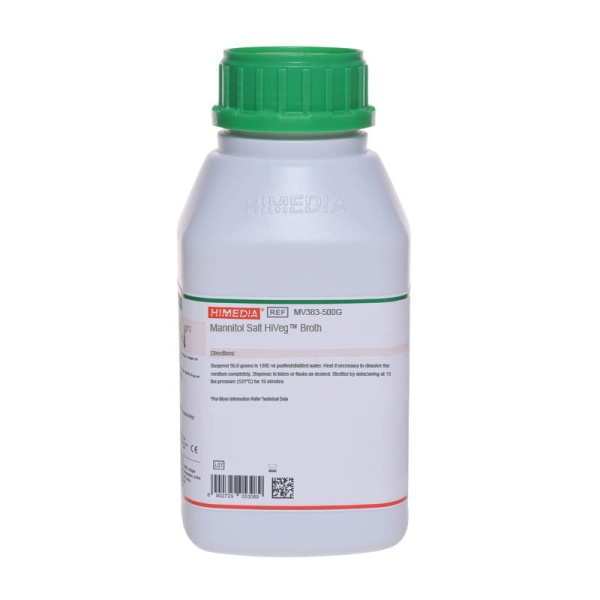
| Product Name | Mannitol Salt HiVeg® Broth |
|---|---|
| SKU | MV383 |
| Product Type | HiVeg™ |
| Physical Form | Powder |
| Origin | Animal Free (Veg) |
| Packaging type | HDPE |
| References | 1.American Public Health Association, Standard Methods for the Examination of Dairy Products, 1978, 14th Ed., Washington D.C. 2.Bacteriological Analytical Manual, 1995, Food and Drug Administration, 8th ed., AOAC, International, U.S.A. 3.Chapman G.H., 1945, J. Bact., 50:201. 4.Isenberg, H.D. Clinical Microbiology Procedures Handbook 2nd Edition. 5.Jorgensen, J.H., Pfaller, M.A., Carroll, K.C., Funke, G., Landry, M.L., Richter, S.S and Warnock., D.W.(2015) Manual of Clinical Microbiology, 11th Edition. Vol. 1. 6.MacFaddin J. F., 1985, Media for Isolation-Cultivation-Identification-Maintenance of Medical Bacteria, Vol. 1, Williams and Wilkins, Baltimore 7.Marshall R. (Ed.), 1992, Standard Methods for the Examination of Dairy Products, 16th ed., APHA, Washington, D.C 8.Salfinger Y., and Tortorello M.L., 2015, Compendium of Methods for the Microbiological Examination of Foods, 5thEd., American Public Health Association, Washington, D.C.9.Wehr H. M. and Frank J. H., 2004, Standard Methods for the Microbiological Examination of Dairy Products, 17th Ed.,APHA Inc., Washington, D.C |
| Customized Product Available | No |