HiMedia Laboratories GmbH, Marie-Curie-Str. 3, 64683, Einhausen, Germany.

 Your enquiry has been submitted
Something problem with the server. Try again.
 Your enquiry has been submitted
Recommended for cultural identification and differentiation of enteropathogenic Escherichia coli which do not ferment sorbitol.
| Ingredients | g/L |
|---|---|
| HiVeg® extract | 3.000 |
| HiVeg® peptone No. 3 | 15.000 |
| D-Sorbitol | 2.000 |
| Sodium chloride | 5.000 |
| Ferric ammonium citrate | 0.500 |
| Sodium thiosulphate | 0.500 |
| Phenol red | 0.030 |
| Agar | 20.000 |
| Final pH (at 25°C) | 7.6±0.2 |
**Formula adjusted, standardized to suit performance parameters
Suspend 46.03 grams in 1000 ml purified/distilled water. Heat to boiling to dissolve the medium completely. Dispense in test tubes and sterilize by autoclaving at 15 lbs pressure (121°C) for 15 minutes. Cool to 45-50°C. Allow the tubes to cool in a slanted position.
Escherichia coli is the most common bacterium isolated in clinical samples, the most prevalent facultative gram-negative rods in faeces, the most common cause of urinary tract infection and a common cause of both intestinal and extra-intestinal infections (1). Strains of E. coli that are primary intestinal pathogens of man are described in four groups namely Enterotoxigenic E.coli (ETEC), Enteroinvasive E. coli (EIEC), Verocytotoxin-producing E. coli (VTEC) and Enteropathogenic E. coli (EPEC) (2). EPEC causes infantile diarrhea (1).
Sorbitol Iron Agar is a differential tube medium described by Rappaport and Henig (1). It is a modification of Kligler Iron Agar where dextrose and lactose is substituted with D-sorbitol. The pathogenic strain of E. coli is identified on the basis of inability to ferment sorbitol and hydrogen sulfide production. Sorbitol Iron HiVeg® Agar is prepared by using vegetable peptones in place of animal based peptones which make the media free of BSE/TSE risks.
HiVeg® extract and HiVeg® peptone No. 3 in the medium provide carbon, nitrogen, vitamins and minerals required for the growth of organisms. D-Sorbitol is the fermentable carbohydrate source. Sodium chloride provides essential ions. The combination of ferric ammonium citrate and sodium thiosulphate enables the detection of hydrogen sulphide production, which is evidenced by a black colour formation. Phenol red is the pH indicator, detecting the fermentation of sorbitol and subsequent formation of acidic conditions.
Food samples
Colourless colonies from Sorbitol HiVeg® Agar (MV298) are inoculated into Sorbitol Iron Agar by stabbing the butts and streaking the slants. After 18-24 hours, freshly isolated pathogenic strains of E. coli show neither acid nor blackening of the medium. Proteus species may or may not blacken the medium, may produce acid in the butt; and on transfer to urease test medium, will give a positive urease test. Ordinary strains of E. coli produce acid and gas on Sorbitol Iron Agar, some pathogenic strains after laboratory cultivation may develop the capacity to ferment sorbitol and produce acid. Subsequently transfer of such cultures on Kligler Iron HiVeg® Agar (MV078) or Triple Sugar Iron HiVeg® Agar (MV021), Urease Test Medium will help in identification.
Read the label before opening the container. Wear protective gloves/protective clothing/eye protection/face protection. Follow good microbiological lab practices while handling specimens and culture. Standard precautions as per established guidelines should be followed while handling specimens. Safety guidelines may be referred in individual safety data sheets.
Performance of the medium is expected when used as per the direction on the label within the expiry period when stored at recommended temperature.
Appearance
Light yellow to pink homogeneous free flowing powder
Gelling
Firm, comparable with 2.0% agar gel.
Colour and Clarity of prepared medium
Red coloured clear to slightly opalescent gel forms in tubes as slants
Reaction
Reaction of 4.6% w/v aqueous solution at 25°C. pH: 7.6±0.2
pH
7.40-7.80
Cultural Response
Cultural characteristics observed after an incubation at 35-37°C for 18-24 hours.
| Organism | Inoculum (CFU) | Growth | Sorbitol | H2S |
|---|---|---|---|---|
Growth Promoting |
||||
| Escherichia coli ATCC 25922 (00013*) | 50-100 | luxuriant | positive reaction, yellowreaction colour with gas formation | negative |
| # Klebsiella aerogenes ATCC 13048 (00175*) | 50-100 | luxuriant | positive reaction, yellowreaction colour | negative |
| Enterococcus faecalis ATCC 29212 (00087*) | 50-100 | luxuriant | positive reaction, yellowreaction colour | negative |
| Klebsiella pneumoniae ATCC 13883 (00097*) | 50-100 | luxuriant | positive reaction, yellowreaction colour | negative |
| $Proteus hauseri ATCC 13315 | 50-100 | luxuriant | negative reaction | positive reaction, blackening of medium |
| Salmonella Typhimurium ATCC 14028 (00031*) | 50-100 | luxuriant | positive reaction, yellowreaction, colour | positive reaction, blackening of medium |
| Shigella flexneri ATCC 12022 (00126*) | 50-100 | luxuriant | negative reaction | negative reaction |
| Escherichia coli serotype O11 and O55 | 50-100 | luxuriant | negative reaction | negative reaction |
| Escherichia coli O157:H7 NCTC 12900 (00014*) | 50-100 | luxuriant | negative reaction | negative reaction |
Key: (*) Corresponding WDCM numbers. (#) Formerly known as Enterobacter aerogenes ($) Formerly known as Proteus vulgaris
Store between 10-30°C in a tightly closed container and the prepared medium at 20-30°C. Use before expiry date on the label. On opening, product should be properly stored dry, after tightly capping the bottle in order to prevent lump formation due to the hygroscopic nature of the product. Improper storage of the product may lead to lump formation. Store in dry ventilated area protected from extremes of temperature and sources of ignition. Seal the container tightly after use. Product performance is best if used within stated expiry period.
User must ensure safe disposal by autoclaving and/or incineration of used or unusable preparations of this product. Follow established laboratory procedures in disposing of infectious materials and material that comes into contact with sample must be decontaminated and disposed of in accordance with current laboratory techniques (3,4).
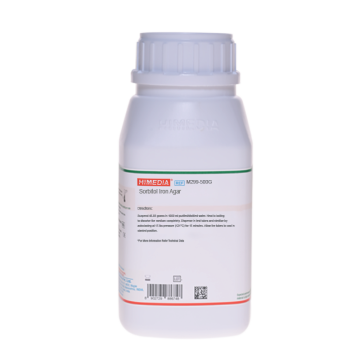
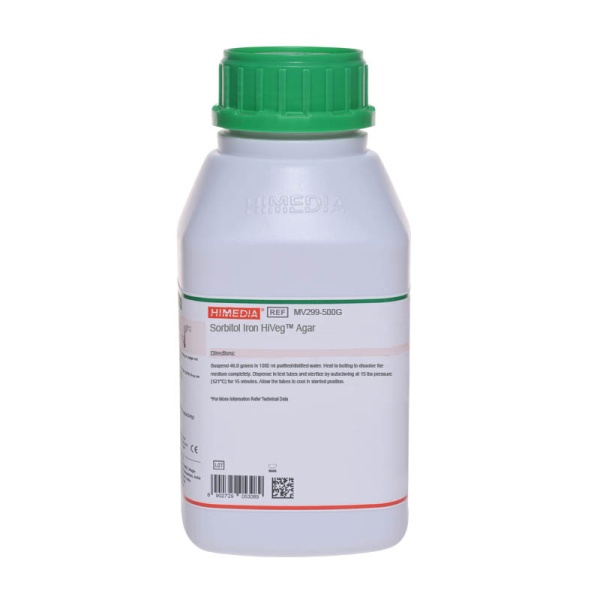
| Product Name | Sorbitol Iron HiVeg® Agar |
|---|---|
| SKU | MV299 |
| Product Type | HiVeg™ |
| Physical Form | Powder |
| Origin | Animal Free (Veg) |
| Packaging type | HDPE |
| References | 1. Rappaport F. and Henig E., 1952, J. Clin. Pathol., 5:361. 2.Collee J. G., Fraser A. G., Marmion B. P., Simmons A., (Eds.), Mackie and McCartney, Practical Medical Microbiology,1996, 14th Edition, Churchill Livingstone. |
| Customized Product Available | No |