HiMedia Laboratories GmbH, Marie-Curie-Str. 3, 64683, Einhausen, Germany.

 Your enquiry has been submitted
Something problem with the server. Try again.
 Your enquiry has been submitted
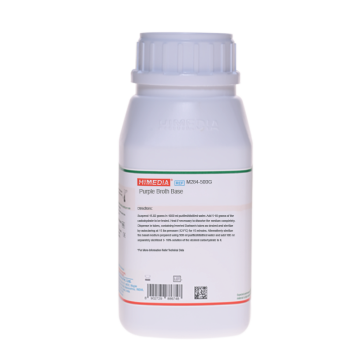
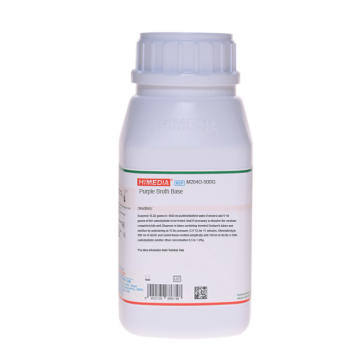
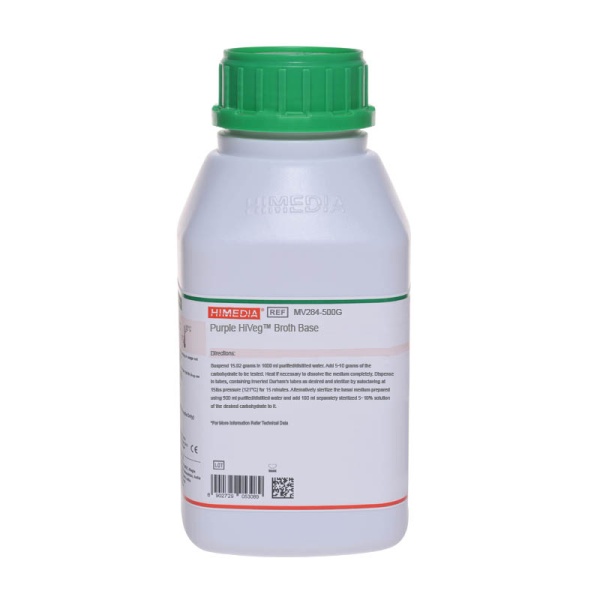
Purple HiVeg® Agar / Broth Base is recommended for the preparation of carbohydrate media used in fermentation studies for the cultural identification of pure cultures of enteric and other microorganisms.
| Ingredients | MV098 Grams/Litre | MV284 Grams/Litre |
|---|---|---|
| HiVeg® special peptone | 10.00 | 10.00 |
| HiVeg® extract | 1.00 | |
| Sodium chloride | 5.00 | 5.00 |
| Bromo cresol purple | 0.02 | 0.02 |
| Agar | 15.00 |
Final pH (at 25°C) 6.8± 0.2
** Formula adjusted, standardized to suit performance parameters.
Vegetable based (Code MV)
Animal based (Code M)
Recommended for: Fermentation studies for the cultural identification of pure cultures of enteric and other microorganisms.
Reconstitution:
Quantity on preparation (500g):
pH (25°C): 6.8± 0.2
Supplement: Carbohydrate
Sterilization: 121°C / 15 minutes.
Storage: Dry Medium - Below 30°C, Prepared Medium 2-8°C.
Suspend 31 grams of MV098 and 15 grams of MV284 in 1000 ml distilled water. Add 5 - 10 grams of the carbohydrate to be tested. Heat to boiling to dissolve the medium completely. Dispense in tubes as desired and sterilize by autoclaving at 15 lbs pressure (121°C) for 15 minutes. Alternatively sterilize the basal medium prepared using 900 ml distilled water and add 100 ml separately sterilized 5-10% solution of the desired carbohydrate to it.
These media are prepared by replacing Special peptone and Beef extract with HiVeg® special peptone and HiVeg® extract which are free from BSE/TSE risks. Purple HiVeg® Media are the modification of Purple Media which were originally formulated by Vera (1). HiVeg® extract and HiVeg® special peptone supply the essential nutrients especially nitrogenous to the growing organisms. Sodium chloride maintains the osmotic balance of the medium. Bromo cresol purple is the pH indicator which turns yellow at acidic pH. Gas production is evident by its collection in Durham's tube. The acid produced during the fermentation of carbohydrate causes bromo cresol purple, the pH indicator to turn yellow. Purple HiVeg® Broth is inoculated with 18 to 24 hours old pure culture and incubated for 24 to 72 hours (upto 30 days if necessary) at 35± 2°C either in an aerobic or anaerobic atmosphere depending on the organism being tested. It is recommended (3) to add carbohydrate in 1% concentration to avoid possible reversion reactions except glucose (dextrose). If the medium containing carbohydrate is sterilized by autoclaving, precautions should be taken to use minimum amount of heat required for sterilization to avoid hydrolysis of the carbohydrate.
Appearance of powder
Greenish yellow coloured, homogeneous, free flowing powder.
Gelling
Firm, comparable with 1.5% Agar gel of MV098
Colour and Clarity
Purple coloured, clear gel forms in petri plates, clear solution in tubes.
Reaction
Reaction of 3.1% w/v of MV098 or 1.5% w/v of MV284 aqueous solution is pH 6.8± 0.2 at 25°C
Cultural characteristics observed after incubation at 35 - 37°C for 18 - 48 hours.
| Organisms (ATCC) | Inoculum (CFU) | Growth | without carbohydrate | with 1% dextrose | ||
|---|---|---|---|---|---|---|
| Acid | Gas | Acid | Gas | |||
| Neisseria meningitidis (13090) | 102-103 | good-luxuriant | - | - | + | - |
| Escherichia coli (25922) | 102-103 | luxuriant | - | - | + | + |
| Staphylococcus aureus (25923) | 102-103 | luxuriant | - | - | + | + |
| Listeria monocytogenes* (19112) | 102-103 | luxuriant | - | - | + | - |
Key: Acid += yellow colour
* = fermentative metabolism
| Product Name | Purple HiVeg® Broth Base |
|---|---|
| SKU | MV284 |
| Product Type | HiVeg™ |
| Physical Form | Powder |
| Origin | Animal Free (Veg) |
| Packaging type | HDPE |
| References | 1. Koneman E. W., Allen S. D., Janda W. M., Schreckenberger P. C., Winn W. C. Jr., 1992, Colour Atlas and Textbook ofDiagnostic Microbiology, 4th Ed., J. B. Lippinccott Company 2.Ewing W. H., 1986, Edwards and Ewings identification of Enterobacteriaceae , 4th ed. Elsevier Science PublishingCo, Inc., New York, N.Y. 3.Forbes B. A., Sahm A. S., and Weissfeld D. F., 1998, Bailey & Scotts Diagnostic Microbiology, 10th Ed., Mosby, Inc.,St. Louis, Mo. 4.Vera H. D., 1950, Am. J. Public Health, 40:1267. 5.FDA Bacteriological Analytical Manual, 2005, 18th Ed., AOAC, Washington, DC. 6.International Organization for Standardization (ISO), 1995, Draft ISO/DIS 13720.MacFaddin J. F., 1985, Media forIsolation-Cultivation-Identification-Maintenance of Medical Bacteria, Vol. Wilkins, Baltimore and I Williams. |
| Customized Product Available | No |