HiMedia Laboratories GmbH, Marie-Curie-Str. 3, 64683, Einhausen, Germany.

 Your enquiry has been submitted
Something problem with the server. Try again.

**
| Ingredients | Grams/Litre | ||||||
|---|---|---|---|---|---|---|---|
| Base (MV054) | Dextrose (MV056) | Dulcitol (MV617) | Lactose (MV275) | Maltose (MV276) | Mannitol (MV570) | Sucrose (MV274) | |
| HiVeg® peptone No.3 | 10.00 | 10.00 | 10.00 | 10.00 | 10.00 | 10.00 | 10.00 |
| HiVeg® extract | 1.00 | 1.00 | 1.00 | 1.00 | 1.00 | 1.00 | 1.00 |
| Sodium chloride | 5.00 | 5.00 | 5.00 | 5.00 | 5.00 | 5.00 | 5.00 |
| Dextrose | 5.00 | ||||||
| Dulcitol | 5.0 | ||||||
| Lactose | 5.00 | ||||||
| Maltose | 5.00 | ||||||
| Phenol red | 0.018 | 0.018 | 0.018 | 0.018 | 0.018 | 0.018 | 0.018 |
| Mannitol | 5.00 | ||||||
| Sucrose | 5.0 | ||||||
Final pH (at 25°C) 7.4± 0.2
** Formula adjusted, standardized to suit performance parameters
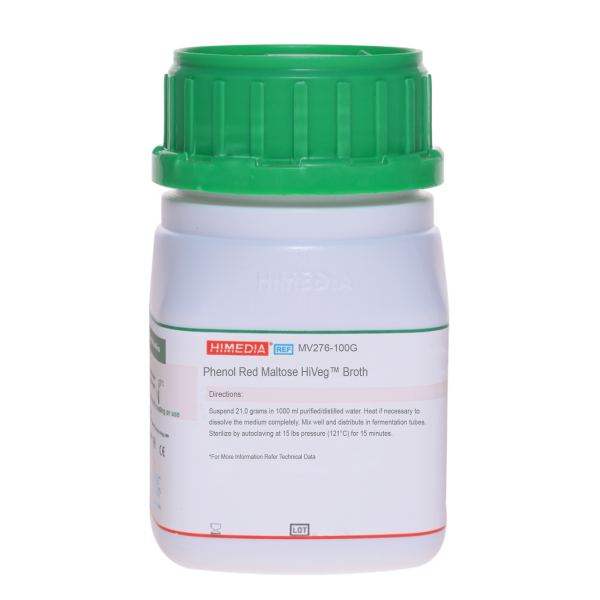
Suspend 16 grams of MV054 or 21 grams of other media in 1000 ml distilled water. Heat to dissolve the medium completely. Dispense in tubes containing inverted Durham's tubes and sterilize by autoclaving at 15 lbs pressure (121°C) for 15 minutes. Aseptically add filter sterilized or autoclave sterilized carbohydrate solution to sterile basal medium (MV054).
These media are prepared by using vegetable peptones in place of animal based peptones which make the media free of BSE/TSE risks. These media are the modification of Phenol Red Broth media which are recommended (1, 2, 3) for determination of fermentation reactions in differentiation of microorganisms. Ability of an organism to ferment specific carbohydrate added in a basal medium, results in the production of acid and gas which in turn helps in the differentiation between genera and species. Phenol Red HiVeg® Broth Base is a complete medium without added carbohydrate. It is used as a negative control for studying fermentations or as a base for the addition of carbohydrates. HiVeg® peptone No. 3 and HiVeg® extract provide nitrogenous nutrients to the organisms. Phenol red is the pH indicator which turns yellow at acidic pH. Sodium chloride maintains osmotic equilibrium. Gas formation is seen in Durham's tubes. No yellow colour should occur in the control tube. If it does the results cannot be correctly interpreted since acid has been produced without fermentation.
Light pink coloured, homogeneous, free flowing powder.
Red coloured, clear solution without any precipitate.
Reaction of aqueous solution of 1.6% w/v of MV054 or 2.1% w/v of other media is pH 7.4± 0.2 at 25°C.
* Cultural characteristics observed after an incubation at 35-37°C for 18-24 hrs. (§)
| Organisms (ATCC) | Growth | Base | Dextrose | Dulcitol | Lactose | Maltose | Mannitol | Sucrose | |||||||
|---|---|---|---|---|---|---|---|---|---|---|---|---|---|---|---|
| Acid | Gas | Acid | Gas | Acid | Gas | Acid | Gas | Acid | Gas | Acid | Gas | Acid | Gas | ||
| Citrobacter freundii (8090) | luxuriant | — | — | + | + | + | — | + | + | + | + | + | + | + | + |
| Enterobacter aerogenes (13048) | luxuriant | — | — | + | + | + | — | + | + | + | + | + | + | + | + |
| Escherichia coli (25922) | luxuriant | — | — | + | + | + | — | + | + | + | + | + | + | — | — |
| Klebsiella pneumoniae (13883) | luxuriant | — | — | + | + | + | — | + | + | + | + | + | + | + | + |
| Proteus vulgaris (13315) | luxuriant | — | — | + | + | — | — | — | — | — | — | + | — | — | — |
| S. serotype Typhimurium (14028) | luxuriant | — | — | + | + | — | — | — | — | + | — | + | + | — | — |
| S. serotype Typhi (6539) | luxuriant | — | — | + | + | — | — | — | — | — | — | + | + | — | — |
| Serratia marcescens (8100) | luxuriant | — | — | — | — | — | — | — | — | — | — | — | — | + | + |
| Shigella flexneri (12022) | luxuriant | — | — | + | + | — | — | — | — | — | — | + | + | — | — |
*for more details refer,
Store below 30°C, and the prepared medium at 2 - 8°C. Use before expiry date on the label.
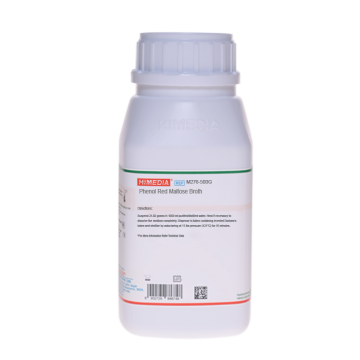
| Product Name | Phenol Red Maltose HiVeg® Broth |
|---|---|
| SKU | MV276 |
| Product Type | HiVeg™ |
| Physical Form | Powder |
| Origin | Animal Free (Veg) |
| Packaging type | HDPE |
| References | 1. Koneman E. W., Allen S. D., Janda W.M., Schreckenberger P.C., Winn W.C. Jr., 1992, Colour Atlas and Textbook ofDiagnostic Microbiology, 4th Ed., J. B. Lippinccott Company 2.Vera H. D., 1950, Am. J. Public Health, 40, 1267 3.MacFaddin J. F., 1985, Media for Isolation-Cultivation-Identification -Maintenanceof Medical Bacteria, Vol. I, Williamsand Wilkins, Baltimore. 4.Finegold S. M. and Baron E. J., 1986, Bailey and Scotts Diagnostic Microbiology, 7th Ed., The C.V. Mosby Co., St. Louis. 5.Ewing W. H., 1986, Edwards and Ewings Identification of Enterobacteriaceae, 4th ed.,Elsevier Science Publishing Co.,Inc., New York. 6.MacFaddin J. F., 2000, Biochemical tests for Identification of Medical Bacteria, 3rd edi., Lippincott, Williams and Wilkins,Baltimore. |
| Customized Product Available | No |