HiMedia Laboratories GmbH, Marie-Curie-Str. 3, 64683, Einhausen, Germany.


 Your enquiry has been submitted
Something problem with the server. Try again.
 Your enquiry has been submitted
| Vegetable based (Code MV) | Animal based (Code M) |
|---|---|
| MV1310 | M1310 |
| HiVeg® hydrolysate | Casein enzymic hydrolysate |
| Recommended for | Identification of Enterococci. from food and dairy products. |
|---|---|
| Reconstitution | 58.40 g/l |
| Quantity on preparation (500g): | 8.56 L |
| pH (25°C) | 7.0± 0.2 |
| Supplement | TTC Solution (FD057) |
| Sterilization | 121°C / 15 minutes. |
| Storage | Dry Medium - Below 30°C, Prepared Medium 2 - 8°C. |
| Ingredients | Grams/Litre |
|---|---|
| HiVeg® hydrolysate | 15.00 |
| Yeast extract | 5.00 |
| Potassium dihydrogen phosphate | 5.00 |
| Sodium citrate | 15.00 |
| Polysorbate 80 | 1.00 |
| Sodium carbonate | 2.00 |
| Sodium azide | 0.40 |
| Agar | 15.00 |
| Final pH (at 25°C) | 7.0± 0.2 |
** Formula adjusted, standardized to suit performance parameters.
Suspend 58.40 grams in 990 ml distilled water. Heat to boiling to dissolve the medium completely. Sterilize by autoclaving at 15 lbs pressure (121°C) for 15 minutes. Cool to 50°C and aseptically add contents of 1 vial of TTC Solution, 1% (FD057). Mix well and pour into sterile petri plates.
Warning : Sodium azide has a tendency to form explosive metal azides with plumbing materials. It is advisable to use enough water to flush off the disposables.
This medium is prepared by replacing Casein enzymic hydrolysate (animal based peptone) by HiVeg® hydrolysate (vegetables peptone) that makes the medium free of BSE/ TSE risks. CAE (Citrate Azide Enterococcus) HiVeg® Agar Base is the modification of the medium originally described by Burkwall and Hartmann (1) and modified by Reuter (2) for identification of Enterococci in meat, meat products, dairy products and other food stuff.
HiVeg® hydrolysate and yeast extract provides nitrogenous compounds. Sodium citrate and azide inhibits the accompanying microbial flora. Polysorbate 80 serves as the fatty acid source. Enterococci reduce the colourless 2, 3, 5-triphenyl tetrazolium chloride to form a red coloured complex, formazon thereby imparting red colour to the colonies, (3).
Appearance of powder
Light yellow coloured, may have slightly greenish tinge, homogeneous, free flowing powder.
Gelling
Firm, comparable with 1.5% Agar gel.
Colour and Clarity
Yellow coloured clear to slightly opalescent gel forms in petri plates.
Reaction
Reaction of 5.84% w/v aqueous solution is pH 7.0± 0.2 at 25°C.
Cultural Response
Cultural characteristics observed after an incubation at 35 - 37°C for 18-24 hours, with added TTC solution (FD057).
| Organisms (ATCC) | Inoculum (CFU) | Growth | Recovery | Colour of Colony |
|---|---|---|---|---|
| Enterococcus faecalis (29212) | 10²-10³ | luxuriant | >50% | red |
| Escherichia coli (25922) | 10²-10³ | inhibited | - | - |
| Staphylococcus aureus (25923) | 10²-10³ | inhibited | - | - |
| Streptococcus pyogenes (12344) | 10²-10³ | none-poor | <10% | - |
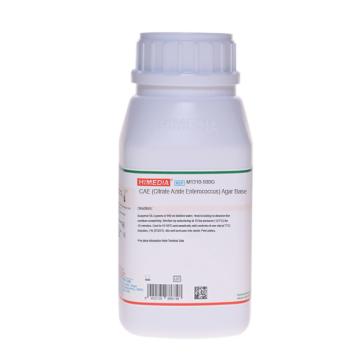
| Product Name | CAE (Citrate Azide Enterococcus) HiVeg® Agar Base |
|---|---|
| SKU | MV1310 |
| Product Type | HiVeg™ |
| Physical Form | Powder |
| Origin | Animal Free (Veg) |
| Packaging type | HDPE |
| References | 1. Burkwall M. K. and Hartman P. A., 1964, Appl. Microbiol., 12:18. |
| Customized Product Available | No |