HiMedia Laboratories GmbH, Marie-Curie-Str. 3, 64683, Einhausen, Germany.

 Your enquiry has been submitted
Something problem with the server. Try again.
 Your enquiry has been submitted
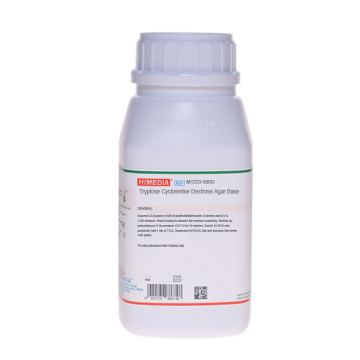
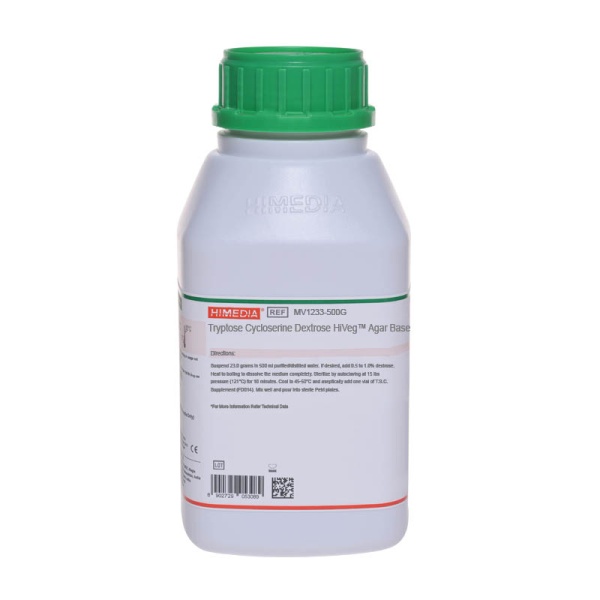
Tryptose Cycloserine Dextrose HiVeg® Agar Base is recommended for the isolation of mesophilic spore forming anaerobes in food spoilage.
| Ingredients | Grams/Litre |
|---|---|
| HiVeg® hydrolysate No. 1 | 15.0 |
| Papaic digest of soyabean meal | 5.0 |
| Yeast extract | 5.0 |
| Ferric ammonium citrate | 1.0 |
| Agar | 20.0 |
Final pH (at 25°C) 7.6± 0.2
** Formula adjusted, standardized to suit performance parameters.
Suspend 23.0 grams in 500 ml. distilled water. If desired, add 0.5 to 1.0% dextrose. Heat to boiling to dissolve the medium completely. Sterilize by autoclaving at 15 lbs pressure (121°C) for 10 minutes. Cool to 50°C and aseptically add one vial of T.S.C. Supplement (FD014). Mix well and pour into sterile petri plates.
This medium is prepared by using vegetable peptones which are free from BSE/TSE risks associated with animal based peptones. Tryptose Cycloserine Dextrose HiVeg® Agar Base is the modification of Tryptose Cycloserine Dextrose Agar Base which is used for isolation of mesophilic spore forming anaerobes in food spoilage (1). This medium is equally potent in performance as the original Tryptose Cycloserine Dextrose Agar Base which has been effectively used as selective media for the isolation and enumeration of mesophilic anaerobic spore formers from environmental samples collected from cannery plant surveys (2).
HiVeg® hydrolysate No.1, Papaic digest of soyabean meal, yeast extract provide nitrogenous compounds, carbon, vitamin B complex and trace elements essential for Clostridium growth. Incorporation of D-cycloserine in this medium effectievley inhibits growth of most Enterococci. Some anerobes reduce sulphite to hydrogen sulphide (H2S) which is indicated by blackening of the colonies due to presence of ferric ammonium citrate
| Vegetable based (Code MV) | Animal based (Code M) |
|---|---|
| MV1233 | M1233 |
| HiVeg® hydrolysate No. 1 | Tryptose |
Isolation of mesophilic spore forming anaerobes in food spoilage.
46.0 g/l
10.86 L
7.6± 0.2
T.S.C. Supplement (FD014), Dextrose, if desired.
121°C / 10 minutes.
Dry Medium - Below 30°C, Prepared Medium 2 - 8°C.
Appearance of powder
Yellow coloured, homogeneous, free flowing powder.
Gelling
Firm, comparable with 2.0% Agar gel.
Colour and Clarity
Light amber coloured, clear to slightly opalescent gel forms in petri plates.
Reaction
Reaction of 4.6% w/v aqueous solution is pH 7.6± 0.2 at 25°C
Cultural characterisitics observed after an incubation at 37°C for 18-48 hours.
| Organisms (ATCC) | Inoculum (CFU) | Growth | Recovery |
|---|---|---|---|
| Clostridium perfringens (12924) | 102-103 | luxuriant | >70% |
| Clostridium sporogenes (11437) | 102-103 | luxuriant | >70% |
| Product Name | Tryptose Cycloserine Dextrose HiVeg® Agar Base |
|---|---|
| SKU | MV1233 |
| Product Type | HiVeg™ |
| Physical Form | Powder |
| Origin | Animal Free (Veg) |
| Packaging type | HDPE |
| References | 1. Downes F. P. and Ito K., (Eds.), 2001, Compendium of Methods for the Microbiological Examination of Foods, 4th Ed.,APHA, Washington, D.C. |
| Customized Product Available | No |