HiMedia Laboratories GmbH, Marie-Curie-Str. 3, 64683, Einhausen, Germany.

 Your enquiry has been submitted
Something problem with the server. Try again.
 Your enquiry has been submitted
Phenol Red HiVeg® Agar Media are used for studying the fermentation of various carbohydrates in the differentiation of microorganisms.
| Ingredients | Phenol Red HiVeg® Agar Base (MV053) | Phenol Red Dextrose HiVeg® Agar (MV055) | Phenol Red Maltose HiVeg® Agar (MV271) | Phenol Red Lactose HiVeg® Agar (MV270) | Phenol Red Sucrose HiVeg® Agar (MV273) | Phenol Red Mannitol HiVeg® Agar (MV571) |
|---|---|---|---|---|---|---|
| HiVeg® peptone No. 3 | 10.00 | 10.00 | 10.00 | 10.00 | 10.00 | 10.00 |
| HiVeg® extract | 1.00 | 1.00 | 1.00 | 1.00 | 1.00 | 1.00 |
| Sodium chloride | 5.00 | 5.00 | 5.00 | 5.00 | 5.00 | 5.00 |
| Dextrose | - | 10.00 | - | - | - | - |
| Maltose | - | - | 10.00 | - | - | - |
| Lactose | - | - | - | 10.00 | - | - |
| Sucrose | - | - | - | - | 10.00 | - |
| Mannitol | - | - | - | - | - | 10.00 |
| Phenol red | 0.025 | 0.025 | 0.025 | 0.025 | 0.025 | 0.025 |
| Agar | 15.00 | 15.00 | 15.00 | 15.00 | 15.00 | 15.00 |
| Final pH (at 25°C) | 7.4± 0.2 | |||||
** Formula adjusted, standardized to suit performance parameters
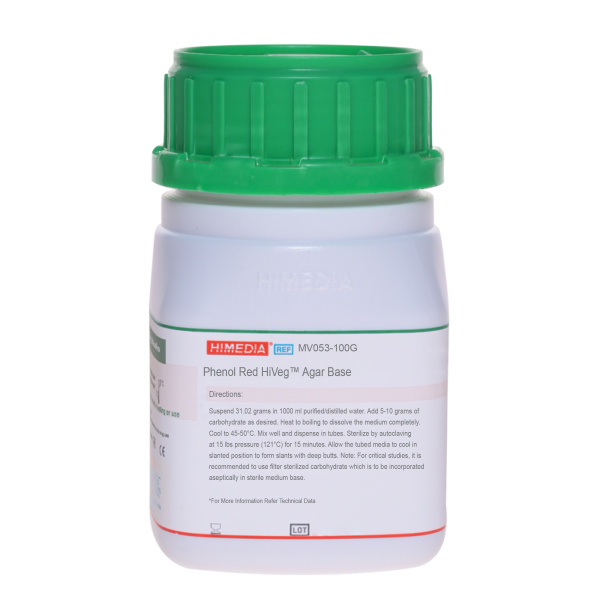
Suspend 31 grams of MV053 or 41 grams of other media in 1000 ml distilled water. Heat with frequent agitation to dissolve the medium completely. Sterilize by autoclaving at 15 lbs pressure (121°C) for 15 minutes. Add 0.5% of seperately sterilized desired carbohydrate to M053. Allow the tubed media to cool in slanted position to form slants with deep butts.
These media are prepared by using vegetable peptones in place of animal based peptones that makes the media free of BSE/ TSE risks. Phenol Red HiVeg® Agar media are the modification of Phenol Red Agar media which are recommended (1, 2, 3) for studying the fermentation of various carbohydrates individually by the pure cultures of microorganisms.
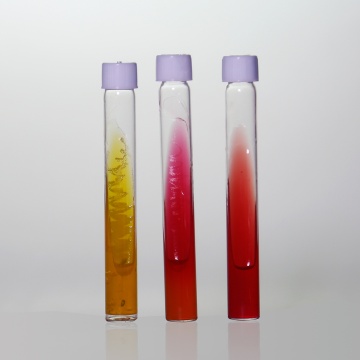
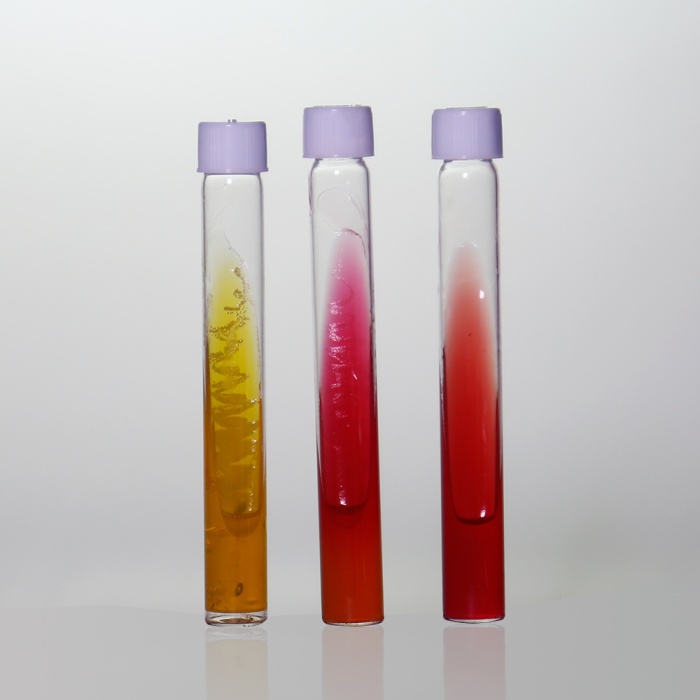
HiVeg® peptone No.3 which is free from fermentable carbohydrates is added in the medium thereby preventing the production of false positive reactions. Phenol Red HiVeg® Agar when supplemented with a specific carbohydrate, a positive carbohydrate fermentation reaction is indicated by the production of a yellow colour in agar due to the effect of acid production. Gas production is indicated by the splitting of agar or by the bubbles formation. Plates or tubes may be incubated aerobically or anaerobically depending on the type of the test organism. Addition of some carbohydrates may result in an acid reaction and hence 0.1N sodium hydroxide can be added dropwise to restore the original colour taking care not to obtain too deep red or cerise colour, would prevent fermentation occurring within the usual incubation period.
Appearance of Powder
Light pink coloured, homogeneous, free flowing powder.
Gelling
Firm, comparable with 1.5% Agar gel.
Colour and Clarity
Red coloured, slightly opalescent gel forms in tubes as slants.
Reaction
Reaction of aqueous solution of 3.1% w/v of MV053 or 4.1% w/v of other media is pH 7.4± 0.2 at 25°C.
Cultural characteristics observered after on incubation at 35-37° for 18-24 hrs.
| Organisms (ATCC) | Growth | MV053 Base | MV055 Dextrose | MV270 Lactose | MV271 Maltose | MV571 Mannitol | MV273 Sucrose | ||||||
|---|---|---|---|---|---|---|---|---|---|---|---|---|---|
| Acid | Gas | Acid | Gas | Acid | Gas | Acid | Gas | Acid | Gas | Acid | Gas | ||
| Alcaligenes faecalis (8750) | luxuriant | - | - | - | - | - | - | - | - | - | - | - | - |
| Escherichia coli (25922) | luxuriant | - | - | + | + | + | + | + | + | + | + | + | + |
| Klebsiella pneumoniae (13883) | luxuriant | - | - | + | + | + | + | + | + | + | + | + | + |
| Proteus vulgaris (13315) | luxuriant | - | - | + | + | - | - | + | + | + | + | - | - |
| S. serotype Typhimurium (14028) | luxuriant | - | - | + | + | - | - | + | - | + | - | - | - |
| Shigella flexneri (12022) | luxuriant | - | - | + | - | - | - | + | - | + | - | - | - |
Key : Acid Production
+ : Positive reaction, yellow colour
- : Negative reaction, red colour
Gas production
+ : gas production
- : No gas production
Store below 30°C and the prepared medium at 2 - 8°C. Use before expiry date on the label.
| Product Name | Phenol Red HiVeg® Agar Base |
|---|---|
| SKU | MV053 |
| Product Type | HiVeg™ |
| Physical Form | Powder |
| Origin | Animal Free (Veg) |
| Packaging type | HDPE |
| References | 1. MacFaddin J., 1985, Media for Isolation-Cultivation-Identification-Maintenance of Medical Bacteria, Vol. I, Williams andWilkins, Baltimore. 2.Finegold and Baron, 1986, Bailey and Scotts Diagnostic Microbiology, 7th ed., The C.V. Mosby Co., St. Louis. 3.Ewing, 1986, Edwards and Ewings Identification of Enterobacteriaceae, 4th ed., Elsevier Science Publishing Co., Inc., NewYork. |
| Customized Product Available | No |