HiMedia Laboratories GmbH, Marie-Curie-Str. 3, 64683, Einhausen, Germany.

 Your enquiry has been submitted
Something problem with the server. Try again.

Recommended for confirmation of the presumptive test for members of the coliform group from food and water samples.
| Ingredients | g/L |
|---|---|
| HiVeg®Â® peptone | 10.000 |
| Lactose | 10.000 |
| Dipotassium hydrogen phosphate | 3.500 |
| Sodium sulphite | 2.500 |
| Basic fuchsin | 0.500 |
| Agar | 15.000 |
| Final pH (at 25°C) | 7.5±0.2 |
Formula adjusted, standardized to suit performance parameters
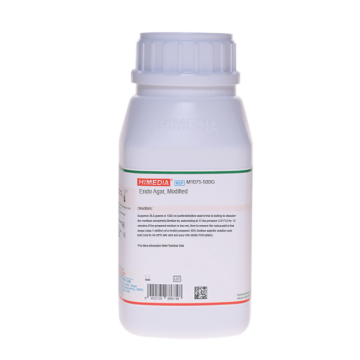
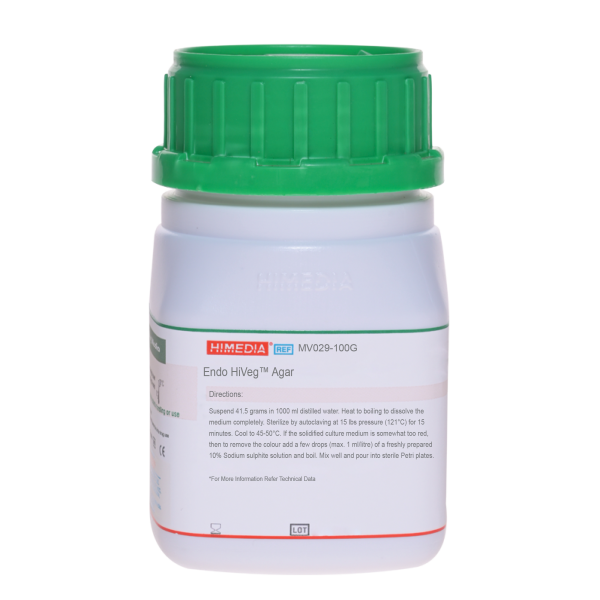
Suspend 41.5 grams in 1000 ml purified / distilled water. Heat to boiling to dissolve the medium completely. Sterilize by autoclaving at 15 lbs pressure (121°C) for 15 minutes. Cool to 45-50°C. If the solidified culture medium is somewhat too red, then to remove the colour add a few drops (max. 1 ml/litre) of a freshly prepared 10% Sodium sulphite solution and boil. Mix well and pour into sterile Petri plates.
Endo Agar was developed by Endo to differentiate gram-negative bacteria on the basis of lactose fermentation, while inhibiting gram-positive bacteria (1). Inhibition of the later was achieved without the use of bile salts as was traditionally used. Endo was successful in inhibiting gram-positive bacteria on his medium by the incorporation of sodium sulphite and basic fuchsin. The resulting Endo Agar, also known as Fuchsin Sulphite and Infusion Agar, was used to isolate the typhoid bacilli. Many modifications of this media have been done over the years. Endo Agar is recommended by APHA as an important medium in the microbiological examination of water and wastewater, dairy products and foods (2,3,4). Endo Agar is used to confirm the detection and enumeration of coliform bacteria following presumptive test of drinking water. It is also used for the detection and isolation of coliforms and faecal coliforms from milk, dairy products and food. Endo HiVeg®Â® Agar is same as Endo Agar except that the animal based peptones are completely replaced with vegetable peptones to avoid BSE/TSE risks associated with animal peptones.
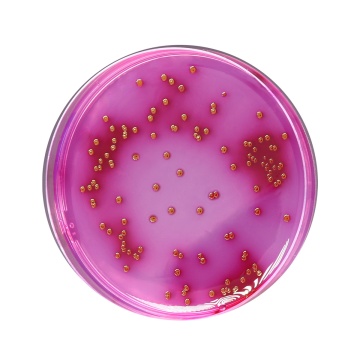
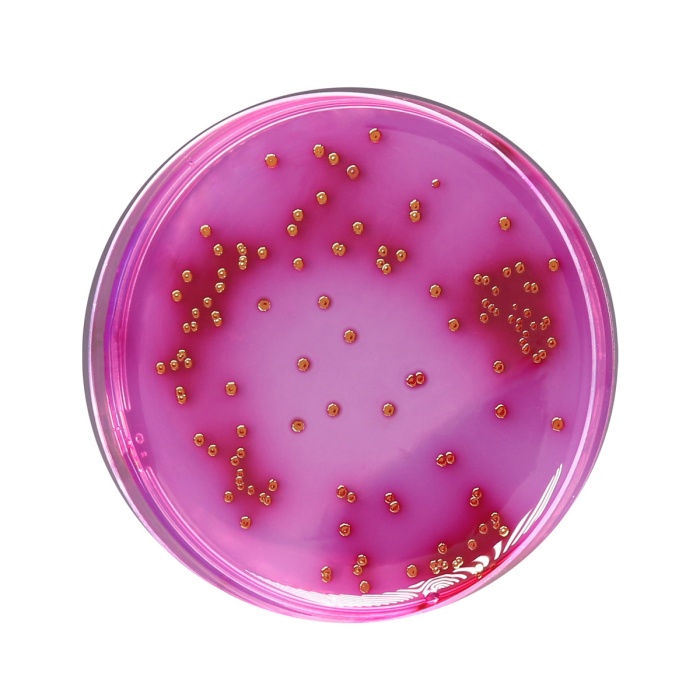
The medium contains HiVeg®Â® peptone which provide nitrogen, carbon, vitamins and minerals required for bacterial growth. Sodium sulphite and basic fuchsin make this medium selective by suppressing gram-positive organisms. Coliforms produce pink colonies on fermentation of lactose while lactose non-fermenters produce colourless colonies on the medium. With Escherichia coli, this reaction is very pronounced as the fuchsin crystallizes, exhibiting a permanent greenish metallic luster (fuchsin luster) to the colonies. Medium should be stored away from light to avoid photo-oxidation.
Food and dairy samples; Water samples
For food and dairy samples, follow appropriate techniques for sample collection and processing as per guidelines (3,4). For water samples, follow appropriate techniques for sample collection, processing as per guidelines and local standards.(2) After use, contaminated materials must be sterilized by autoclaving before discarding.
Read the label before opening the container. Wear protective gloves/protective clothing/eye protection/face protection. Follow good microbiological lab practices while handling specimens and culture. Standard precautions as per established guidelines should be followed while handling specimens. Safety guidelines may be referred in individual safety data sheets.
Performance of the medium is expected when used as per the direction on the label within the expiry period when stored at recommended temperature.
Appearance
Light pink to purple homogeneous free flowing powder
Gelling
Firm, comparable with 1.5% Agar gel
Colour and Clarity of prepared medium
Orangish pink coloured, clear to slightly opalescent gel with fine precipitate forms in Petri plates.
Reaction
Reaction of 4.15% w/v aqueous solution at 25°C. pH: 7.5±0.2
pH
7.30-7.70
Cultural Response
Cultural characteristics observed after an incubation at 35-37°C for 18-24 hours.
| Organism | Inoculum (CFU) | Growth | Recovery | Colour of Colony |
|---|---|---|---|---|
| **Bacillus spizizenni ATCC 6633 (00003*) | >=104 | inhibited | 0% | |
| # Klebsiella aerogenes ATCC 29212 (00087*) | 50-100 | good-luxuriant | >=50% | pink |
| Enterococcus faecalis ATCC 29212 (00087*) | 50-100 | none-poor | <=10% | pink, small |
| Escherichia coli ATCC 25922 (00013*) | 50-100 | good-luxuriant | >=50% | pink to rose red with metallic sheen |
| Klebsiella pneumoniae ATCC 13883 (00097*) | 50-100 | good-luxuriant | >=50% | pink, mucoid |
| ## Proteus hauseri ATCC 13315 | 50-100 | good-luxuriant | >=50% | colourless to pale pink |
| Pseudomonas aeruginosa ATCC 27853 (00025*) | 50-100 | good-luxuriant | >=50% | colourless, irregular |
| Salmonella Typhi ATCC 6539 | 50-100 | good-luxuriant | >=50% | colourless to pale pink |
| Staphylococcus aureus subsp. aureus ATCC 25923 (00034*) | >=104 | inhibited | 0% | |
| Enterobacter cloacae ATCC 13047 (00083*) | 50-100 | good | 40-50% | pink |
| Salmonella Typhimurium ATCC 14028 (00031*) | 50-100 | good-luxuriant | >=50% | colourless |
| Salmonella Enteritidis ATCC 13076 (00030*) | 50-100 | good-luxuriant | >=50% | colourless |
| Shigella flexneri ATCC 12022 (00126*) | 50-100 | good-luxuriant | >=50% | colourless |
Key: *Corresponding WDCM numbers.
#- Formerly known as Enterobacter aerogenes
** Formerly known as Bacillus subtilis subsp. spizizenii
## Formerly known as Proteus vulgaris
Store between 10-30°C in a tightly closed container and the prepared medium at 2-8°C. Use before expiry date on the label. On opening, product should be properly stored dry, after tightly capping the bottle inorder to prevent lump formation due to the hygroscopic nature of the product. Improper storage of the product may lead to lump formation. Store in dry ventilated area protected from extremes of temperature and sources of ignition Seal the container tightly after use. Product performance is best if used within stated expiry period.
User must ensure safe disposal by autoclaving and/or incineration of used or unusable preparations of this product. Follow established laboratory procedures in disposing of infectious materials and material that comes into contact with sample must be decontaminated and disposed of in accordance with current laboratory techniques (3,4).
| Product Name | Endo HiVeg® Agar |
|---|---|
| SKU | MV029 |
| Product Type | HiVeg™ |
| Physical Form | Powder |
| Origin | Animal Free (Veg), Lactose |
| Packaging type | HDPE |
| References | 1.. Endo S., 1904, Zentralbl. Bakteriol., Abt. 1, Orig.35:109-11 2.Baird R.B., Eaton A.D., and Rice E.W., (Eds.), 2015, Standard Methods for the Examination of Water andWastewater, 23rd ed., APHA, Washington, D.C. 3.Salfinger Y., and Tortorello M.L. Fifth (Ed.), 2015, Compendium of Methods for the Microbiological Examination ofFoods, 5th Ed., American Public Health Association, Washington, D.C. 4.Wehr H. M. and Frank J. H., 2004, Standard Methods for the Microbiological Examination of Dairy Products, 17th Ed.,APHA Inc., Washington, D.C. 5.Isenberg, H.D. Clinical Microbiology Procedures Handb0ook. 2nd Edition. 6.Jorgensen,J.H., Pfaller , M.A., Carroll, K.C., Funke, G., Landry, M.L., Richter, S.S and Warnock., D.W. (2015)Manual of Clinical Microbiology, 11th Edition. Vol. 1. |
| Customized Product Available | No |