 HiMedia Laboratories GmbH, Marie-Curie-Str. 3, 64683, Einhausen, Germany.

 Your enquiry has been submitted
Something problem with the server. Try again.

Recommended for the chromogenic differentiation of Serratia from food samples.
| Ingredients | g / L |
|---|---|
| Peptone, special | 15.000 |
| Chromogenic mixture | 8.250 |
| Selective mix | 1.320 |
| Agar | 15.000 |
Final pH (at 25°C): 7.2±0.2
**Formula adjusted, standardized to suit performance parameters
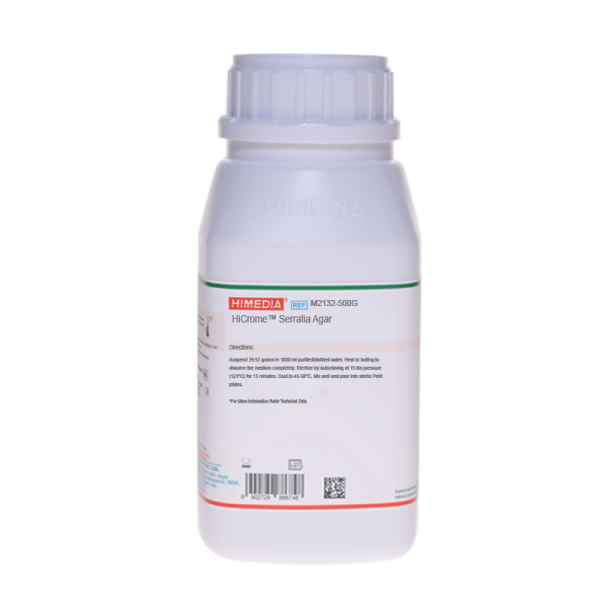
Suspend 39.57 gram in 1000 ml purified/distilled water. Heat to boiling to dissolve the medium completely. Sterilize by autoclaving at 15 lbs pressure (121°C) for 15 minutes. Cool to 45-50°C. Mix well and pour into sterile Petri plates.
Serratia are opportunistic gram-negative bacteria classified in the tribe Klebsiellae and the large family Enterobacteriaceae. Serratia marcescens strains are resistant to several antibiotics and are involved in nosocomial infections, particularly urinary tract infections and wound infections. Non pigmented strains are generally more resistant as they usually harbor resistance plasmids (1,2). It is the most common clinical isolate and the most important human pathogen. The conventional media like MacConkey Agar has very poor specificity and may result in false positives. The chromogenic media selectively differentiates Serratia spp giving bluish purple colour from other Enterobacteriaceae. Peptone special provides all the nitrogenous compounds and vitamins required for the growth of organisms. The chromogenic substrate is specifically cleaved by Serratia giving bluish purple coloured colonies. Selective mix inhibits other Enterobacteriaceae and other interfering bacterias.
Food samples
For food samples follow appropriate techniques for handling specimens as per established guidelines (3). After use, contaminated materials must be sterilized by autoclaving before discarding.
Read the label before opening the container. Wear protective gloves/protective clothing/eye protection/face protection. Follow good microbiological lab practices while handling specimens and culture. Standard precautions as per established guidelines should be followed while handling specimens. Safety guidelines may be referred in individual safety data sheets.
Performance of the medium is expected when used as per the direction on the label within the expiry period when stored at recommended temperature.
Appearance: Cream to yellow homogeneous free flowing powder
Gelling: Firm, comparable with 1.5% Agar gel
Colour and Clarity of prepared medium: Light amber coloured, clear to slightly opalescent gel forms in Petri plates
Reaction: Reaction of 3.95% w/v aqueous solution at 25°C. pH : 7.2±0.2
pH: 7.00-7.40
Cultural characteristics observed after an incubation at 35-37°C for 24 hours.
| Organism | Inoculum (CFU) | Growth | Recovery | Colour of Colony |
|---|---|---|---|---|
| Serratia marcescens ATCC 8100 | 50-100 | luxuriant | >=50% | bluish-pinkish purple |
| Escherichia coli ATCC 25922 (00013*) | 50-100 | none-poor | <=10% | colourless |
| Enterococcus faecalis ATCC 29212 (00087*) | 104 | inhibition | 0% | - |
| Klebsiella pneumoniae ATCC 13883 (00097*) | 50-100 | none-poor | <=10% | greenish blue |
| #Klebsiella aerogenes ATCC 13048 (00175*) | 50-100 | none-poor | <=10% | greenish blue |
| Staphylococcus aureus subsp. aureus ATCC 25923 (00034*) | 104 | inhibition | 0% | - |
Key : (*) Corresponding WDCM numbers, (#) Formerly known as Enterobacter aerogenes
Store between 15-25°C in a tightly closed container and the prepared medium at 2-8°C. Use before expiry date on the label. On opening, product should be properly stored dry, after tightly capping the bottle in order to prevent lump formation due to the hygroscopic nature of the product. Improper storage of the product may lead to lump formation. Store in dry ventilated area protected from extremes of temperature and sources of ignition Seal the container tightly after use. Product performance is best if used within stated expiry period.
User must ensure safe disposal by autoclaving and/or incineration of used or unusable preparations of this product. Follow established laboratory procedures in disposing of infectious materials and material that comes into contact with sample must be decontaminated and disposed of in accordance with current laboratory techniques (4,5).
| Product Name | HiCrome® Serratia Agar |
|---|---|
| SKU | M2132 |
| Customized Product Available | No |