HiMedia Laboratories GmbH, Marie-Curie-Str. 3, 64683, Einhausen, Germany.

 Your enquiry has been submitted
Something problem with the server. Try again.
 Your enquiry has been submitted
Recommended for detection of Mycoplasmas in Pharmaceutical products, vaccines, cell banks and virus cultures in accordance with EP/USP.
| Ingredients | g/L |
|---|---|
| BI Broth# | 17.790 |
| Yeast Extract | 19.800 |
| Deoxyribonucleic acid (DNA) | 0.019 |
| Phenol Red | 0.0237 |
| Agar | 15.000 |
| Final pH (at 25°C) | 7.8±0.2 |
**Formula adjusted, standardized to suit performance parameters
# Equivalent to Beef Heart Infusion Broth
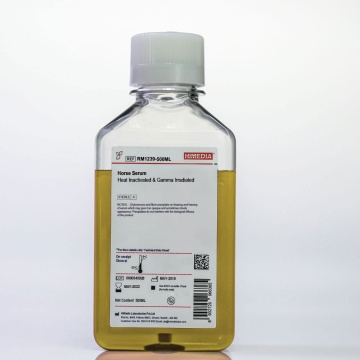
Suspend 26.32 gms of in 416 ml purified/distilled water. Heat to boiling to dissolve the medium completely. Sterilize by autoclaving at 15 lbs pressure (121°C) for 15 minutes or as per validated cycle. Cool to 45-50°C. Add 5 ml of the reconstituted contents of 1 vial of Hayflick Supplement (FD300). Aseptically add unheated 79 ml Horse serum (RM1239) to the prepared medium. Mix well and dispense in sterile Petri plates or as desired.
Mycoplasma, represents a group of minute bacteria devoid of cellwalls belonging to class Mollicutes (1). These are responsible for causing serious contamination in cell and or tissue cultures used to generate compendial articles. They may also cause contamination of filtered sterilized Soyabean Casein Digest Broth. Infection of cells in a culture can affect nearly every pathway of cell metabolism including alteration of the cells phenotypical characterization and normal growth. The presence of mycoplasma species does not always result in turbid growth in cultures or visible alteration of the cells. Hayflick et al have reported complex medias for growth of Mycoplasmas (2,3). Testing of mycoplasmas is necessary to assure reliably pure biotech products and allied materials used to generate these products. Hayflick Agar media (solid) is recommended for general detection of Mycoplasmas in Pharmacopoeias (4,5) for testing of products for Mycoplasma. When testing for Mycoplasmas, at least two known Mycoplasma species or strains as positive controls, one of which should be dextrose fermenter (i.e. M. pneumoniae or equivalent species and strain) and one of which should be an arginine hydrolyzer (i.e. M. orale or equivalent species and strain) should be included in each test. Only when testing insect cell lines should one include a Spiroplasma control strain (e.g., S.citri ATCC 29747, S. melliferum ATCC 29416, or equivalent species and strains.) Additionally these strains may be a little more fastidious in their nutritional requirements. They require lower incubation temperatures (as do insect cell lines).
This medium contains BI Broth containing HM infusion powder and peptone which provides nitrogen, vitamins, aminoacids and carbon sources. Sodium chloride maintains the osmotic balance. Many Mycoplasmas require serum for their good growth. Addition of Penicillin supress growth of unwanted flora. Phenol red in the medium indicates the growth of Mycoplasma on change of colour of medium from red to yellow or purple. Added Horse serum provides growth factors including lipid components to Mycoplasma. DNA provides additional nutrients to Mycoplasma.Yeast extract serves rich source of Nicotinamide-Adenine Dinucleotide (NAD) required by M.synoviae. Agar acts as a solidifying agent. Mycoplasma species are either aerobic or facultative anaerobic but some are microaerophilic. Few are anaerobic saprophytic Mycoplasma which grow best at 22-35°C while pathogenic strains grow at 35°C. Tubes should be incubated in an atmosphere containing 5-10% carbon dioxide and examined after incubation of 48 hours but they should not be discarded as negative until after incubation for three weeks. M. synoviae is not able to grow on Hayflick broth medium because growth depends on NAD. M. hyorhinis ATCC 29052 which is recommended as a fastidious strain for use in indicator cell method, is not able to grow on this medium.
Pharmaceutical samples
For detection of Mycoplasma, it is recommended to intermittently subculture growth obtained in liquid Hayflick Broth media (ME1885) onto solid Hayflick Agar media (ME1886).A 10 ml of the product to be tested is inoculated in 100 ml of Hayflick Broth (ME1885). Subcultures are incubated for 7 days and microaerophilic conditions at 35-37°C. On days 2-4, 6-8, 13-15 and 19-21 after inoculation the liquid media, Hayflick Broth (ME1885) are subcultured on atleast one plate of each type of Hayflick Agar (ME1886) and incubated for 7 days under microaerophilic conditions at 35-37°C. In addition 0.2 ml of the product to be tested are inoculated directly onto each of the Hayflick Agar (ME1886) and incubated for not less than 14 days under microaerophilic conditions (5-10% CO2) and sufficient humidity at 35-37°C. Positive and negative controls have to be performed. According to the recommendations of EP the solid media are viewed for typical Mycoplasma colonies.
Read the label before opening the container. Wear protective gloves/protective clothing/eye protection/face protection. Follow good microbiological lab practices while handling specimens and culture. Standard precautions as per established guidelines should be followed while handling specimens. Safety guidelines may be referred in individual safety data sheets.
Performance of the medium is expected when used as per the direction on the label within the expiry period when stored at recommended temperature.
Appearance
Light yellow to pink coloured homogeneous free flowing powder
Gelling
Firm, comparable with 1.5% Agar gel
Colour and Clarity of prepared medium
Orange-pink coloured clear to slightly opalescent gel forms with added supplement (FD300) and Horse serum (RM1239) in Petri plates.
Reaction
Reaction of 5.26% w/v aqueous solution at 25°C. pH: 7.8±0.2
pH
7.60-8.00
Cultural characteristics observed with added sterile supplement (FD300) and Horse serum (RM1239)in presence of 10% carbon dioxide (CO2) after an incubation at 35-37°C for >=14 days.
| Organism | Inoculum (CFU) | Growth | Recovery |
|---|---|---|---|
| Mycoplasma gallisepticum ATCC 19610 | 50-100 | good-luxuriant | >=50% |
| Mycoplasma orale ATCC 23714 | 50-100 | good-luxuriant | >=50% |
| Mycoplasma pneumoniae ATCC 15531 | 50-100 | good-luxuriant | >=50% |
Store between 10-30°C in a tightly closed container and the prepared medium at 2-8°C. Use before expiry date on the label. On opening, product should be properly stored dry, after tightly capping the bottle in order to prevent lump formation due to the hygroscopic nature of the product. Improper storage of the product may lead to lump formation. Store in dry ventilated area protected from extremes of temperature and sources of ignition. Seal the container tightly after use. Product performance is best if used within stated expiry period.
User must ensure safe disposal by autoclaving and/or incineration of used or unusable preparations of this product. Follow established laboratory procedures in disposing of infectious materials and material that comes into contact with sample must be decontaminated and disposed of in accordance with current laboratory techniques (6,7).
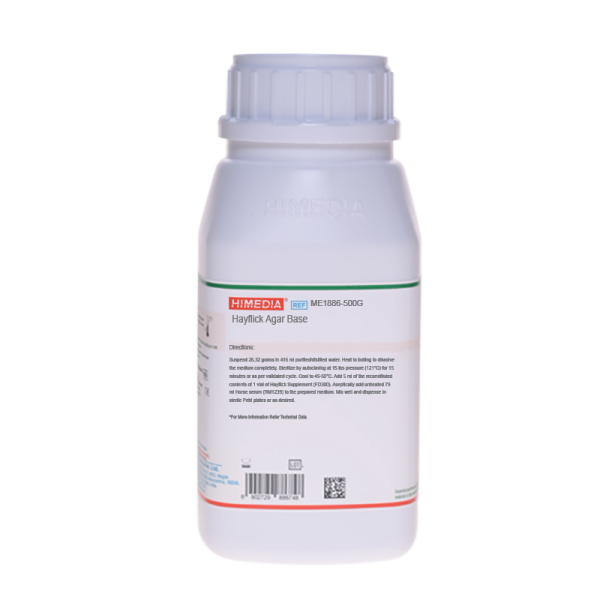
| Product Name | Hayflick Agar Base |
|---|---|
| SKU | ME1886 |
| Product Type | Regular |
| Physical Form | Powder |
| Origin | Animal |
| Packaging type | HDPE |
| References | To be added |
| Customized Product Available | No |