HiMedia Laboratories GmbH, Marie-Curie-Str. 3, 64683, Einhausen, Germany.

 Your enquiry has been submitted
Something problem with the server. Try again.
 Your enquiry has been submitted
Recommended for selective and differential isolation of Aeromonas hydrophila from environmental specimens.
| Ingredients | Gms / Litre |
|---|---|
| HiCynth™ Peptone No.1* | 6.000 |
| HiCynth™ Peptone No.6* | 3.000 |
| L-Lysine hydrochloride | 3.500 |
| L-Arginine hydrochloride | 2.000 |
| Inositol | 2.500 |
| Lactose | 1.500 |
| Sorbose | 3.000 |
| Xylose | 3.750 |
| Synthetic detergent | 2.000 |
| Sodium thiosulphate | 10.670 |
| Sodium chloride | 5.000 |
| Ferric ammonium citrate | 0.800 |
| Bromo thymol blue | 0.040 |
| Thymol blue | 0.040 |
| Agar | 12.500 |
| Final pH (at 25°C) | 8.0±0.2 |
**Formula adjusted, standardized to suit performance parameters
*Chemically defined peptones
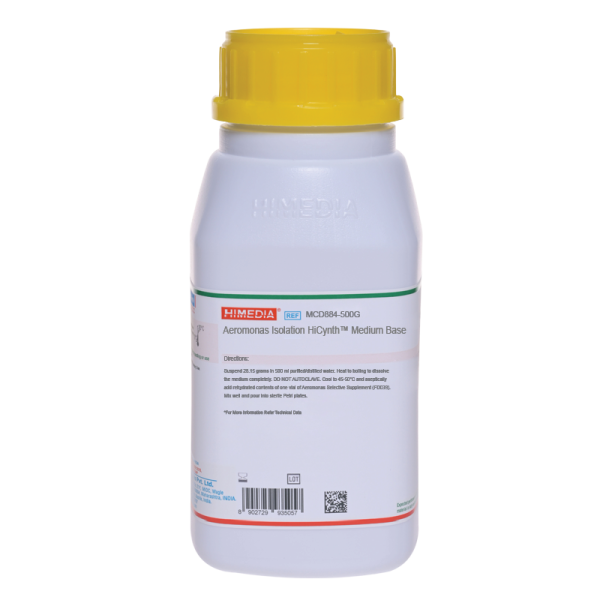
Suspend 28.15 grams in 500 ml purified/distilled water. Heat to boiling to dissolve the medium completely. DO NOT AUTOCLAVE. Cool to 45-50°C and aseptically add rehydrated contents of one vial of Amp Selective Supplement (FD039. Mix well and pour into sterile Petri plates.
Aeromonas species occur widely in soil and water where these species cause disease in fish and amphibians. Also found in untreated and chlorinated drinking water, raw food and raw milk (1,2). It is observed that the major cause of gastrointestinal infections by Aeromonas species (1,3) is because of ingesting infected water (4,5). This medium therefore, may be considered as a useful diagnostic aid for investigating diarrhoeal disease (6,7). Aeromonas medium was found to be superior over some other formulae for detection of Aeromonas species in tap water, bottled water and foods including meat, poultry, fish and seafood (8,9,10). Aeromonas Isolation Medium is based on the formulation of Ryan (11). It is a modification of XLD Medium, which supports the growth of Aeromonas, Plesiomonas, Proteus, as well as Enterobacteriaceae so the medium is used as universal medium in the investigation of enteric disease. The selectivity of the medium is increased by the addition of Amp Selective Supplement (FD039). The effectiveness of Ampicillin as a selective agent has been reported by several workers (6,12,3,14). It was noted that the recovery of Aeromonas species was very low from fresh foods of animal origin when cultivated on media. Also difficulties were encountered in distinguishing the Aeromonas hydrophila group from the background microflora. Polumbo et.al formulated Starch Ampicillin (SA) Agar with starch hydrolysis as the differential trait and ampicillin to suppress the background microflora (15).
HiCynth™ Peptone No.1 and HiCynth™ Peptone No.6 provide essential nitrogenous and carbonaceous compounds, long chain amino acids, vitamins and other essential growth nutrients. The salts provide the essential minerals and electrolytes. Sodium chloride maintains osmotic equilibrium. Lactose, sorbose, inositol and xylose are sources of carbon and energy. Bile salts and sodium thioglycollate makes the medium selective. Bromothymol blue and thymol blue acts as indicators giving the characteristic colony colour.
Food samples, Water samples and Environmental specimens.
For food, follow appropriate techniques for sample collection and processing as per guidelines (16).
For water samples, follow appropriate techniques for sample collection, processing as per guidelines and local standards (17). After use, contaminated materials must be sterilized by autoclaving before discarding.
Read the label before opening the container. Wear protective gloves/protective clothing/eye protection/face protection. Follow good microbiological lab practices while handling specimens and culture. Standard precautions as per established guidelines should be followed while handling specimens. Safety guidelines may be referred in individual safety data sheets.
Performance of the medium is expected when used as per the direction on the label within the expiry period when stored at recommended temperature.
Appearance
Light yellow to light tan homogeneous free flowing powder
Gelling
Firm, comparable with 1.25% Agar gel.
Colour and Clarity of prepared medium
Dark green coloured clear to slightly opalescent gel forms in Petri plates.
Reaction
Reaction of 5.63% w/v aqueous solution at 25°C. pH: 8.0±0.2
pH
7.80-8.20
Cultural characteristics observed with added Amp Selective Supplement (FD039) after an incubation at 35-37°C for 18-24 hours.
| Organism | Inoculum (CFU) | Growth | Recovery | Colony characteristics |
|---|---|---|---|---|
| Aeromonas hydrophila ATCC 7966 (00063*) | 50-100 | luxuriant | >=50% | dark green, opaque with dark centre |
| Escherichia coli ATCC 25922 (00013*) | >=104 | inhibited | 0% | |
| Pseudomonas aeruginosa ATCC 27853 (00025*) | 50-100 | good-luxuriant | >=50% | blue/grey, transluscent pinpoint |
| Salmonella Typhi ATCC 6539 | >=104 | inhibited | 0% | |
| Shigella flexneri ATCC 12022 (00126*) | >=104 | inhibited | 0% |
Key: (*) Corresponding WDCM numbers.
Store between 10-30°C in a tightly closed container and the prepared medium at 2-8°C. Use before expiry date on the label. On opening, product should be properly stored dry, after tightly capping the bottle in order to prevent lump formation due to the hygroscopic nature of the product. Improper storage of the product may lead to lump formation. Store in dry ventilated area protected from extremes of temperature and sources of ignition. Seal the container tightly after use. Product performance is best if used within stated expiry period.
User must ensure safe disposal by autoclaving and/or incineration of used or unusable preparations of this product. Follow established laboratory procedures in disposing of infectious materials and material that comes into contact with sample must be decontaminated and disposed of in accordance with current laboratory technique (18,19)
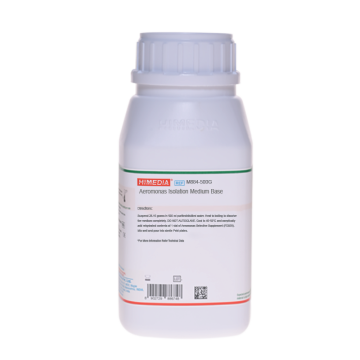
| Product Name | Aeromonas Isolation HiCynth™ Medium Base |
|---|---|
| SKU | MCD884 |
| Product Type | HiCynth™ |
| Physical Form | Powder |
| Origin | Chemically defined (HiCynth™) |
| Packaging type | HDPE |
| References | 1. Ryan N., 1985, Personal Communication. |
| Customized Product Available | No |