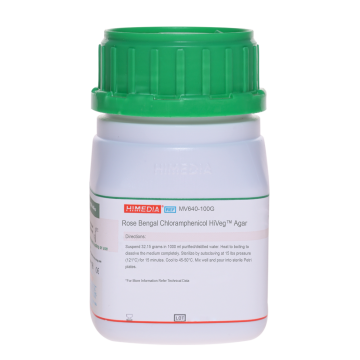
HiMedia Laboratories GmbH, Marie-Curie-Str. 3, 64683, Einhausen, Germany.

 Your enquiry has been submitted
Something problem with the server. Try again.
 Your enquiry has been submitted
Recommended for selective isolation and enumeration of yeasts and moulds from foods, environmental materials and clinical samples.
| Ingredients | Gms / Litre |
|---|---|
| HiCynth™ Peptone No.4* | 5.000 |
| Dextrose (Glucose) | 10.000 |
| Potassium dihydrogen phosphate | 1.000 |
| Magnesium sulphate | 0.500 |
| Rose bengal | 0.050 |
| Chloramphenicol | 0.100 |
| Agar | 15.500 |
| Final pH (at 25°C) | 7.2±0.2 |
**Formula adjusted, standardized to suit performance parameters
*Chemically defined peptone
Suspend 32.15 grams in 1000 ml purified / distilled water. Heat to boiling to dissolve the medium completely. Sterilize by autoclaving at 15 lbs pressure (121°C) for 15 minutes. Cool to 45-50°C. Mix well and pour into sterile Petri plates.
Rose Bengal Chloramphenicol Agar was formulated originally by Jarvis (3) and further modified by Overcast and Weakley (8). The use of rose bengal in the media having neutral pH was reported by Smith and Dawson (8). Rose Bengal Chloramphenicol HiCynth™ Agar is prepared by replacing animal and vegetable peptones with chemically defined peptones to avoid BSE/TSE risks associated with animal peptones. HiCynth™ Peptone No.4 provides carbon, nitrogen substances, long chain amino acids, vitamins and other essential growth nutrients. Dextrose (Glucose) is the fermentable carbohydrate. Chloramphenicol has inhibitory action on gram-negative bacteria. Rose bengal dye suppresses the development of bacteria and reduces the spreading of moulds, controls the size and height of moulds colonies such as Rhizopus species (7). The medium has neutral pH, which with the antibiotics has noted to be advantageous (5, 6). Rose bengal is taken up by moulds and yeast colonies thereby assist in enumeration (10).
The number of yeasts or moulds is calculated per 1 gram or 1 ml of sample to be tested by multiplying the number of colonies by dilution factor. Colonies of bacteria and yeasts could be confused by appearance and thus should be examined microscopically. Due to the selective properties of this medium and the type of specimen being cultured, some strains of fungi may grow poorly or fail to grow on the complete medium; similarly, some strains of bacteria may also not inhibited or only partially inhibited. Care should be taken not to expose this medium to light, since photo degradation of rose bengal yields compounds that are toxic to fungi (1, 9).
Food samples; Environmental samples, Clinical samples -skin scrapings
For clinical samples follow appropriate techniques for handling specimens as per established guidelines (2,4).
For food samples, follow appropriate techniques for sample collection and processing as per guidelines (10).
After use, contaminated materials must be sterilized by autoclaving before discarding.
In Vitro diagnostic use. Read the label before opening the container. Wear protective gloves/protective clothing/eye protection/ face protection. Follow good microbiological lab practices while handling specimens and culture. Standard precautions as per established guidelines should be followed while handling clinical specimens. Safety guidelines may be referred in individual safety data sheets
Performance of the medium is expected when used as per the direction on the label within the expiry period when stored at recommended temperature.
Appearance
Light yellow to pink homogeneous free flowing powder
Gelling
Firm, comparable with 1.55% Agar gel.
Colour and Clarity of prepared medium
Deep pink coloured clear to slightly opalescent gel forms in Petri plates.
Reaction
Reaction of 3.22% w/v aqueous solution at 25°C. pH: 7.2±0.2
pH
7.00-7.40
Cultural characteristics observed after an incubation at 25-30°C for 5 days.
| Organism | Inoculum (CFU) | Growth |
|---|---|---|
| #Aspergillus brasiliensis ATCC 16404 (00053*) | 50-100 | good-luxuriant |
| Bacillus subtilis subsp. spizizenii ATCC 6633 (00003*) | >=104 | inhibited |
| Cladosporium cladosporioides ATCC 11278 | 50-100 | good-luxuriant |
| Escherichia coli ATCC 25922 (00013*) | >=104 | inhibited |
| Enterococcus faecalis ATCC 29212 (00087*) | >=104 | inhibited |
| Mucor racemosus ATCC 42647 | 50-100 | good-luxuriant |
| Pencillium notatum ATCC 10108 | 50-100 | good-luxuriant |
| Saccharomyces cerevisiae ATCC 9763 | 50-100 | good-luxuriant |
Key: # Formerly known as Aspergillus niger
* Corresponding WDCM numbers
Store the dehydrated and prepared media between 15-25°C in a tightly closed container. Use before expiry date on the label.
On opening, product should be properly stored dry, after tightly capping the bottle in order to prevent lump formation due to the hygroscopic nature of the product. Improper storage of the product may lead to lump formation. Store in dry ventilated area protected from extremes of temperature and sources of ignition Seal the container tightly after use.
Product performance is best if used within stated expiry period.
User must ensure safe disposal by autoclaving and/or incineration of used or unusable preparations of this product. Follow established laboratory procedures in disposing of infectious materials and material that comes into contact with clinical sample must be decontaminated and disposed of in accordance with current laboratory techniques (2, 4).
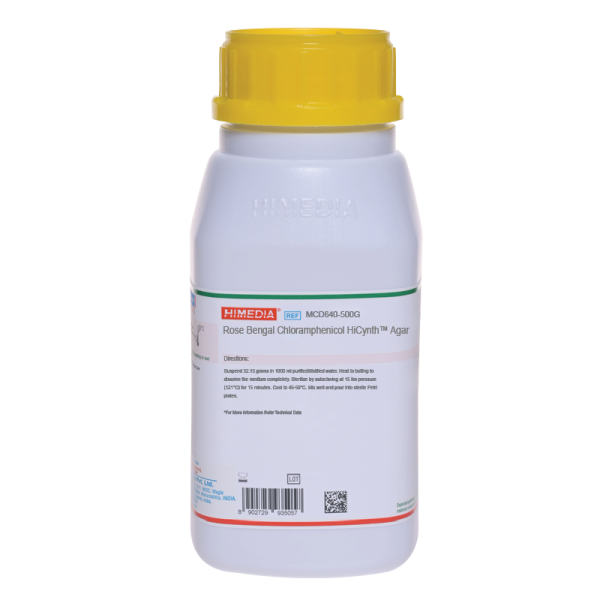
| Product Name | Rose Bengal Chloramphenicol HiCynth™ Agar |
|---|---|
| SKU | MCD640 |
| Product Type | HiCynth™ |
| Physical Form | Powder |
| Origin | Chemically defined (HiCynth™) |
| Packaging type | HDPE |
| References | 1.Jarvis B., 1973, J. Appl. Bacteriol., 36:723. 2.Overcast W.W. and Weakley D.J., 1969, J. Milk Food Technol., 32:442. 3.Smith and Dawson V. T., 1944, Soil Sci., 58:467. 4.Ottow J.C.G. and Glathe H., 1968, Appl. Microbiol., 16(1):170. 5.Koburger J.A., 1968, Bact. Proc., 13:A73. 6.MacFaddin J.F., 1985, Media for Isolation-Cultivation-Identification-Maintenance of Medical Bacteria, Vol. I, Williams andWilkins, Baltimore. 7.Salfinger Y., and Tortorello M.L. Fifth (Ed.), 2015, Compendium of Methods for the Microbiological Examination ofFoods, 5th Ed., American Public Health Association, Washington, D.C. 8.Banks J. G., 9.Isenberg, H.D. Clinical Microbiology Procedures Handbook. 2nd Edition..10Jorgensen,J.H., Pfaller , M.A., Carroll, K.C., Funke, G., Landry, M.L., Richter, S.S and Warnock., D.W. (2015)Manual of Clinical Microbiology, 11th Edition. Vol. 1. |
| Customized Product Available | No |