HiMedia Laboratories GmbH, Marie-Curie-Str. 3, 64683, Einhausen, Germany.

 Your enquiry has been submitted
Something problem with the server. Try again.
 Your enquiry has been submitted
Recommended as a selective medium used for isolation of Burkholderia cepacia from the respiratory secretions of patients with cystic fibrosis and other non-clinical specimens
| Ingredients | g/L |
|---|---|
| HiCynth™ peptone No.1# | 5.000 |
| HiCynth™ peptone No.5# | 4.000 |
| Sodium pyruvate | 7.000 |
| Potassium dihydrogen phosphate | 4.400 |
| Disodium hydrogen phosphate | 1.400 |
| Synthetic detergent 1 | 1.500 |
| Ammonium sulphate | 1.000 |
| Magnesium sulphate | 0.200 |
| Ammonium ferrous sulphate | 0.010 |
| Phenol red | 0.020 |
| Crystal violet | 0.001 |
| Agar | 12.000 |
| Final pH (at 25°C) | 6.2±0.2 |
**Formula adjusted, standardized to suit performance parameters
# - Chemically defined peptones
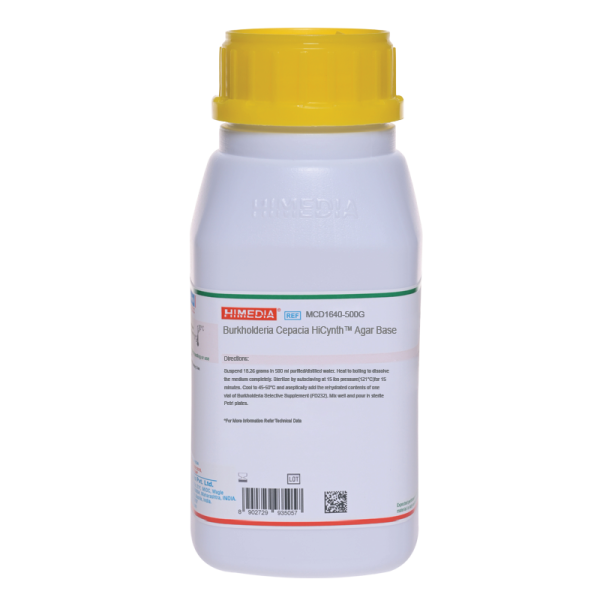
Suspend 18.26 gram in 500 ml purified / distilled water. Heat to boiling to dissolve the medium completely. Sterilize by autoclaving at 15 lbs pressure (121°C) for 15 minutes. Cool to 45-50°C and aseptically add the rehydrated contents of 1 vial of PGT Selective Supplement (FD232). Mix well and pour in sterile Petri plates.
Burkholderia cepacia is an important opportunistic pathogen and causes pulmonary infection among individuals with cystic fibrosis (CF). The organism may lead to Burkholderia cepacia syndrome, a neutralizing pneumonia associated with fever that culminates in to a rapid and fatal clinical deterioration (1). B.cepacia is difficult to isolate on routinely used laboratory media like MacConkey Agar, since B.cepacia is a slow grower and therefore it is usually outgrown by the faster growing Escherichia coli, Staphylococcus aureus and Pseudomonas aeruginosa.
Burkholderia Cepacia Agar is based on PC medium, which was originally devised by Gilligan (2). This medium was found to be superior to MacConkey Agar for growth of B.cepacia. Burkholderia Cepacia HiCynth™ Agar Base is similar to Burkholderia Cepacia Agar Base wherein the animal based peptones are completely replaced with chemically defined peptones to avoid BSE / TSE risks associated with animal peptones. The medium is made selective for B.cepacia by the incorporation of synthetic detergent No.1, crystal violet and antibiotics in supplement (FD232) provides additional selectivity.
HiCynth™ peptone No. 1 and HiCynth™ peptone No.5 in the medium provides the nitrogenous and carbonaceous compounds, long chain amino acids, vitamin B source and other essential nutrients. Crystal violet, synthetic detergent No. 1 and antimicrobial agents are used as selective agents. Crystal violet and ynthetic detergent No. 1 inhibits gram-positive cocci including Enterococci and Staphylococci. The antibiotics (FD) namely ticarcillin, polymyxin B and gentamycin inhibit gram-negative bacteria. B.cepacia metabolizes pyruvate forming alkaline end products. These end products elevate the pH of the medium. The phenol red indicator changes colour from pink orange to pink red in alkaline pH.
Inoculate the plate with the specimen so as to obtain isolated colonies. The plates should be incubated for a period of 4 days to allow B.cepacia to grow and form colonies and subsequent colour change (3,4). The medium is not selective only for B.cepacia. Other organisms forming similar colonies may also grow on this medium. Therefore results obtained on this media should not be the sole criteria for identification of B.cepacia (5).
Clinical samples - Respiratory secretions
For clinical samples follow appropriate techniques for handling specimens as per established guidelines (6,7).
After use, contaminated materials must be sterilized by autoclaving before discarding.
In Vitro diagnostic Use only. For professional use only. Read the label before opening the container. Wear protective gloves/protective clothing/eye protection/ face protection. Follow good microbiological lab practices while handling specimens and culture. Standard precautions as per established guidelines should be followed while handling clinical specimens. Safety guidelines may be referred in individual safety data sheets.
Performance of the medium is expected when used as per the direction on the label within expiry period when stored at the recommended temperature.
Appearance
Light yellow to pink homogeneous free flowing powder
Gelling
Firm, comparable with 1.2% Agar gel.
Colour and Clarity of prepared medium
Orange coloured clear to slightly opalescent gel forms in Petri plates
Reaction
Reaction of 3.65% w/v aqueous solution at 25°C. pH : 6.2±0.2
pH
6.00-6.40
Cultural Response
Cultural characteristics observed, with addition of PGT Selective Supplement (FD232), after an incubation at 35-37°C for 48-72 hours.
| Organism | Inoculum (CFU) |
Growth | Recovery | Colour of colony |
|---|---|---|---|---|
| Burkholderia cepacia ATCC 25608 |
50-100 | good-luxuriant | >=50% | sage green colonies with bright pink medium |
| ^ Pseudomonas paraeruginosa ATCC 9027 (00026*) | >=104 | inhibited | 0% |
Key: (*) Corresponding WDCM numbers, ^ Formerly known as Pseudomonas aeruginosa
Store between 10-30°C in a tightly closed container and the prepared medium at 2-8°C. Use before expiry date on the label. On opening, product should be properly stored dry, after tightly capping the bottle in order to prevent lump formation due to the hygroscopic nature of the product. Improper storage of the product may lead to lump formation. Store in dry ventilated area protected from extremes of temperature and sources of ignition Seal the container tightly after use.
Product performance is best if used within stated expiry period.
| Product Name | Burkholderia Cepacia HiCynth™ Agar Base |
|---|---|
| SKU | MCD1640 |
| Product Type | HiCynth™ |
| Physical Form | Powder |
| Origin | Chemically defined (HiCynth™) |
| Packaging type | HDPE |
| References | 1.Christensen et al, 1980, J. Clin. Microbiol., 27:270 2.Gilligar, Gage, Bradshaw, schidlow and Deciscco, 1985, J. Clin. Microbiol., 22: |
| Customized Product Available | No |