HiMedia Laboratories GmbH, Marie-Curie-Str. 3, 64683, Einhausen, Germany.

 Your enquiry has been submitted
Something problem with the server. Try again.
 Your enquiry has been submitted
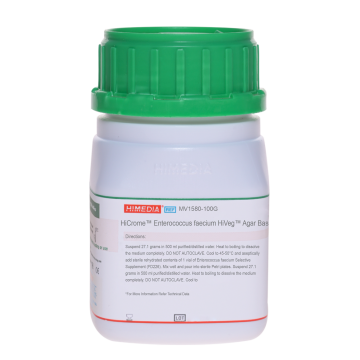
Recommended for chromogenic identification of Enterococcus faecium from faeces, sewage and water supplies.
| Ingredients | g/L |
|---|---|
| HiCynth™ Peptone No.2* | 23.000 |
| Corn starch | 1.000 |
| Sodium chloride | 5.000 |
| Arabinose | 10.000 |
| Phenol red | 0.100 |
| Chromogenic substrate | 0.100 |
| Agar | 15.000 |
| Final pH (at 25°C) | 7.8±0.2 |
**Formula adjusted, standardized to suit performance parameters
* Chemically defined peptone
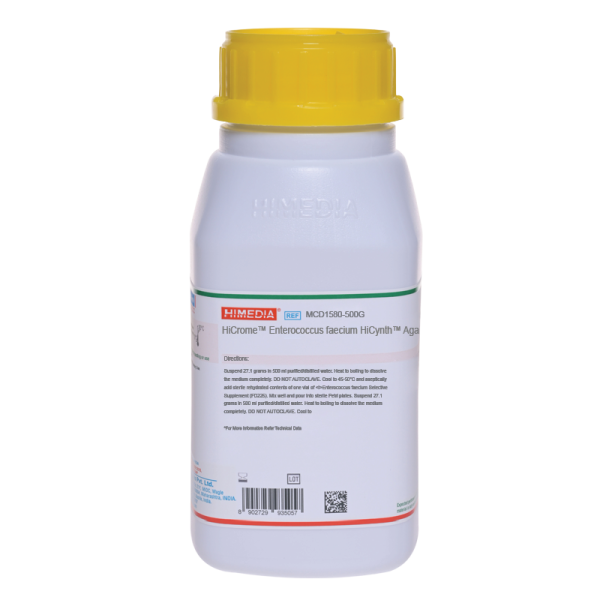
Suspend 27.1 gram in 500 ml purified/distilled water. Heat to boiling to dissolve the medium completely. DO NOT AUTOCLAVE. Cool to 45-50°C and aseptically add sterile rehydrated contents of 1 vial of AzCe Selective Supplement (FD226). Mix well and pour into sterile Petri plates.
HiCrome® Enterococcus faecium HiCynth™ Agar Base is recommended for the chromogenic detection of Enterococcus faecium from urine, faeces, soil, food, water, plants and animals. E.faecium is commonly found in the gastrointestinal tracts of humans (1). The resistance exhibited by Enterococcus species to various antimicrobials has led them to being a major cause of human infections including nosocomial infections (2). E.faecalis causes 80-90% of infection while E.faecium causes the majority of the remainder (3). The use of selective media for the isolation of Enterococci has been previously reviewed, including those containing chromogenic substrates (4) and media containing cephalexin-aztreonam supplements. Enterococcus species possess the enzyme β-glucosidase, which specifically cleaves the chromogenic substrate to produce blue coloured colonies. E.faecium ferment arabinose; and cleaves the chromogenic substrate present in the media to produce green coloured colonies along with yellow colouration to the medium. E.faecalis does not ferment arabinose and therefore retains the blue colour.
HiCrome® Enterococcus faecium HiCynth™ Agar Base is prepared by replacing animal and vegetable peptones with chemically defined peptones to avoid BSE/TSE risks associated with animal peptones. HiCynth™ Peptone No.2 serves as a source of carbon, nitrogen and essential growth nutrients. Corn starch neutralizes the toxic metabolites while sodium chloride maintains the osmotic equilibrium. Phenol red serves as a pH indicator with arabinose being the fermentable carbohydrate.
Food samples: fermented foods, meat products; Water samples.
For food samples, follow appropriate techniques for sample collection and processing as per guidelines (5). For water samples, follow appropriate techniques for sample collection, processing as per guidelines and local standards (6). After use, contaminated materials must be sterilized by autoclaving before discarding.
Read the label before opening the container. Wear protective gloves/protective clothing/eye protection/face protection. Follow good microbiological lab practices while handling specimens and culture. Standard precautions as per established guidelines should be followed while handling specimens. Safety guidelines may be referred in individual safety data sheets.
Performance of the medium is expected when used as per the direction on the label within the expiry period when stored at recommended temperature.
Appearance:
Light yellow to pinkish beige homogeneous free flowing powder
Gelling:
Firm, comparable with 1.5% Agar gel
Colour and Clarity of prepared medium:
Red coloured, clear to slightly opalescent gel forms in Petri plates
Reaction:
Reaction of 5.42% w/v aqueous solution at 25°C. pH: 7.8±0.2
pH:
7.60-8.00
Cultural characteristics observed with added AzCe Selective Supplement (FD226) after an incubation at 35-37°C for 24-48 hours.
| Organism | Inoculum (CFU) | Growth | Recovery | Colour of Colony |
|---|---|---|---|---|
| Escherichia coli ATCC 25922 (00013*) | >=104 | inhibited | 0% | |
| Enterococcus faecalis ATCC 29212 (00087*) | 50-100 | luxuriant | >=50% | blue |
| Enterococcus faecium ATCC 19434 (00010*) | 50-100 | luxuriant | >=50% | green |
| Enterococcus hirae ATCC 10541 (00011*) | 50-100 | luxuriant | >=50% | blue |
| Pseudomonas aeruginosa ATCC 27853 (00026*) | >=104 | inhibited | 0% | |
| Staphylococcus aureus subsp.aureus ATCC 25923 (00034*) | >=104 | inhibited | 0% |
Key: (*) Corresponding WDCM numbers.
Store between 15-25°C in a tightly closed container and the prepared medium at 2-8°C. Use before expiry date on the label. On opening, product should be properly stored dry, after tightly capping the bottle in order to prevent lump formation due to the hygroscopic nature of the product. Improper storage of the product may lead to lump formation. Store in dry ventilated area protected from extremes of temperature and sources of ignition Seal the container tightly after use. Product performance is best if used within stated expiry period.
User must ensure safe disposal by autoclaving and/or incineration of used or unusable preparations of this product. Follow established laboratory procedures in disposing of infectious materials and material that comes into contact with sample must be decontaminated and disposed of in accordance with current laboratory techniques (7,8).
| Product Name | HiCrome® Enterococcus faecium HiCynth™ Agar Base |
|---|---|
| SKU | MCD1580 |
| Product Type | HiCynth™, HiCrome™ |
| Physical Form | Powder |
| Origin | Chemically defined (HiCynth™) |
| Packaging type | HDPE |
| References | 1.Skinner F. A. and Quesnel L. B., (Ed.), 1978, Streptococci. Academic Press, Inc. (London) Ltd., London, United Kingdom,p. 245-2612.Chenoweth C., Schaberg D., The Epidemiology of Enterococci, Eur. J.Clin. Micorbiol. Infect. Dis., 9:80-89, 1990.3.Moellering R. C., 1992, Clin. Infect. Dis. 14:1173. |
| Customized Product Available | No |