HiMedia Laboratories GmbH, Marie-Curie-Str. 3, 64683, Einhausen, Germany.

 Your enquiry has been submitted
Something problem with the server. Try again.

Recommended for selective cultivation of Lactobacilli.
| Ingredients | Gms / Litre |
|---|---|
| HiCynth™ Peptone No. 4* | 10.000 |
| HiCynth™ Peptone No. 5* | 5.000 |
| Dextrose (Glucose) | 10.000 |
| Arabinose | 5.000 |
| Saccharose (Sucrose) | 5.000 |
| Sodium acetate | 15.000 |
| Ammonium citrate | 2.000 |
| Potassium dihydrogen phosphate | 6.000 |
| Magnesium sulphate | 0.570 |
| Manganese sulphate | 0.120 |
| Ferrous sulphate | 0.030 |
| Polysorbate 80 (Tween 80) | 1.000 |
| Agar | 15.000 |
| Final pH (at 25°C) | 5.4±0.2 |
**Formula adjusted, standardized to suit performance parameters
*Chemically defined peptones
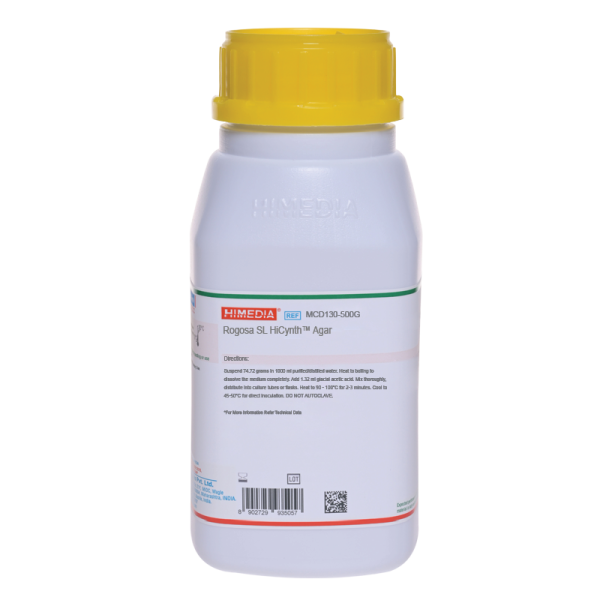
Suspend 74.72 grams in 1000 ml purified / distilled water. Heat to boiling to dissolve the medium completely. Add 1.32 ml glacial acetic acid. Mix thoroughly, distribute into culture tubes or flasks. Heat to 90 - 100°C for 2-3 minutes. Cool to 45-50°C for direct inoculation. DO NOT AUTOCLAVE.
Rogosa SL HiCynth™ Agar also known as RMW Agar, is a modification of the media formulated by Rogosa, Mitchell and Wiseman (1,2). This media is used for isolation, enumeration and identification of Lactobacilli from foodstuffs and specimens (3,4). Accompanying bacterial flora is suppressed due to the low pH of the medium and also because of the high sodium acetate concentration. Rogosa SL HiCynth™ Agar is prepared by replacing animal and vegetable peptones with chemically defined peptones to avoid BSE/TSE risks associated with animal peptones.
HiCynth™ Peptone No. 4 and HiCynth™ Peptone No. 5 provide nitrogenous compounds, sulphur, trace elements and vitamin B complex, essential for growth of Lactobacilli. Dextrose, arabinose and saccharose are the fermentable carbohydrates. Polysorbate 80 is the source of fatty acids. Ammonium citrate and Sodium acetate inhibit moulds, Streptococci and many other organisms. Potassium dihydrogen phosphate provides buffering capability. Magnesium sulphate, manganese sulphate and ferrous sulphate are sources of inorganic ions. Low pH of the medium and addition of acetic acid makes the medium selective for Lactobacilli inhibiting other bacterial flora (3).
It is recommended that the plates should be incubated at 30°C for 5 days or at 37°C for 3 days in an atmosphere of 95% hydrogen and 5% carbon dioxide (5). If this is not possible, overlay the inoculated plates with a second layer of the agar before incubation. High acetate concentration and acidic pH suppress many strains of other lactic acid bacteria. All colonies should be checked by gram staining and by catalase test before further identification. The salt in the formulation makes the medium unsuitable for isolation of dairy Lactobacilli. e.g. L. lactis, L. bulgaricus and L. helveticus (2,3).
Food samples
For food samples follow appropriate techniques for handling specimens as per established guidelines (4).
After use, contaminated materials must be sterilized by autoclaving before discarding.
For professional use only. Read the label before opening the container. Wear protective gloves/protective clothing/ eye protection/ face protection. Follow good microbiological lab practices while handling specimens and culture. Standard precautions as per established guidelines should be followed while handling specimens. Safety guidelines may be referred in individual safety data sheets.
Performance of the medium is expected when used as per the direction on the label within the expiry period when stored at recommended temperature.
Appearance
Cream to yellow homogeneous soft lumps which can be easily broken down to powder form.
Gelling
Firm, comparable with 1.5% Agar gel
Colour and Clarity of prepared medium
Light yellow coloured opalescent gel forms in Petri plates
Reaction
Reaction of 7.5% w/v aqueous solution with 0.132% v/v acetic acid at 25°C. pH: 5.4±0.2
pH
5.20-5.60
Cultural characteristics observed in presence of 5% Carbon dioxide (CO2) and 95% H2 after an incubation at 35-37° C for 40-48 hours.
| Organism | Inoculum (CFU) | Growth | Recovery |
|---|---|---|---|
| Lactobacillus casei ATCC 9595 | 50-100 | good - luxuriant | >=50% |
| Lactobacillus fermentum ATCC 9338 | 50-100 | good to luxuriant | >=50% |
| Lactobacillus leichmanni ATCC 4797 | 50-100 | good to luxuriant | >=50% |
| Lactobacillus plantarum ATCC 8014 | 50-100 | good-luxuriant | >=50% |
| Staphylococcus aureus subsp. aureus ATCC 25923 (00034*) | >=104 | inhibited | 0% |
Key: (*) Corresponding WDCM numbers.
Store dehydrated and the prepared medium at 2-8°C. Use before expiry date on the label. On opening, product should be properly stored dry, after tightly capping the bottle in order to prevent lump formation due to the hygroscopic nature of the product. Improper storage of the product may lead to lump formation. Store in dry ventilated area protected from extremes of temperature and sources of ignition Seal the container tightly after use. Product performance is best if used within stated expiry period.
User must ensure safe disposal by autoclaving and/or incineration of used or unusable preparations of this product. Follow established laboratory procedures in disposing of infectious materials and material that comes into contact with clinical sample must be decontaminated and disposed of in accordance with current laboratory techniques (6,7).
| Product Name | Rogosa SL HiCynth™ Agar |
|---|---|
| SKU | MCD130 |
| Product Type | HiCynth™ |
| Physical Form | Powder |
| Origin | Chemically defined (HiCynth™) |
| Packaging type | HDPE |
| References | 1. Downes F. P. and Ito K., (Eds.), Compendium of Methods for the Microbiological Examination of Foods, 4th Ed., AmericanPublic Health Association, Washington, D.C. 2.MacFaddin J. F., 1985, Media for Isolation-Cultivation-Identification- Maintenance of Medical Bacteria, Vol. I, Williamsand Wilkins, Baltimore. Md. 3.Rogosa M., Mitchell J. A. and Wiseman R. F, 1951, J. Bacteriol., 62, 132-133. 4.Rogosa M., Mitchell J. A. and Wiseman R. F., 1951, J. Dental Res. 30:682. 5.Sharpe M. L. (Ed.), 1960, Lab-Practice, 9(4): 223. |
| Customized Product Available | No |