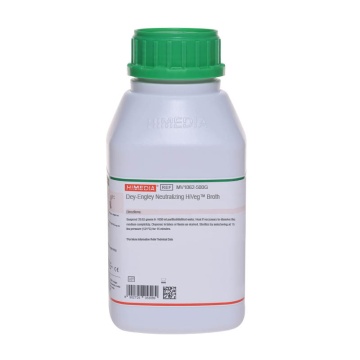
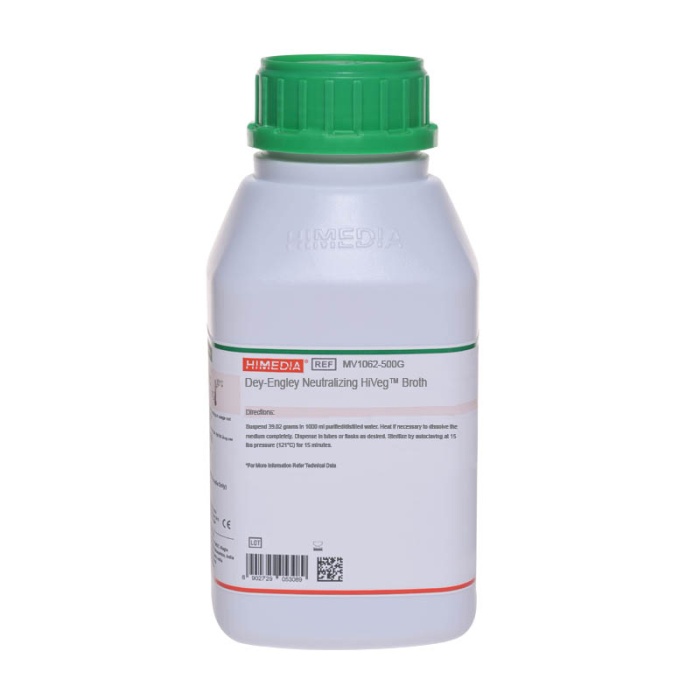
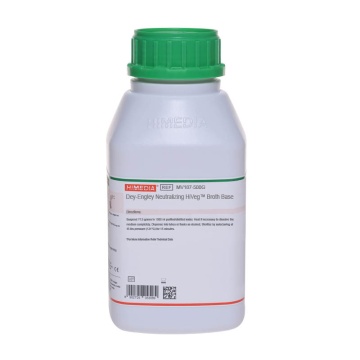
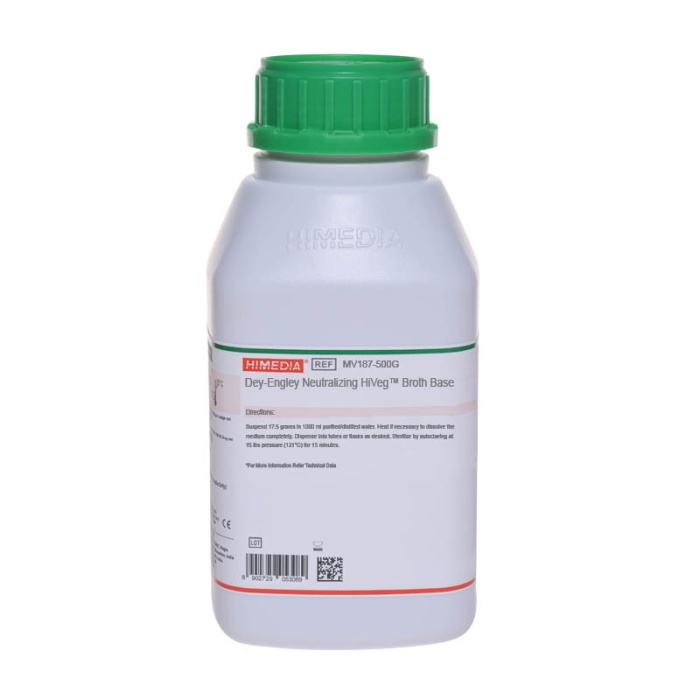
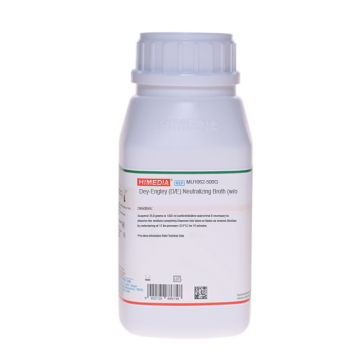
HiMedia Laboratories GmbH, Marie-Curie-Str. 3, 64683, Einhausen, Germany.


 Your enquiry has been submitted
Something problem with the server. Try again.

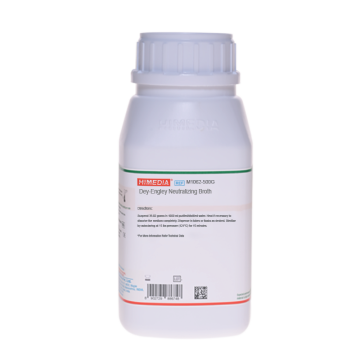
Dey-Engley Neutralizing HiCynth™ Broth is used in disinfectant testing where neutralization of the antiseptics and disinfectants is important for determining its bactericidal activity.
| Ingredients | Gms / Litre |
|---|---|
| HiCynth™ Peptone No.1 | 5.000 |
| HiCynth™ Peptone No.5 | 2.500 |
| Dextrose | 10.000 |
| Sodium thioglycollate | 1.000 |
| Sodium thiosulphate | 6.000 |
| Sodium bisulphite | 2.500 |
| Lecithin | 7.000 |
| Polysorbate 80 | 5.000 |
| Bromocresol purple | 0.020 |
| Final pH (at 25°C) | 7.6±0.2 |
**Formula adjusted, standardized to suit performance parameters
*Chemically defined peptones
Suspend 39.02 grams in 1000 ml distilled water. Heat if necessary to dissolve the medium completely. Dispense into tubes or flasks as desired. Sterilize by autoclaving at 15 lbs pressure (121°C) for 15 minutes.
Dey-Engley Neutralizing Broth is formulated as per the procedure described by Engley and Dey (1). Dey -Engley Neutralizing Broth is especially suited for environmental sampling where neutralization of the chemical is important to determine its bactericidal activity. Dey-Engley Neutralizing HiCynth™ Broth is prepared by completely replacing animal or vegetable peptones with chemically defined peptones to avoid BSE/TSE risks associated with animal peptone. A strongly bacteriostatic substance inhibits the growth and reproduction of bacteria without killing them. These bacteria hold the ability to cause infection under favourable conditions. Dey-Engley Neutralizing Broth Base and Dey-Engley Neutralizing Broth has the same formula but the former does not containing the neutralizing components. The Dey-Engley Neutralizing Broth neutralizes a broad spectrum of antiseptics and disinfectants including quaternary ammonium compounds, phenolics, iodine and chlorine preparations, mercurials, formaldehyde and glutaraldehyde. Dey-Engley Neutralizing Broth is used for the neutralization and testing of antiseptics and disinfectants according to the procedure of Engley and Dey (1).
HiCynth™ peptone No. 1 and HiCynth™ Peptone No.5 provides nitrogeneous and carbanaceous compounds, long chain amino acids, vitamins and other essential nutrients. Dextrose is an energy source. The present formulation incorporate neutralizing substances for almost all the active products used as antiseptics and disinfectants. Sodium bisulfite neutralizes aldehydes; sodium thioglycollate neutralizes mercurials; sodium thiosulfate neutralizes iodine and chlorine (1); lecithin neutralizes quaternary ammonium compounds; and polysorbate 80, a non-ionic surface-active agent, neutralizes substituted phenolics (2-5). Bromocresol purple is an indicator for dextrose utilization. Due to the high concentration of lecithin in the broth medium, turbidity cannot be used to detect growth. Therefore, bromocresol purple and dextrose are added to the medium. Those organisms that ferment dextrose will turn the medium from purple to yellow. Growth of Pseudomonas species, which do not ferment dextrose, can be detected by the formation of a pellicle on the surface of the broth (1).
For testing disinfectants, prepare two sets of test tubes, one containing 9 ml Dey-Engley Neutralizing Broth (MCD1062) and other with 9 ml Dey-Engley Neutralizing Broth Base (MCD187). Add 1 ml of disinfectant under test. Mix well and allow it to stand for 15 minutes. Inoculate 0.1 ml of 1:100,000 dilution of overnight broth cultures and incubate at 37°C for 48 hours. Growth is indicated by a colour change from purple to yellow or pellicle formation. Growth in Neutralizing Broth and no growth in Neutralizing Broth Base indicate neutralization of disinfectant. To check bactericidal activity, both broth tubes are inoculated on D/E Neutralizing Agar (MCD186). Positive growth from negative tubes of Neutralizing Broth Base indicates bacteriostatic substance while negative growth indicates a bactericidal disinfectant. All positive tubes should show growth on Dey-Engley Neutralizing Agar. The control disinfectants used in test procedure are 2% chlorine, 2% formaldehyde, 1% glutaraldeyde, 2%iodine, 2% phenol, 1/750 quaternary ammonium compounds, 1/1000 mercurials etc.
Appearance
Light yellow to bluish grey homogeneous free flowing powder
Colour and Clarity of prepared medium
Purple coloured, opalescent solution in tubes with slight precipitate
Reaction
Reaction of 3.9% w/v aqueous solution at 25°C. pH: 7.6±0.2
pH
7.40-7.80
Cultural characteristics observed after an incubation at 35-37°C for 40-48 hours.
| Organism | Inoculum (CFU) | Growth |
|---|---|---|
| Cultural Response | ||
| Bacillus subtilis ATCC 6633 | 50-100 | luxuriant |
| Escherichia coli ATCC 25922 | 50-100 | luxuriant |
| Pseudomonas aeruginosa ATCC 27853 | 50-100 | luxuriant |
| Salmonella Typhimurium ATCC 14028 | 50-100 | luxuriant |
| Staphylococcus aureus ATCC 25923 | 50-100 | luxuriant |
| Escherichia coli ATCC 8739 | 50-100 | luxuriant |
| Staphylococcus aureus ATCC 6538 | 50-100 | luxuriant |
Store below 30°C in tightly closed container and use freshly prepared medium. Use before expiry date on the label.
| Product Name | Dey Engley Neutralizing HiCynth™ Broth |
|---|---|
| SKU | MCD1062 |
| Product Type | HiCynth™ |
| Physical Form | Powder |
| Origin | Chemically defined (HiCynth™) |
| Packaging type | HDPE |
| References | 1. Engley and Dey, 1970. Chem. Spec. Manuf. Assoc. Proc., Mid-Year Meet., p. 100. |