HiMedia Laboratories GmbH, Marie-Curie-Str. 3, 64683, Einhausen, Germany.

 Your enquiry has been submitted
Something problem with the server. Try again.
 Your enquiry has been submitted
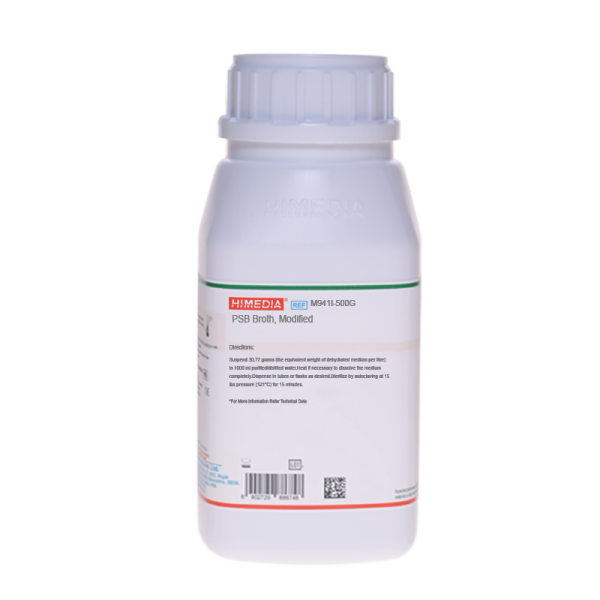
Recommended for primary enrichment and enumeration of Yersinia enterocolitica from food. The composition and performance criteria are in accordance with ISO 1994, ISO/DIS 10273 :2017 and ISO 11133:2014 (E) /Amd. :2020
| Ingredients | g/L |
|---|---|
| Peptone # | 5.000 |
| Sorbitol | 10.000 |
| Sodium chloride | 5.000 |
| Disodium hydrogen phosphate | 8.230 |
| Sodium dihydrogen phosphate monohydrate | 1.200 |
| Bile salts | 1.500 |
| Final pH (at 25°C) | 7.6±0.2 |
**Formula adjusted, standardized to suit performance parameters
# Equivalent to Enzymatic digest of casein
Suspend 30.77 gram (the equivalent weight of dehydrated medium per litre) in 1000 ml purified/distilled water. Heat if necessary to dissolve the medium completely. Dispense in tubes or flasks as desired. Sterilize by autoclaving at 15 lbs pressure (121°C) for 15 minutes.
Yersinia enterocolitica are ubiquitous, being isolated frequently from soil, water, animals, and a variety of foods. They comprise a biochemically heterogeneous group that can grow at refrigeration temperatures. PSB Broth Base is recommended by APHA (1) for enrichment of Yersinia species. PSB Broth, Modified is a modification of PSB Broth (M9411) recommended by ISO Committee (2,3). Supplementation of phosphate buffer with sorbitol and bile salts appears to be better for cold enrichment (4).
Peptone provides essential growth nutrients. Sodium chloride maintains osmotic equilibrium while phosphates buffer the medium well. Sorbitol is the energy source. Bile salts are added to make the medium selective for Yersinia species by inhibiting accompanying gram-positive bacteria.
Food and Animal feeding stuff
Enrichment: For the first initial suspension place the sample (x) in known volume of the PSB broth (M9411), to give a dilution of 1/10 dilution (by mass/volume or volume/volume). Homogenize the suspension using a peristaltic blender for 2 min. Incubate at 22°C to 25°C for 2 to 3 days with or 5 days without agitation.
For the second inition suspension in the same way with the ITC broth (M1220) so as to obtain a test portion/enrichment medium dilution of 1/100 (mass/volume or volume/volume). Incubate at 25°C for 48 hours.
Isolation:
Read the label before opening the container. Wear protective gloves/protective clothing/eye protection/face protection. Follow good microbiological lab practices while handling specimens and culture. Standard precautions as per established guidelines should be followed while handling specimens. Safety guidelines may be referred in individual safety data sheets.
Performance of the medium is expected when used as per the direction on the label within the expiry period when stored at recommended temperature.
Appearance
Cream to yellow homogeneous free flowing powder
Colour and Clarity of prepared medium
Light yellow coloured clear to very slightly hazy solution
Reaction
Reaction of 3.08% w/v aqueous solution at 25°C. pH : 7.6±0.2
pH
7.40-7.80
Productivity: Cultural characteristics observed after an incubation at 25 ± 1°C for 3-5 days. Recovery is carried out on SSDC Agar (M1703)
Selectivity: Cultural characteristics observed after an incubation at 25 ± 1°C for 3-5 days Recovery is carried out on SSDC Agar (M1703)
| Organism | Inoculum (CFU) | Growth | Characteristic reaction on SSDC Agar (M1703) |
|---|---|---|---|
| Productivity | |||
| Yersinia enterocolitica subsp. enterocolitica ATCC 9610 (00038*) +Escherichia coli ATCC 8739 (00012*) +Pseudomonas aeruginosa ATCC 27853 (00025*) |
50-100 >=104 >=104 |
>10 colonies | colourless round colonies, approximately 1mm diameter. A finely granulated centre can be seen under 10X magnification |
| Yersinia enterocolitica subsp. enterocolitica ATCC 9610 (00038*) +Escherichia coli ATCC 25922 (00013*) +Pseudomonas aeruginosa ATCC 27853 (00025*) |
50-100 >=104 >=104 |
>10 colonies | colourless round colonies, approximately 1mm diameter. A finely granulated centre can be seen under 10X magnification |
| Yersinia enterocolitica biotype 1 serotype 0:8 ATCC 23715 (00160*) +Escherichia coli ATCC 8739 (00012*) +Pseudomonas aeruginosa ATCC 27853 (00025*) |
50-100 >=104 >=104 |
>10 colonies | colourless round colonies, approximately 1mm diameter. A finely granulated centre can be seen under 10X magnification |
| Yersinia enterocolitica biotype 1 serotype 0:8 ATCC 23715 (00160*) +Escherichia coli ATCC 25922 (00013*) +Pseudomonas aeruginosa ATCC 27853 (00025*) |
50-100 >=104 >=104 |
>10 colonies | colourless round colonies, approximately 1mm diameter. A finely granulated centre can be seen under 10X magnification |
| Selectivity | |||
| Pseudomonas aeruginosa ATCC 27853 (00025*) | >=104 | inhibited | |
| Proteus mirabilis ATCC 29906 (00023*) | >=104 | inhibited | |
Key: (*) Corresponding WDCM numbers.
Store between 10-30°C in a tightly closed container and the prepared medium at 15-30°C. Use before expiry date on the label. On opening, product should be properly stored dry, after tightly capping the bottle inorder to prevent lump formation due to the hygroscopic nature of the product. Improper storage of the product may lead to lump formation. Store in dry ventilated area protected from extremes of temperature and sources of ignition. Seal the container tightly after use. Product performance is best if used within stated expiry period.
User must ensure safe disposal by autoclaving and/or incineration of used or unusable preparations of this product. Follow established laboratory procedures in disposing of infectious materials and material that comes into contact with sample must be decontaminated and disposed of in accordance with current laboratory techniques (5,6).
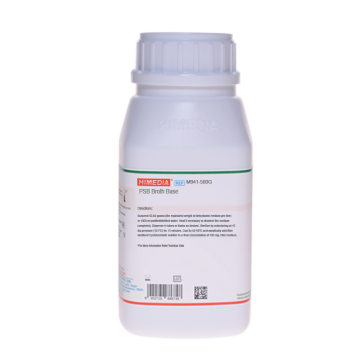
| Product Name | PSB Broth, Modified |
|---|---|
| SKU | M941I |
| Product Type | Regular |
| Physical Form | Powder |
| Origin | Animal |
| Packaging type | HDPE |
| References | 1. Speck M. (Ed.), 1984, Compendium of Methods for The Microbiological Examination of Foods, 3rd ed., APHA, Washington,D.C. |
| Customized Product Available | No |