HiMedia Laboratories GmbH, Marie-Curie-Str. 3, 64683, Einhausen, Germany.

 Your enquiry has been submitted
Something problem with the server. Try again.

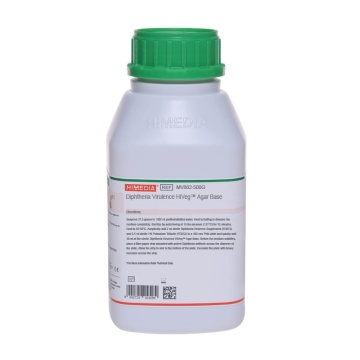
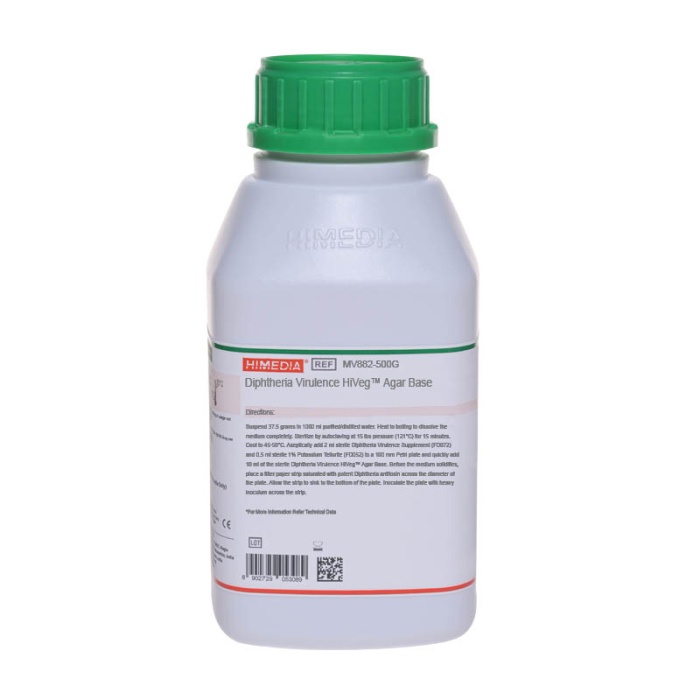
Recommended for determining toxigenicity of Corynebacterium diphtheriae.
| Ingredients | Gms / Litre |
|---|---|
| Proteose peptone | 20.000 |
| Sodium chloride | 2.500 |
| Agar | 15.000 |
| Final pH (at 25°C) | 7.8±0.2 |
Formula adjusted, standardized to suit performance parameters
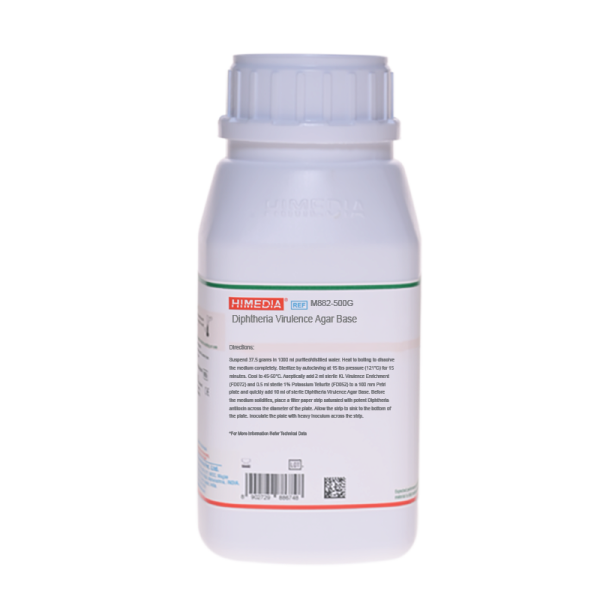
Suspend 37.5 grams in 1000 ml purified / distilled water. Heat to boiling to dissolve the medium completely. Sterilize by autoclaving at 15 lbs pressure (121°C) for 15 minutes. Cool to 55-60°C. Aseptically add 2 ml sterile KL Virulence Enrichment (FD072) and 0.5 ml sterile PTe 1% Selective Supplement (1 ml per vial)(FD052) to a 100 mm Petri plate and quickly add 10 ml of sterile Diphtheria Virulence Agar Base. Before the medium solidifies, place a filter paper strip saturated with potent Diphtheria antitoxin across the diameter of the plate. Allow the strip to sink to the bottom of the plate. Inoculate the plate with heavy inoculum across the strip.
Corynebacterium diptheriae is a principle human pathogen and owes its pathogenicity to the production of a potent exotoxin active on a variety of tissue including heart muscles and peripheral nerves (1). Toxin diffusing from a streak culture of suspected C. diphtheriae is demonstrated by the formation of a white line of precipitate where it meets with diphtheria antitoxin diffusing from a strip of filter paper embedded in the agar. In vitro toxigenicity (virulence) of C. diphtheriae was first described by Elek (2). Eleks technique was further improved by King, Frobisher and Parsons (3) by the use of a standardized medium. This medium gave results comparable with animal inoculation test. Also it was found that proteose peptone supported toxin production in addition to maintaining the consistency of results. Hermann et al (4) developed a non-serum based enrichment to overcome the irregularities encountered during the usage of horse, sheep or rabbit serum based enrichments. These non-serum based enrichments consist of AcicaseT™, tween 80 and glycerol (5). Upon incubation of the inoculated plate, a line of precipitin is observed for toxigenic strains.
Proteose peptone provides the carbon and nitrogen sources required for good growth of a wide variety of organisms and also for toxin production. Sodium chloride maintains the osmotic balance of the medium. Agar is incorporated as the solidifying agent. Potassium tellurite inhibits most gram-negative bacteria except Corynebacterium species, Streptococcus mitis, Streptococcus salivarius and Enterococci. Staphylococcus epidermidis may exhibit growth. False positive results may also be encountered. Therefore, a positive control has to always be run in parallel (6). Corynebacterium ulcerans and Corynebacterium pseudotuberculosis may also produce line of precipitation (7).
Clinical samples - Throat swab
For clinical samples follow appropriate techniques for handling specimens as per established guidelines (8,9). After use, contaminated materials must be sterilized by autoclaving before discarding.
In Vitro diagnostic Use only. Read the label before opening the container. Wear protective gloves/protective clothing/ eye protection/ face protection. Follow good microbiological lab practices while handling specimens and culture. Standard precautions as per established guidelines should be followed while handling clinical specimens. Safety guidelines may be referred in individual safety data sheets.
Performance of the medium is expected when used as per the direction on the label within the expiry period when stored at recommended temperature.
Appearance
Cream to yellow homogeneous free flowing powder
Gelling
Firm, comparable with 1.5% Agar gel
Colour and Clarity of prepared medium
Medium amber coloured, slightly opalescent gel forms in Petri plates
Reaction
Reaction of 3.75% w/v aqueous solution at 25°C. pH: 7.8±0.2
pH
7.60-8.00
Cultural characteristics observed with added KL Virulence Enrichment (FD072) and 0.5 ml of PTe 1% Selective Supplement (1 ml per vial)(FD052) after an incubation at 35-37°C for 24-72 hours.
| Organism | Inoculum (CFU) | Growth | Recovery | Line of precipitin |
|---|---|---|---|---|
| Bacillus subtilis subsp. spizizenii ATCC 6633 (00003*) | >=104 | inhibited | 0% | |
| Corynebacterium diphtheriae type gravis | 50-100 | luxuriant | >=50% | positive |
| Corynebacterium diphtheriae type intermedius | 50-100 | luxuriant | >=50% | positive |
| Corynebactrium diphtheriae type mitis | 50-100 | luxuriant | >=50% | positive |
| Staphylococcus epidermidis ATCC 12228 (00036*) | 50-100 | none-poor | <=10% |
Key: (*) Corresponding WDCM numbers.
Store between 10-30°C in a tightly closed container and the prepared medium at 2-8°C. Use before expiry date on the label. On opening, product should be properly stored dry, after tightly capping the bottle in order to prevent lump formation due to the hygroscopic nature of the product. Improper storage of the product may lead to lump formation. Store in dry ventilated area protected from extremes of temperature and sources of ignition. Seal the container tightly after use. Product performance is best if used within stated expiry period.
User must ensure safe disposal by autoclaving and/or incineration of used or unusable preparations of this product. Follow established laboratory procedures in disposing of infectious materials and material that comes into contact with clinical sample must be decontaminated and disposed of in accordance with current laboratory techniques (5,6).
| Product Name | Diphtheria Virulence Agar Base |
|---|---|
| SKU | M882 |
| Product Type | Regular |
| Physical Form | Powder |
| Origin | Animal |
| Packaging type | HDPE |
| References | 1. Collee J. G., Fraser A. G., Marmion B. P., Simmons A., (Eds.), Mackie and McCartney, Practical Medical Microbiology,1996, 14th Edition, Churchill Livingstone |
| Customized Product Available | No |