HiMedia Laboratories GmbH, Marie-Curie-Str. 3, 64683, Einhausen, Germany.

 Your enquiry has been submitted
Something problem with the server. Try again.
 Your enquiry has been submitted
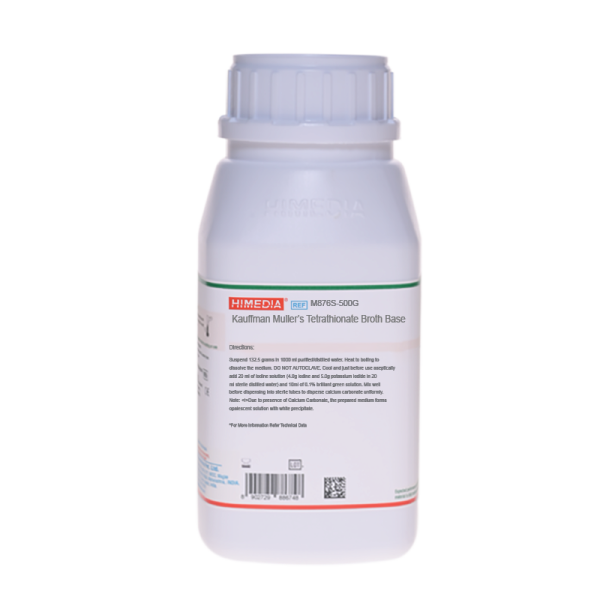
Kauffman Muller's Tetrathionate Broth Base is recommended as selective enrichment medium for isolation of Shigella species from food samples. It is recommended by BIS committee under the specifications IS:5887(Part I)-1999.
| Ingredients | Gms / Litre |
|---|---|
| Peptone | 9.000 |
| Meat extract | 9.000 |
| Sodium chloride | 4.500 |
| Calcium carbonate | 50.000 |
| Sodium thiosulphate | 50.000 |
| Oxbile | 10.000 |
Formula adjusted, standardized to suit performance parameters
Suspend 132.5 grams in 1000 ml distilled water. Heat just to boiling to disosolve the medium. DO NOT AUTOCLAVE. Cool and just before use aseptically add 20 ml of iodine solution. (4 gram iodine and 5 gram Potassium iodide in 20 ml sterile distilled water) and 10 ml of 0.1% Brilliant green solution. Mix well before dispensing in the sterile tubes to disperse Calcium carbonate uniformly.
Note: Due to presence of Calcium carbonate the prepared medium forms opalescent solution with white precipitate.
Salmonella species cause many types of infections, from mild self-limiting gastroenteritis to life-threatening typhoid fever (1). Salmonella present in food samples may also be injured in food-processing procedures, which include exposure to low temperatures, sub-marginal heat, drying, radiation, preservative, and sanitizers (2). This medium is hence used as a selective enrichment for the cultivation of Salmonella species that may be present in small numbers and have been injured through various procedures.
Muller recommended Tetrathionate Broth as a selective medium for the recovery of Salmonella and demonstrated the effectiveness of Tetrathionate Broth(3) for enriching typhoid and paratyphoid bacilli while inhibiting coliform organisms. Kauffmann modified this formula to include Ox bile (4,5) for its selective properties, which supresses coliform bacteria and inhibits Gram-positive organisms. Using modified Muller's broth, Kauffmann increased the number of rapid screening of Salmonella in food(6,7). Meat Peptone provides nitrogen, carbon, vitamins, and amino acids. Sodium Chloride maintains the osmotic balance of the medium. Calcium Carbonate neutralizes and absorbs toxic metabolites. Selectivity is accomplished by the combination of Sodium Thiosulfate and tetrathionate, which suppresses commensal intestinal organisms (8). The British Standard Specification specifies Brilliant Green Tetrathionate Broth for isolating Salmonella from meat and meat products and from poultry and poultry products. Muller Kauffmann Tetrathionate Broth Base conforms with ISO Standards (9).
Appearance: Cream to yellow homogeneous free flowing powder
Colour and Clarity of prepared medium: With added brilliant green and iodine solution - Light green coloured opalescent solution forms with heavy white precipitate
Cultural characteristics observed, when subcultured on Soyabean Casein digest Agar, after an incubation at 43°C for 18-24 hours with added iodine and brilliant green solution.
| Organism | Inoculum (CFU) | Recovery |
|---|---|---|
| Salmonella Typhimurium ATCC 14028 | 50-100 | excellent |
| Salmonella Enteritidis ATCC 13076 | 50-100 | excellent |
| Salmonella Paratyphi A | 50-100 | excellent |
| Salmonella Paratyphi B | 50-100 | excellent |
| Salmonella Typhi ATCC 6539 | >=103 | inhibited |
| Escherichia coli ATCC 25922 | 50-100 | none-poor |
| Proteus vulgaris ATCC 13315 | 50-100 | none-poor |
| Shigella flexneri ATCC12022 | 50-100 | Good |
Store below 30°C in tightly closed container and use the freshly prepared medium. Use before expiry date on the label.
| Product Name | Kauffman Mueller’s Tetrathionate Broth Base |
|---|---|
| SKU | M876S |
| Product Type | Regular |
| Physical Form | Powder |
| Origin | Animal |
| Packaging type | HDPE |
| References | 1.Mueller L., 1923, C. R. Soc. Biol., (Paris) 89:434.2.Kauffman F., 1935, Ztschr. F. Hyg., 117:26.3.International Organization for Standardization, 1974, (Draft International Standard ISO/DIS 3565), Geneva, Switzerland.4.Public Health Laboratory Service, 1974, Monograph Series No. 8, Public Health Laboratory Service, London, England.5.Harvey R. W. S. and Price T. S., 1976, J. Hyg. Camb., 77:333.6.Jeffries L., 1959, J. Clin. Pathol., 12:568.7.Speck M. L., (Ed.), 1984, Compendium of Methods for the Microbiological Examination of Foods, 2nd Ed., American PublicHealth Association, Washington, D.C.8.DAoust J. Y., 1989, Salmonella in Food borne Bacterial pathogens, (Eds.) Doyle M. P., 327, Marcel Dekker, New York.9.International Organization for Standardization (ISO), 2002, Draft 6579. |
| Customized Product Available | No |