HiMedia Laboratories GmbH, Marie-Curie-Str. 3, 64683, Einhausen, Germany.

 Your enquiry has been submitted
Something problem with the server. Try again.

Recommended for isolating Actinomyces species from soil samples.
| Ingredients | Gms / Litre |
|---|---|
| Dextrose (Glucose) | 1.000 |
| Potassium dihydrogen phosphate | 0.100 |
| Sodium nitrate | 0.100 |
| Potassium chloride | 0.100 |
| Magnesium sulphate | 0.100 |
| Agar | 15.000 |
**Formula adjusted, standardized to suit performance parameters
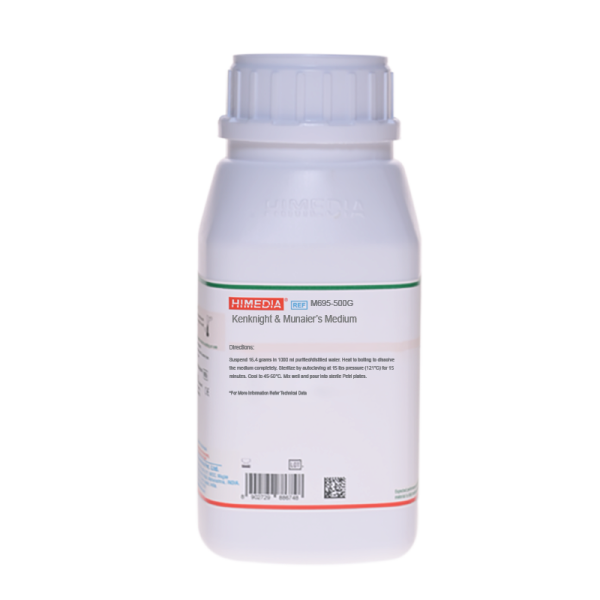
Suspend 16.4 grams in 1000 ml purified / distilled water. Heat to boiling to dissolve the medium completely. Sterilize by autoclaving at 15 lbs pressure (121°C) for 15 minutes. Cool to 45-50°C. Mix well and pour into sterile Petri plates.
The genera Actinomyces, belong to the fermentative Actinomycetes group. They cause a number of diseases, notably, actinomycosis and some opportunistic diseases (2). Actinomycetes have some unique properties that may be related to their ability to survive and grow in the soils. They are prolific producers of extracellular enzymes that degrade the complex macromolecule substrates commonly found in soils (5). The dessication resistance properties of spore formers such as Streptomyces (6) are likely to be important to survive in soils that are often dry (1).
Kenknight and Munaiers medium is used for isolating Actinomyces species from soil samples (7). Dextrose serves as carbohydrate source for the growth of Actinomyces. Sodium nitrate serves as the source of nitrogen. Various salts in the medium not only buffer the medium but also provide essential ions required for the growth of Actinomyces.
Soil samples.
For soil samples, follow appropriate techniques for sample collection, processing as per guidelines and local standards (7). After use, contaminated materials must be sterilized by autoclaving before discarding.
Read the label before opening the container. Wear protective gloves/protective clothing/eye protection/ face protection. Follow good microbiological lab practices while handling specimens and culture. Standard precautions as per established guidelines should be followed while handling specimens. Safety guidelines may be referred in individual safety data sheets.
Performance of the medium is expected when used as per the direction on the label within the expiry period when stored at recommended temperature.
Appearance
Light yellow to brownish yellow homogeneous free flowing powder
Gelling
Firm, comparable with 1.5% Agar gel
Colour and Clarity of prepared medium
Light amber coloured, clear to slightly opalescent gel forms
in Petri plates
Cultural Response
Cultural characteristics observed after an incubation at 25-30°C for upto 7
days.
| Organism | Growth |
|---|---|
| Actinomyces israelii ATCC 10049 | luxuriant |
| Streptomyces albus subsp albus ATCC 3004 | good |
Store between 10-30°C in a tightly closed container and the prepared medium at 20-30°C. Use before expiry date on the label. On opening, product should be properly stored dry, after tightly capping the bottle in order to prevent lump formation due to the hygroscopic nature of the product. Improper storage of the product may lead to lump formation. Store in dry ventilated area protected from extremes of temperature and sources of ignition. Seal the container tightly after use. Product performance is best if used within stated expiry period.
User must ensure safe disposal by autoclaving and/or incineration of used or unusable preparations of this product. Follow established laboratory procedures in disposing of infectious materials and material that comes into contact with sample must be decontaminated and disposed of in accordance with current laboratory techniques (3,4).
| Product Name | Kenknight & Munaier’s Medium |
|---|---|
| SKU | M695 |
| Product Type | Regular |
| Physical Form | Powder |
| Origin | Chemically defined |
| Packaging type | HDPE |
| References | 1.Collee J. G, Fraser A. G, Marmion B. P, Simmons A., 14th Ed., Mackie and MacCartney Practical Medical Microbiology,Churchill Livingstone. 2.MacCartney A. J., 1989, FEMS Microbiol. Rev., 46:145-1633.McBride M. J., and Ensign J. C., 1987, J. Bacteriol., 169:4995-50014.Balows A., Truper H. G., Dworkin M., Harder W., Schleifer K. H. (Eds.), The Prokaryotes, 2nd Ed., Vol. I, Springer-Verlag5.N.S. Subba Rao, Soil Microorganisms and Plant Growth, Oxford and IBH Publishing Co. |
| Customized Product Available | No |