HiMedia Laboratories GmbH, Marie-Curie-Str. 3, 64683, Einhausen, Germany.

 Your enquiry has been submitted
Something problem with the server. Try again.

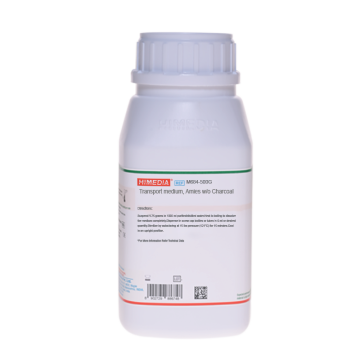
Recommended for transportation and preservation of microbiological specimen.
| Ingredients | g/L |
|---|---|
| Sodium chloride | 3.000 |
| Potassium chloride | 0.200 |
| Calcium chloride, anhydrous | 0.100 |
| Magnesium chloride | 0.100 |
| Potassium dihydrogen phosphate | 0.200 |
| Disodium hydrogen phosphate | 1.150 |
| Sodium thioglycollate | 1.000 |
| Charcoal | 10.000 |
| Agar | 4.000 |
| Final pH (at 25°C) | 7.2±0.2 |
**Formula adjusted, standardized to suit performance parameters
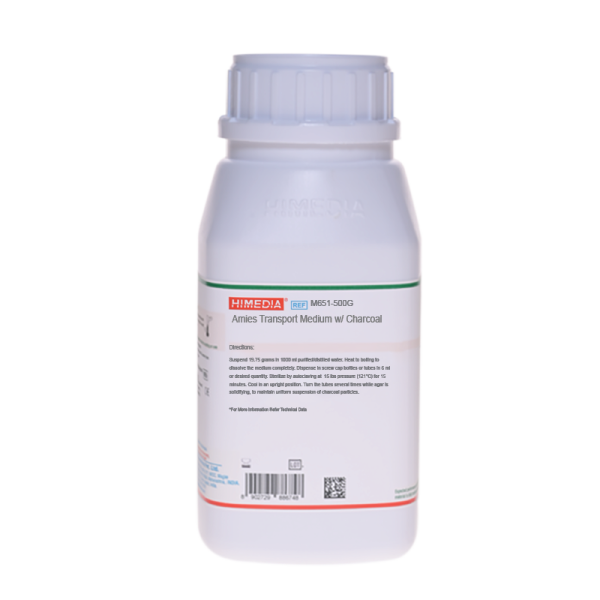
Suspend 19.75 grams in 1000 ml purified/distilled water. Heat to boiling to dissolve the medium completely. Dispense in screw cap bottles or tubes in 6 ml or desired quantity. Sterilize by autoclaving at 15 lbs pressure (121°C) for 15 minutes. Cool in an upright position. Turn the tubes several times while agar is solidifying, to maintain uniform suspension of charcoal particles.
The pre requisite of a transport medium is that it should be non-nutritive, semi-solid, and reductive and should be able to hamper self-destructive enzymatic reactions within the cells and in addition, must inhibit toxic oxidation reactions. Amies (1) modified Stuart's Transport Medium (2,3,4) by replacing glycerophosphate with an inorganic phosphate buffer and adding charcoal to the medium. This modified medium gave a higher percentage of positive results than the transport medium of Stuart. Amies Transport Medium provides a reduced environment due to the presence of sodium thioglycollate and small amount of agar. Charcoal helps to neutralize materials that are toxic to sensitive pathogens like Neisseria gonorrhoeae. Calcium magnesium, potassium and sodium salts help the survival of gonococcal cells and also control permeability of bacterial cells. Phosphates buffer the medium.
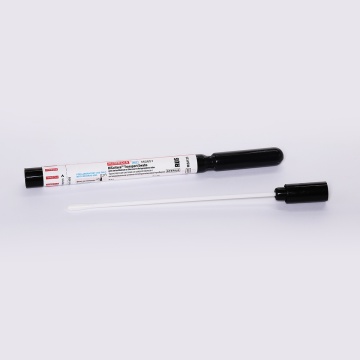
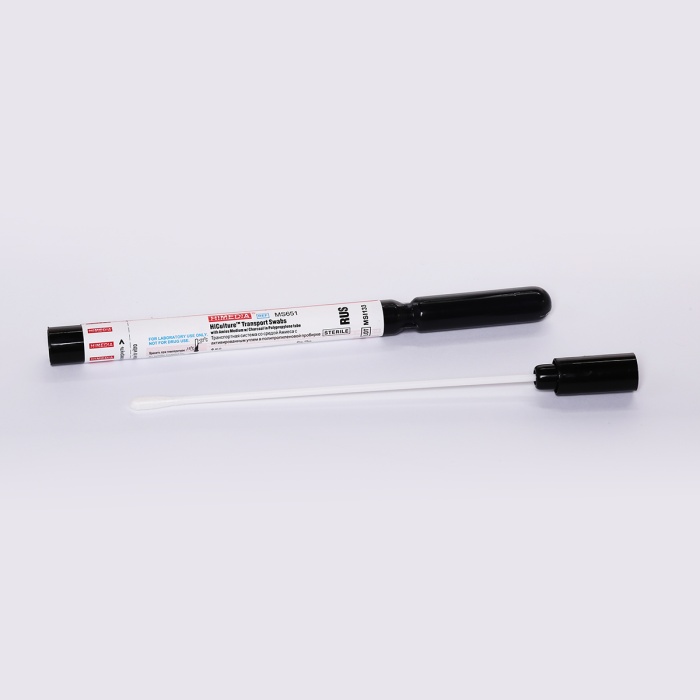
For the collection of the specimens, use sterile cotton-tipped swabs or wooden sticks. Push the swab down one third of the medium depth. When the cap is screwed down, the swab is forced to the bottom of the medium. The cap should be firmly screwed. Keep the medium cool during transportation but do not freeze. The specimen will be preserved during transportation and also the viability of the organisms will be maintained. But the viability will diminish over the time. Some growth of contaminants may also occur during longer period of transport. After transportation, the specimen should be inoculated in proper medium as soon as possible. For optimum results, the time lapse between sample collection and inoculum onto culture medium should be reduced to the minimum.
The cultures on transport swabs must not be kept at room temperature for more than 24 hours.
Clinical samples - pathological samples
For clinical samples follow appropriate techniques for handling specimens as per established guidelines (5,6). After use, contaminated materials must be sterilized by autoclaving before discarding.
In Vitro diagnostic Use only. For professional use only. Read the label before opening the container. Wear protective gloves/protective clothing/eye protection/ face protection. Follow good microbiological lab practices while handling specimens and culture. Standard precautions as per established guidelines should be followed while handling clinical specimens. Safety guidelines may be referred in individual safety data sheets.
Performance of the medium is expected when used as per the direction on the label within the expiry period when stored at recommended temperature.
Appearance
Grey to black homogeneous free flowing powder
Gelling
Semisolid, comparable with 0.4% Agar gel.
Colour and Clarity of prepared medium
Black coloured opaque gel forms in tubes as butts
Reaction
Reaction of 2% w/v aqueous solution at 25°C. pH: 7.2±0.2
pH
7.00-7.40
Cultural Response
Cultural characteristics observed when subcultured on Soyabean Casein Digest Agar (M290) after an incubation at 35-37°C for 18-24 hours.
| Organism | Inoculum (CFU) | Recovery |
|---|---|---|
| Escherichia coli ATCC 25922 (00013*) | 50-100 | luxuriant |
| Klebsiella pneumoniae ATCC 13883 (00097*) | 50-100 | luxuriant |
| Neisseria meningitidis ATCC 13090 | 50-100 | luxuriant |
| Pseudomonas aeruginosa ATCC 27853 (00025*) | 50-100 | luxuriant |
| Salmonella Typhi ATCC 6539 | 50-100 | luxuriant |
| Shigella flexneri ATCC 12022 (00126*) | 50-100 | luxuriant |
| Staphylococcus aureus subsp. aureus ATCC 25923 (00034*) | 50-100 | luxuriant |
| Vibrio cholerae ATCC 15748 | 50-100 | luxuriant |
Key: *Corresponding WDCM numbers.
Store between 10-30°C in a tightly closed container and the prepared medium at 15-30°C. Use before expiry date on the label. On opening, product should be properly stored dry, after tightly capping the bottle in order to prevent lump formation due to the hygroscopic nature of the product. Improper storage of the product may lead to lump formation. Store in dry ventilated area protected from extremes of temperature and sources of ignition Seal the container tightly after use. Product performance is best if used within stated expiry period.
User must ensure safe disposal by autoclaving and/or incineration of used or unusable preparations of this product. Follow established laboratory procedures in disposing of infectious materials and material that comes into contact with clinical sample must be decontaminated and disposed of in accordance with current laboratory techniques (5,6).
| Product Name | Amies Transport Medium w/ Charcoal |
|---|---|
| SKU | M651 |
| Product Type | Regular |
| Physical Form | Powder |
| Origin | Chemically defined |
| Packaging type | HDPE |
| References | 1. Amies C.R., 1967, Can. J. Public Health, 58:296 2.Stuart R.D., 1946, J. Path. Bact., 58:343. 3.Stuart R.D., 1959, Pub. Hlth. Rep., 74:431. 4.Stuart R.D., Toshach S.R. and Patsula T.M., 1954, Can. J. Pub. Hlth., 45:75. 5.MacFaddin J.F., 1985, Media For Isolation-Cultivation-Identification-Maintenance of Medical Bacteria, Vol. 1, Williamsand Wilkins, Baltimore. 6.Isenberg, H.D. Clinical Microbiology Procedures Handb0ook. 2nd Edition. 7.Jorgensen,J.H., Pfaller , M.A., Carroll, K.C., Funke, G., Landry, M.L., Richter, S.S and Warnock., D.W. (2015)Manual of Clinical Microbiology, 11th Edition. Vol. 1. |
| Customized Product Available | No |