HiMedia Laboratories GmbH, Marie-Curie-Str. 3, 64683, Einhausen, Germany.

 Your enquiry has been submitted
Something problem with the server. Try again.
 Your enquiry has been submitted
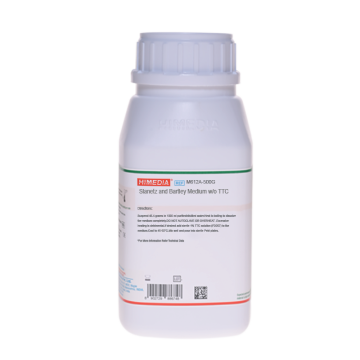
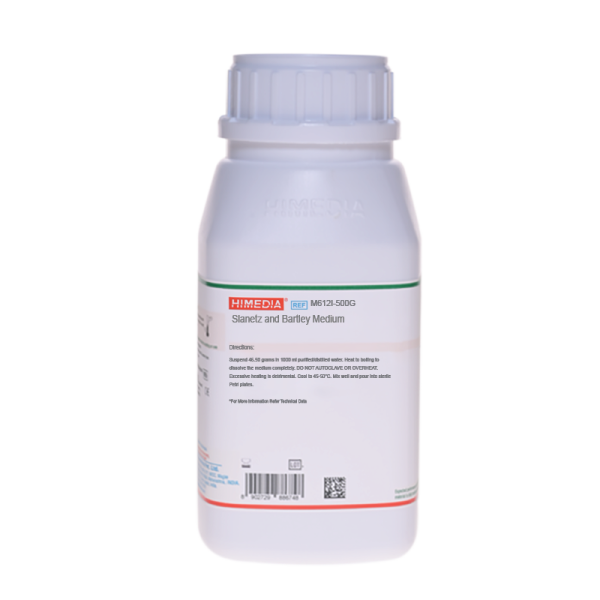
Recommended for detection and enumeration of faecal Streptococci from water samples by membrane filtration technique. The composition and performance criteria of this medium are as per the specifications laid down in ISO/ DIS 7899 -2: 2000 (E) and APНА.
| Ingredients | g / L |
|---|---|
| Tryptose | 20.000 |
| Yeast extract | 5.000 |
| Glucose | 2.000 |
| Dipotassium hydrogen phosphate | 4.000 |
| Sodium azide | 0.400 |
| TTC Solution (1%) | 10.00ml |
| Agar | 8-18 |
| Final pH (at 25°C) | 7.2±0.1 |
| Ingredients | g / L |
|---|---|
| Tryptose | 20.000 |
| Yeast extract | 5.000 |
| Dextrose | 2.000 |
| Dipotassium hydrogen phosphate | 4.000 |
| Sodium azide | 0.400 |
| 2,3,5-Triphenyl tetrazolium chloride | 0.100 |
| Agar | 15.000 |
| Final pH (at 25°C) | 7.2±0.1 |
Formula adjusted, standardized to suit performance parameters
Suspend 46.5 grams in 1000 ml purified / distilled water. Heat to boiling to dissolve the medium completely. DO NOT AUTOCLAVE OR OVERHEAT. Excessive heating is detrimental. Cool to 45-50°C. Mix well and pour into sterile Petri plates.
Slanetz and Bartley Medium was originally devised by Slanetz and Bartley (1) for the detection and enumeration of Enterococci by membrane filtration technique. It can be also used as a direct plating medium (2,3). M6121 differs from M612 in the type of buffering system used. This medium composition is as per specifications laid in ISO (4), АРНА (5).
Tryptose and yeast extract serves as a source of essential nutrients along with B-complex vitamins and nitrogenous nutrients. The medium is highly selective for Enterococci. Sodium azide has inhibitory effect on gram-negative organisms. Triphenyl Tetrazolium Chloride is reduced to the insoluble formazan inside the bacterial cell forming dark red-coloured colonies. When the medium is incubated at higher temperature (44-45°C), all red or maroon colonies can be considered as presumptive Enterococci (6,7).
The Department of Health (8) has recommended this medium to be used for enumeration of Enterococci in water supplies. Water is filtered through a membrane filter which is then placed on the surface of the Slanetz and Bartley Medium plates and incubated at 35°C for 4 hours and then at 44-45°C for 44-48 hours. Red or maroon colonies are counted as Enterococci. The preliminary incubation at 35°C helps for the recovery of stressed organisms. Not all the species reduce TTC, hence pale colonies also should be considered. Food samples are homogenized and so diluted with physiological saline to give 15-150 colonies on each petri plate. Homogenates or dilutions are spread on agar surface and incubated at 35°C for 48 hours. Pink or dark red colonies with a narrow whitish border are counted (9).
Water samples
Preparation of test sample: Prepare tenfold dilutions of water samples
Choice of technique:
Read the label before opening the container. Wear protective gloves/protective clothing/eye protection/ face protection. Follow good microbiological lab practices while handling specimens and culture. Standard precautions as per established guidelines should be followed while handling specimens. Safety guidelines may be referred in individual safety data sheets.
Performance of the medium is expected when used as per the direction on the label within the expiry period when stored at recommended temperature.
Appearance
Cream to yellow homogeneous free flowing powder
Gelling
Firm, comparable with 1.5% Agar gel
Colour and Clarity of prepared medium
Light yellow coloured clear to slightly opalescent gel forms in Petri plates
Reaction
Reaction of 4.65% w/v aqueous solution at 25°C. pH: 7.2±0.1
pH
7.10-7.30
Cultural Response
Cultural characteristics observed after an incubation at 44-45°C for 44-48 hours.
| Organism | Inoculum (CFU) | Growth | Recovery | Colour of colony |
|---|---|---|---|---|
| Enterococcus faecalis ATCC 29212 (00087*) | 50-100 | good-luxuriant >=50% | red or maroon | |
| Enterococcus faecalis ATCC 19433 (00009*) | 50-100 | good-luxuriant >=50% | red or maroon | |
| Enterococcus faecalis WDCM 00176 | 50-100 | good-luxuriant >=50% | red or maroon | |
| Enterococcus faecium ATCC 6057 (00177*) | 50-100 | good-luxuriant >=50% | red or maroon | |
| Enterococcus faecium WDCM 00178 | 50-100 | good-luxuriant >=50% | red or maroon | |
| Escherichia coli ATCC 25922 (00013*) | >=104 | inhibited | 0% | |
| Escherichia coli ATCC 8739 (00012*) | >=104 | inhibited | 0% | |
| Staphylococcus aureus subsp. aureus ATCC 6538 (00032*) | >=104 | inhibited | 0% | |
| Staphylococcus aureus subsp. aureus ATCC 25923 (00034)* | >=104 | inhibited | 0% |
Key: * - Corresponding WDCM numbers
Store between 10-30°C in a tightly closed container and the prepared medium at 2-8°C. Use before expiry date on the label. On opening, product should be properly stored dry, after tightly capping the bottle in order to prevent lump formation due to the hygroscopic nature of the product. Improper storage of the product may lead to lump formation. Store in dry ventilated area protected from extremes of temperature and sources of ignition Seal the container tightly after use. Product performance is best if used within stated expiry period.
User must ensure safe disposal by autoclaving and/or incineration of used or unusable preparations of this product. Follow established laboratory procedures in disposing of infectious materials and material that comes into contact with sample must be decontaminated and disposed of in accordance with current laboratory techniques (10,11).
| Product Name | Slanetz and Bartley Medium |
|---|---|
| SKU | M612I |
| Product Type | Regular |
| Physical Form | Powder |
| Origin | Animal |
| Packaging type | HDPE |
| References | 1. Slanetz L. W. and Bartley C.H., 1957, J. Bact., 74:591. 2.Burkwall M.K. and Hartman P.A., 1964, Appl. Microbiol., 12:18. 3.Nordic Committee on Food Analysis, 1968, Leaflet 68. 4.Taylor E.W. and Burman N.P., 1964, J. Appl. Bact., 27:294. 5.Mead G.C., 1966, Proc. Soc. Wat. Treat. Exam., 15:207. 6.Department of Health and Social Security, 1982, Report 71, HMSO, London. 7.Salfinger Y., and Tortorello M.L. Fifth (Ed.), 2015, Compendium of Methods for the Microbiological Examination of Foods, 5th Ed., American Public Health Association, Washington, D.C. 8.Baird R.B., Eaton A.D., and Rice E.W., (Eds.), 2015, Standard Methods for the Examination of Water andWastewater, 23rd ed., APHA, Washington, D.C.9.Isenberg, H.D. Clinical Microbiology Procedures Handb0ook. 2nd Edition.10.Jorgensen,J.H., Pfaller , M.A., Carroll, K.C., Funke, G., Landry, M.L., Richter, S.S and Warnock., D.W. (2015)Manual of Clinical Microbiology, 11th Edition. Vol. 1. |
| Customized Product Available | No |