HiMedia Laboratories GmbH, Marie-Curie-Str. 3, 64683, Einhausen, Germany.

 Your enquiry has been submitted
Something problem with the server. Try again.

Recommended for maintenance of Lactobacilli and for determining the action of bacteria on milk.
| Ingredients | g/L |
|---|---|
| SM powder # | 100.000 |
| Litmus | 0.500 |
| Sodium sulphite | 0.500 |
Final pH (at 25°C): 6.8±0.2
**Formula adjusted, standardized to suit performance parameters
# Equivalent to Skim milk powder
Suspend 101 grams in 1000 ml purified / distilled water, agitating continuously. Dispense 10 ml amounts into 15 x 150 mm tubes and sterilize by autoclaving at 15 lbs pressure (121°C) for 5 minutes. AVOID OVERHEATING.
Milk contains the carbohydrate lactose along with three main proteins i.e. casein, lactalbumin and lactoglobulin (1). Therefore an organism may exhibit one or several of the following metabolic properties in litmus milk, each specific for a particular species aiding bacterial identification. The various metabolic functions are lactose fermentation, litmus reduction, clot formation, peptonization (digestion) and gas formation (2). Litmus Milk is a differential medium used to determine different metabolic functions. Litmus Milk is also useful in the maintenance and propagation of lactic acid bacteria.
Litmus Milk is the most useful medium in dairy industry as it is a reliable indicator of bacterial action on milk (3). Litmus is a good indicator of acidity, alkalinity and its oxidation-reduction potential is useful in milk media with lower toxicity to microorganisms than bromocresol purple (4). Addition of 1% w/v dextrose and/or 5% w/v yeast extract to Litmus Milk accelerates the growth of some organisms, which cannot grow in plain Litmus Milk (3,4,5).
For detection of Clostridium perfringens in water, inoculate freshly heated tubes of Litmus Milk with various quantities of water and heat at 80°C for 10-15 minutes to destroy non-spore-forming organisms. Examine after every 24 hours for positive Stormy Clot reaction at 35°C for up to 5 days (6,7). Anaerobiosis in Litmus Milk can be obtained by adding a small heated iron nail or 0.1 gram of reduced iron to the medium (8). Skim milk is the substrate, metabolized by particular species of bacteria in different ways.
The actions of bacteria can be categorized as follows,
Dairy samples, Water samples
For dairy samples, follow appropriate techniques for sample collection and processing as per guidelines (9,10). For water samples, follow appropriate techniques for sample collection, processing as per guidelines and local standards. (11) After use, contaminated materials must be sterilized by autoclaving before discarding.
Read the label before opening the container. Wear protective gloves/protective clothing/eye protection/ face protection. Follow good microbiological lab practices while handling specimens and culture. Standard precautions as per established guidelines should be followed while handling specimens. Safety guidelines may be referred in individual safety data sheets.
Performance of the medium is expected when used as per the direction on the label within the expiry period when stored at recommended temperature.
Appearance: Pinkish purple to grey homogeneous free flowing powder may contain minute to small particles
Colour and Clarity of prepared medium: Light purple coloured opaque milky solution
Reaction: Reaction of 10.1% w/v aqueous solution at 25°C. pH: 6.8±0.2
pH: 6.60-7.00
Cultural Response: Cultural characteristics observed after an incubation at 35-37°C for upto 14 days and record the reactions of various intervals during the incubation.
| Organism | Growth | Reaction |
|---|---|---|
| Clostridium perfringens ATCC 13124 (00007*) | good-luxuriant | stormy fermentation (gas) |
| Lactobacillus acidophilus ATCC 11506 | good-luxuriant | acid clot (pink) |
| Pseudomonas aeruginosa ATCC 27853 (00025*) | good-luxuriant | peptonization (clearing) |
Key: (*) Corresponding WDCM numbers.
Store between 10-30°C in a tightly closed container and the prepared medium at 15-30°C. Use before expiry date on the label. On opening, product should be properly stored dry, after tightly capping the bottle in order to prevent lump formation due to the hygroscopic nature of the product. Improper storage of the product may lead to lump formation. Store in dry ventilated area protected from extremes of temperature and sources of ignition. Seal the container tightly after use. Product performance is best if used within stated expiry period.
User must ensure safe disposal by autoclaving and/or incineration of used or unusable preparations of this product. Follow established laboratory procedures in disposing of infectious materials and material that comes into contact with sample must be decontaminated and disposed of in accordance with current laboratory techniques (12,13).
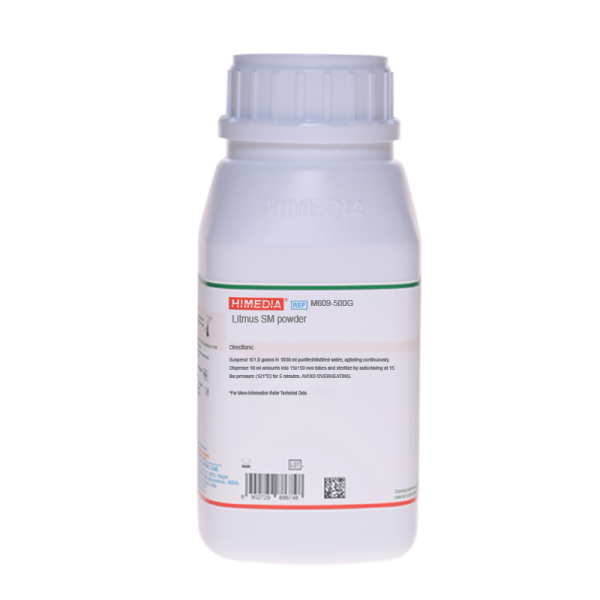
| Product Name | Litmus SM Broth |
|---|---|
| SKU | M609 |
| Product Type | Regular |
| Physical Form | Powder |
| Origin | Animal |
| Packaging type | HDPE |
| References | 1.Cantarow A., Schepartz B., Biochemistry, 3rd Ed., Philadelphia: W B Saunders, 1962:273,792-7932.MacFaddin J. F., 2000, Biochemical tests for Identification of Medical Bacteria, 3rd Ed., Lippincott, Williams and Wilkins,Baltimore. 3.Davis J. G., 1935, J. Dairy Res., 6:121. 4.Davis J. G., 1955, A Dictionary of Dairying, 2nd Ed., Leonard Hill. 5.Davis J. G., 1959, Milk Testing, 2nd Ed., United Trade Press. 6.Department of Health and Social security, 1969, Report No. 21, HMSO, London. 7.MacFaddin J. F., 1985, Media for Isolation-Cultivation-Maintenance of Medical Bacteria, Vol. I, Williams and Wilkins,Baltimore. 8.Townsend C. T., Somers J. J., Lamb F. C. and Olson N. A., 1956, A Laboratory Manual for the Canning Industry, 2nd Ed.,National Canners Association, Washington. |
| Customized Product Available | No |