HiMedia Laboratories GmbH, Marie-Curie-Str. 3, 64683, Einhausen, Germany.

 Your enquiry has been submitted
Something problem with the server. Try again.
 Your enquiry has been submitted
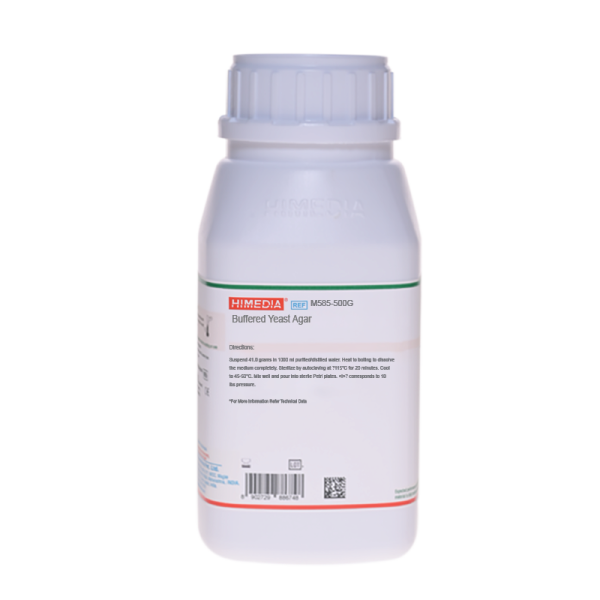
Recommended for cultivation of yeasts and moulds and for the controlling of bottle washing operations in the soft drinks and related industries.
| Ingredients | Gms / Litre |
|---|---|
| Yeast extract | 5.000 |
| Dextrose (Glucose) | 20.000 |
| Ammonium sulphate | 0.720 |
| Ammonium dihydrogen phosphate | 0.260 |
| Agar | 15.000 |
Final pH (at 25°C): 5.5±0.2
**Formula adjusted, standardized to suit performance parameters
Suspend 41 grams in 1000 ml purified / distilled water. Heat to boiling to dissolve the medium completely. Sterilize by autoclaving at 115°C for 20 minutes. Mix well and pour into sterile Petri plates.
Yeasts grow well on a minimal medium containing only dextrose and salts. The addition of yeast extract allows faster growth so that during exponential or log phase growth, the cells divide every 90 minutes (1). Buffered Yeast Agar is prepared as per the modification of the yeast-salt medium described by Davis (4).
The medium contains yeast extract, which supplies B-complex vitamins to stimulate growth. Dextrose is the carbohydrate source. The reaction of this medium can be adjusted to required pH values by the addition of citric or lactic acid to the medium after sterilization. The following table shows the amount of the acids required to be added to 100 ml of Buffered Yeast Agar cooled to 50°C.
| pH | 1% w/v solution of | 1% w/v solution of |
|---|---|---|
| Citric acid monohydrate (ml) | Lactic acid (ml) | |
| 4.75 | 1.26 | 0.125 |
| 4.5 | 2.24 | 0.2 |
| 4.25 | 3.92 | 0.3 |
| 4.0 | 6.16 | 0.45 |
| 3.75 | 9.52 | 0.7 |
| 3.5 | 14.56 | 1.17 |
Bottles used in soft drink industries.
Bunker (2,3) described a practical method for assessing the efficiency of the bottle cleaning operations. In this method, the bottle under test is converted into a roll-tube culture by coating it internally with the medium. When the agar sets, the bottle is incubated and the colonies are counted and examined. This method gives better results than rinsing the bottle and subsequently plating the rinsings. When used for this purpose, the agar concentration in Buffered Yeast Agar should be increased by 1%w/v (before sterilization).
Read the label before opening the container. Wear protective gloves/protective clothing/eye protection/ face protection. Follow good microbiological lab practices while handling specimens and culture. Standard precautions as per established guidelines should be followed while handling specimens. Safety guidelines may be referred in individual safety data sheets.
Performance of the medium is expected when used as per the direction on the label within the expiry period when stored at recommended temperature.
Appearance
Cream to yellow homogeneous free flowing powder
Gelling
Firm, comparable with 1.5% Agar gel
Colour and Clarity of prepared medium
Light amber coloured, clear to slightly opalescent gel forms in Petri plates.
Reaction
Reaction of 4.1% w/v aqueous solution at 25°C. pH : 5.5±0.2
pH
5.30-5.70
Cultural Response
Cultural characteristics observed after an incubation at 25-30°C for 48-72 hours.
| Organism | Inoculum (CFU) | Growth | Recovery |
|---|---|---|---|
| Candida albicans ATCC 10231 (00054*) | 50-100 | good-luxuriant | >=70% |
| Saccharomyces cerevisiae ATCC 9763 (00058*) | 50-100 | good-luxuriant | >=70% |
| #Aspergillus brasiliensis ATCC 16404 (00053*) | 50-100 | good-luxuriant |
Key:- *Corresponding WDCM numbers.
#Formerly known as Aspergillus niger
Store between 10-30°C in a tightly closed container and the prepared medium at 20-30°C. Use before expiry date on the label. On opening, product should be properly stored dry, after tightly capping the bottle in order to prevent lump formation due to the hygroscopic nature of the product. Improper storage of the product may lead to lump formation. Store in dry ventilated area protected from extremes of temperature and sources of ignition Seal the container tightly after use. Product performance is best if used within stated expiry period.
User must ensure safe disposal by autoclaving and/or incineration of used or unusable preparations of this product. Follow established laboratory procedures in disposing of infectious materials and material that comes into contact with sample must be decontaminated and disposed of in accordance with current laboratory techniques (5,6).
| Product Name | Buffered Yeast Agar |
|---|---|
| SKU | M585 |
| Product Type | Regular |
| Physical Form | Powder |
| Origin | Animal Free (Microbial) |
| Packaging type | HDPE |
| References | 1. Ausubel, Brent, Kingston, Moore, Seidman, Smith and Struhl, 1994, Current Protocols in Molecular Biology, CurrentProtocols, Brooklyn, N.Y. 2.Davis J. G., 1931, J. Dairy Res., 3:133. 3.Bunker H. J., 1952, Lab. Prac., 18:354. 4.Bunker H. J., 1956, Wallerstein Lab. Communications, 19(65): 143. |
| Customized Product Available | No |