HiMedia Laboratories GmbH, Marie-Curie-Str. 3, 64683, Einhausen, Germany.

 Your enquiry has been submitted
Something problem with the server. Try again.
 Your enquiry has been submitted
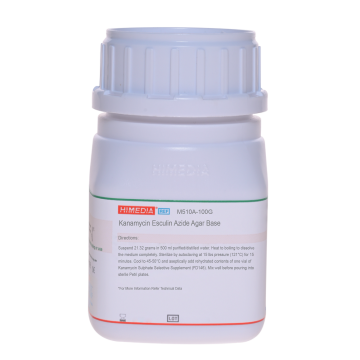
Recommended for selective isolation and identification of group D Streptococci from foodstuffs.
| Ingredients | g/L |
|---|---|
| Tryptone | 20.000 |
| Yeast extract | 5.000 |
| Sodium chloride | 5.000 |
| Sodium citrate | 1.000 |
| Esculin | 1.000 |
| Ferric ammonium citrate | 0.500 |
| Sodium azide | 0.150 |
| Kanamycin sulphate | 0.020 |
| Agar | 12.000 |
Final pH (at 25°C) 7.0±0.2
**Formula adjusted, standardized to suit performance parameters
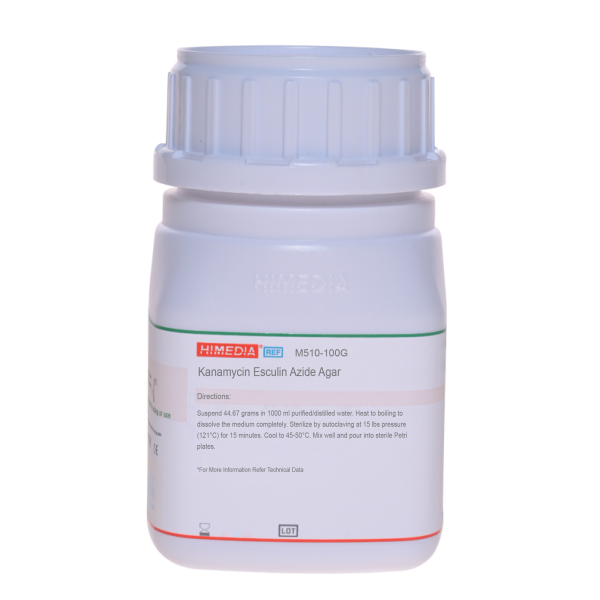
Suspend 44.67 grams in 1000 ml purified / distilled water. Heat to boiling to dissolve the medium completely. Sterilize by autoclaving at 15 lbs pressure (121°C) for 15 minutes. Cool to 45-50°C. Dispense as desired.
Enterococci may be considered an essential part of the autochthonous microflora of humans and animals. Faecal streptococci bearing the group D Lancefield antigens are grouped as Enterococci. Lancefield Group D-Streptococci constituting the faecal Streptococci are contaminants of various food commodities, especially those of animal origin. Kanamycin Esculin Azide Agar is formulated as per Mossel et al (1,2) to detect Enterococci in foodstuffs. Mossel et al (3) used it for the dip slide technique for bacteriological monitoring of foods.
Tryptone and yeast extract provides essential nutrients for Enterococci. Kanamycin sulphate and sodium azide are the selective inhibitory components. Esculin and ferric ammonium citrate together forms the indicator system to detect esculin-hydrolyzing Streptococci, which form black zones around the colonies. The black zones are produced from the formation of black iron phenolic compounds derived from esculin-hydrolysis products and ferrous ions. Mossel et al (4) described the following procedure - 1gm or 1ml mixed food is added to 9 ml of pre-chilled diluent (Tryptone water M463) and decimal dilutions are prepared. The decimal dilutions are inoculated in Kanamycin Esculin Azide Broth (M776) and incubated at 35-37°C for 16-24 hours. If blackening of medium occurs, streaking is done on agar (M510) and after incubation confirmatory tests are carried out.
Kanamycin Esculin Azide Agar has been used successfully for the isolation of glycopeptide-resistant Enterococci from clinical specimens and foods (5,6). There is no universal medium that will isolate all strains of Enterococci (7). Unless a presumptive count is acceptable all isolates should have their identity confirmed with further tests.
Food and dairy samples
For food and dairy samples, follow appropriate techniques for sample collection and processing as per guidelines (8,9,10). After use, contaminated materials must be sterilized by autoclaving before discarding.
Read the label before opening the container. Wear protective gloves/protective clothing/eye protection/ face protection. Follow good microbiological lab practices while handling specimens and culture. Standard precautions as per established guidelines should be followed while handling specimens. Safety guidelines may be referred in individual safety data sheets.
Performance of the medium is expected when used as per the direction on the label within the expiry period when stored at recommended temperature.
Appearance
Cream to yellow w/greenish tinge homogeneous free flowing powder
Gelling
Firm, comparable with 1.2% Agar gel.
Colour and Clarity of prepared medium
Medium amber coloured, clear to slightly opalescent gel with purplish tinge forms in Petri plates.
Reaction
Reaction of 4.47% w/v aqueous solution at 25°C. pH: 7.0±0.2
pH
6.80-7.20
Cultural characteristics observed after an incubation at 35-37°C for 18-24 hours
| Organism | Inoculum (CFU) | Growth | Recovery | Esculin Hydrolysis |
|---|---|---|---|---|
| Enterococcus bovis ATCC 27960 | 50-100 | good-luxuriant | >=50% | positive, blackening of medium around the colony |
| Enterococcus faecium ATCC 50-100 19434 (00010*) | 50-100 | good-luxuriant | >=50% | positive, blackening of medium around the colony |
| Escherichia coli ATCC 25922 (00013*) | >=104 | inhibited | 0% | |
| Enterococcus faecalis ATCC 50-100 29212 (00087*) | 50-100 | good-luxuriant | >=50% | positive, blackening of medium around the colony |
| Staphylococcus aureus subsp. aureus ATCC 25923 (00034*) | >=104 | inhibited | 0% |
Key : *Corresponding WDCM numbers.
Store between 10-30°C in a tightly closed container and the prepared medium at 20-30°C. Use before expiry date on the label. On opening, product should be properly stored dry, after tightly capping the bottle in order to prevent lump formation due to the hygroscopic nature of the product. Improper storage of the product may lead to lump formation. Store in dry ventilated area protected from extremes of temperature and sources of ignition Seal the container tightly after use. Product performance is best if used within stated expiry period.
User must ensure safe disposal by autoclaving and/or incineration of used or unusable preparations of this product. Follow established laboratory procedures in disposing of infectious materials and material that comes into contact with sample must be decontaminated and disposed of in accordance with current laboratory techniques (11,12).
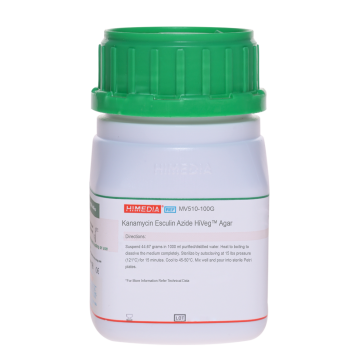
| Product Name | Kanamycin Esculin Azide Agar |
|---|---|
| SKU | M510 |
| Product Type | Regular |
| Physical Form | Powder |
| Origin | Animal |
| Packaging type | HDPE |
| References | 1.Mossel D. A. A., Bijker P. G. H. and Eelderink I., 1978, Arch. Lebensmittel - hyg., 29:121. 2.Mossel D. A .A. el al, 1978, In : `Streptococci., Skinner F. A. and Quesnel L. B. (Eds.), SAB Symposium, Series No.7,Academic Press, London. 3.Mossel D. A. A. et al, 1976, Lab. Practice, 25:393. 4.Mossel D. A. A., Harrenwijn G. A. and Elzebroek B. J. M., 1973, UNICEF, Geneva. 5.Chadwick P. R., Brown D. F. J., Wilcox M. H. et al, 1997, Clin. Microbiol., Inf. 3.559-563. 6.Van den Braak N., Van Belkum A., Van Keulen. M et al, 1998, J. Clin. Microbiol., 3 6.1927-1932. 7.Reuter G., 1985, Inter. J. Food. Microbiol., 2.103-114. |
| Customized Product Available | No |