HiMedia Laboratories GmbH, Marie-Curie-Str. 3, 64683, Einhausen, Germany.

 Your enquiry has been submitted
Something problem with the server. Try again.
 Your enquiry has been submitted
| Ingredients | Gms / Litre |
|---|---|
| Sodium citrate | 3.000 |
| Dextrose | 0.200 |
| Yeast extract | 0.500 |
| L-Cysteine hydrochloride | 0.100 |
| Ferric ammonium citrate | 0.400 |
| Potassium phosphate | 1.000 |
| Sodium chloride | 5.000 |
| Sodium thiosulphate | 0.080 |
| Phenol red | 0.012 |
| Agar | 14.000 |
Final pH (at 25°C): 6.7±0.2
**Formula adjusted, standardized to suit performance parameters
Suspend 24.29 grams in 1000 ml distilled water. Heat to boiling to dissolve the medium completely. Dispense into test tubes. Sterilize by autoclaving at 12 to15 lbs pressure (118 to 121°C) for 15 minutes. Cool the tubes in slanted position to give slants with generous butts.
Christensen Citrate Sulphite Agar is a modification of the Christensen Iron Agar (1). This modification was described by Edwards and Ewing (2). Christensen reported that all members of genera Escherichia, Enterobacter, Citrobacter and Salmonella as well as Alkalescens-Dispar were capable of utilizing citrate as a source of energy while Shigella species failed to utilize citrate.
Organisms that metabolize citrate as a sole source of carbon cleave citrate to oxaloacetate and acetate via the citritase enzyme. Another enzyme, oxaloacetate decarboxylase, then converts oxaloacetate to pyruvate and CO2. Further, this CO2 combines with sodium and water to form sodium carbonate, an alkaline compound (3). As a result, the pH of medium rises and the indicator, phenol red changes from orange red to cerise. Presence of the cerise colour indicates a positive finding for citrate utilization. Medium constituent yeast extract provide the necessary nutrients mainly nitrogenous and vitamins for the growth of the organisms.
L-Cysteine hydrochloride is a reducing agent. Dextrose is the fermentable carbohydrate. Sodium citrate is the energy source for citrate utilizing organisms. Care should be taken while inoculating, as, a too heavy inoculum may give a false positive result (4).
The reduction of ferric ammonium citrate to iron sulphide by H2S producing organisms is indicated by blackening of the medium. Sodium thiosulphate enhances H2S production. Strong positive cultures upon prolonged incubation turn the entire butt black. Some members of Salmonella like Salmonella Typhi are weakly positive and require 2-5 days for hydrogen sulphite production.
Appearance: Light yellow to light pink homogeneous free flowing powder
Gelling: Firm, comparable with 1.4% Agar gel.
Orange red coloured, very slightly opalescent gel forms in tubes as slants
Reaction of 2.42% w/v aqueous solution at 25°C. pH: 6.7±0.2
6.50-6.90
M495: Cultural characteristics observed after an incubation at 35-37°C for 18-24 hours.
| Organism | Inoculum (CFU) | Growth | Citrate Utilisation | H2S |
|---|---|---|---|---|
| Enterobacter aerogenes ATCC 13048 | 50-100 | luxuriant | positive reaction, cerise colour | negative reaction,no colour change |
| Escherichia coli ATCC 25922 | 50-100 | luxuriant | negative reaction, no colour change | negative reaction,no colour change |
| Salmonella Typhimurium ATCC 14028 | 50-100 | luxuriant | positive reaction, cerise colour | positive reaction, blackening of medium |
| Salmonella Enteritidis ATCC 13076 | 50-100 | luxuriant | positive reaction, cerise colour | positive reaction, blackening of medium |
| Klebsiella pneumoniae ATCC 13883 | 50-100 | luxuriant | weakly positive, orange-pink colour | negative reaction,no colour change |
| Shigella flexneri ATCC 12022 | 50-100 | luxuriant | negative reaction, no colour change | negative reaction,no colour change |
| Shigella sonnei ATCC 25931 | 50-100 | luxuriant | negative reaction, no colour change | negative reaction,no colour change |
Store below 30°C in tightly cloased container and the prepared medium at 2 - 8°C. Use before expiry date on the label.
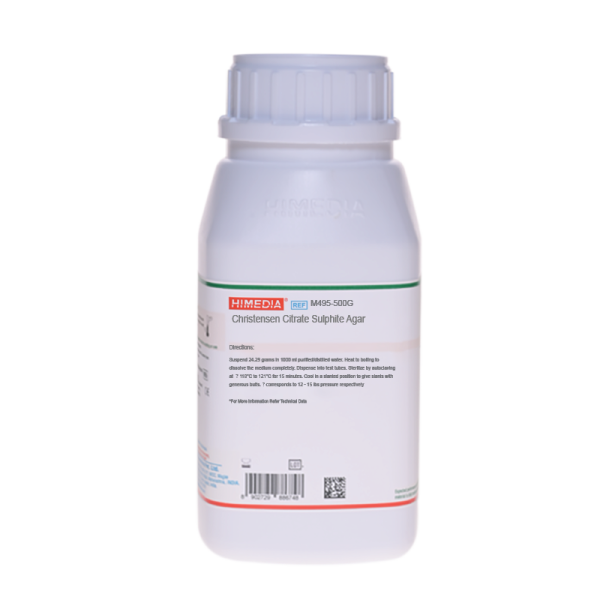
| Product Name | Christensen Citrate Sulphite Agar |
|---|---|
| SKU | M495 |
| Product Type | Regular |
| Physical Form | Powder |
| Origin | Animal Free (Microbial) |
| Packaging type | HDPE |
| References | 1.Christensen W.B., 1949, Research Bull., Weld County Health Dept., Greenley Co., 1:3. 2.Edwards P.R. and Ewing W. H., 1955 and 1962, Identification of Enterobacteriaceae Minneapolis, Burgess Publishing Co.,pg. 179 and 242. 3.Horward B., 1994, Clinical and Pathogenic Microbiology, 2nd ed., Mosby Year Book, Inc. 4.Branson D., 1972, Methods in Clinical Bacteriology, Springfield, III: C. Thomas, 15. |
| Customized Product Available | No |