HiMedia Laboratories GmbH, Marie-Curie-Str. 3, 64683, Einhausen, Germany.

 Your enquiry has been submitted
Something problem with the server. Try again.
 Your enquiry has been submitted
Bile Esculin Azide Agar is a selective medium used for isolation and presumptive identification of fecal Streptococci. The composition and performance criteria of this medium are as per the specifications laid down in ISO 7899-1:1984.
| Ingredients | Gms / Litre |
|---|---|
| Casein enzymic hydrolysate | 17.000 |
| Peptic digest of animal tissue | 3.000 |
| Yeast extract | 5.000 |
| Oxgall | 10.000 |
| Sodium chloride | 5.000 |
| Esculin | 1.000 |
| Ferric ammonium citrate | 0.500 |
| Sodium azide | 0.150 |
| Agar | 15.000 |
Final pH (at 25°C): 7.2±0.2
Formula adjusted, standardized to suit performance parameters
Suspend 56.65 grams in 1000 ml distilled water. Heat to boiling to dissolve the medium completely. Sterilize by autoclaving at 15 lbs pressure (121°C) for 15 minutes.
Caution: Sodium azide has a tendency to form explosive metal azides with plumbing materials. It is advisable to use enough water to flush off the disposables.
Group D Streptococci possess the group D lipoteichoic acid antigen in their cell walls. Former Group D species, which are predominant normal inhabitants of the human gastrointestinal tract, are termed as faecal Streptococci or Enterococci (1). The unique ability of Enterococci to split esculin was reported by Meyer and Schonfeld (2). Enterococci and Group D Streptococci hydrolyse esculin to esculetin and dextrose, which reacts with ferric citrate producing brownish black precipitate (3). The use of esculin hydrolysis in identification of Enterococci was first cited by Rochaix (4). Bile Esculin Agar was originally formulated by Swan (6) for the isolation and identification of Group D Streptococci from food. Facklam and Moody (7, 8) further reported that using Bile Esculin Agar, Group D Streptococci could be differentiated from non Group D Streptococci. Bile Esculin Agar was also shown to aid differentiation of Enterobacteriaceae, Klebsiella, Enterobacter, Serratia from other Enterobacteriaceae genera (9) on the basis of esculin hydrolysis. However, other tests such as salt tolerance should be performed for identifying Enterococci (5).
Bile Esculin Azide Agar is a modification of Bile Esculin Agar (6, 8) as per Isenberg (10). In this medium the bile concentration is reduced and additional sodium azide is incorporated. Bile Esculin Azide Agar, recommended by the ISO Committee (11) is a modification of Bile Esculin Azide Agar (M493), in the type of carbon sources used.
Casein enzymic hydrolysate, peptic digest of animal tissue and yeast extract serves as sources of carbon, nitrogen, amino acids, vitamins and essential growth nutrients. Oxgall and sodium azide inhibits most of the other accompyning bacteria. Esculin in the medium is hydrolyzed to esculetin and dextrose. Esculetin reacts with ferric citrate to form a dark brown or black complex, visualized as a zone of black precipitate around the colonies. If the media is dispensed in tubes in the form of slants, a positive reaction is indicated by blackening of more than half of the slant within 24-48 hours. If blackening is totally absent or if less than half of the slant is blackened within 24-48 hours, the test is negative. Viridans Streptococci sometimes exhibit a weak positive reaction. Also, Leuconostoc, Pediococcus, Lactococcus species causing human infections give a positive bile esculin test (12). To enhance the growth of Enterococci, Bile Esculin Agar can be supplemented with 50ml/l horse serum (3).
Suspected water samples are filtered using membrane filters. These membrane filters are aseptically placed on Slanetz and Bartely Medium (M612I). Red or maroon coloured colonies observed after incubation are further confirmed by aseptically transferring the membrane filter on to Bile Esculin Azide Agar plate, preheated to 44°C. Incubation at 44 ± 0.5°C for 2 hours is done following the inoculation. All typical colonies exhibiting a brown black colouration in the surrounding medium are counted as intestinal Enterococci (11). Alternatively Bile Esculin Azide Agar can also be used for direct isolation of Enterococci (without membrane filter), by incubation at 35-37°C for 18-24 hours.
Appearance: Light yellow to brownish yellow homogeneous free flowing powder
Gelling: Firm, comparable with 1.5% Agar gel
Colour and Clarity of prepared medium: Amber coloured, clear to slightly opalescent solution with a bluish tinge forms in Petri plates.
Reaction: Reaction of 5.67% w/v aqueous solution at 25°C. pH : 7.2±0.2
pH: 7.00-7.40
Cultural Response: Cultural characteristics observed after an incubation at 35-37°C for 18-24 hours.
| Organism | Inoculum (CFU) | Growth | Recovery | Esculin Hydrolysis |
|---|---|---|---|---|
| Enterococcus faecalis ATCC 29212 | 50-100 | luxuriant | >=50% | positive reaction, blackening of medium around the colony |
| Escherichia coli ATCC 25922 | >=10³ | inhibited | 0% | |
| Staphylococcus aureus ATCC 25923 | 50-100 | good | 40-50% | negative reaction |
| Proteus mirabilis ATCC 25933 | 50-100 | good | 40-50% | negative reaction |
| Streptococcus pyogenes ATCC 19615 | 50-100 | none-poor | <=10% | negative reaction |
Store below 30°C in tightly closed container and the prepared medium at 28°C. Use before expiry date on the label.
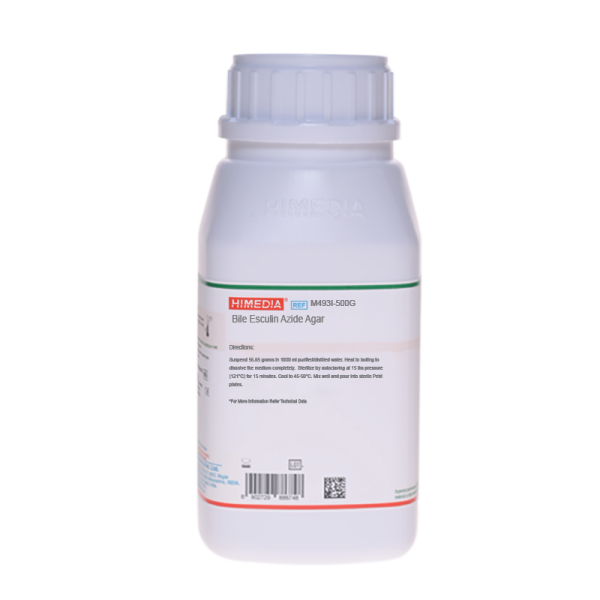
| Product Name | Bile Esculin Azide Agar |
|---|---|
| SKU | M493I |
| Product Type | Regular |
| Physical Form | Powder |
| Origin | Animal |
| Packaging type | HDPE |
| References | 1. Koneman E. W., Allen S. D., Janda W. M., Schreckenberger P. C., Winn W. C. Jr., 1992, Colour Atlas and Textbook ofDiagnostic Microbiology, 4 th Ed., J. B. Lippinccott Company 2.Meyer and Schonfeld, 1926, Zentralbl. Bakeriol, Parasitenk. Infectionskr. Hyg. Abt. Orig. 99:402. 3.MacFaddin J. F., 1985, Media for Isolation-Cultivation-Identification-Maintenance of Medical Bacteria, Vol. I, Williamsand Wilkins, Baltimore. 4.Rochaix, 1924, Comt. Rend. Soc. Biol., 90:771. 5.Facklam R., 1973, Appl. Microbiol., 26:138. 6.Swan, 1954, J. Clin. Pathol., 7:160. 7.Facklam R., 1972, Appl. Microbiol., 23:1131. 8.Facklam R. R and Moody M. D., 1970, Appl. Microbiol., 20(2):245. 9.Edberg S. C., Pittman S., and Singer J. M., 1977, J. Clin. Microbiol., 6:1 10.Isenberg, 1970, Clin. Lab. Forum, July. 11. Murray P. R., Baron E. J., Jorgensen J. H., Pfaller M. A., Yolken R. H.,(Eds.), 8th Ed., 2003, Manual of ClinicalMicrobiology, ASM, Washington, D.C.1 2.Isenberg, H.D. Clinical Microbiology Procedures Handb0ook. 2nd Edition. 13.Jorgensen,J.H., Pfaller , M.A., Carroll, K.C., Funke, G., Landry, M.L., Richter, S.S and Warnock., D.W. (2015)Manual of Clinical Microbiology, 11th Edition. Vol. 1. 14.American Public Health Association, Standard Methods for the Examination of Dairy Products, 1978, 14th Ed., WashingtonD.C. 15.Salfinger Y., and Tortorello M.L. Fifth (Ed.), 2015, Compendium of Methods for the Microbiological Examination ofFoods, 5th Ed., American Public Health Association, Washington, D.C. 16.Wehr H. M. and Frank J. H., 2004, Standard Methods for the Microbiological Examination of Dairy Products, 17th Ed.,APHA Inc., Washington, D.C.1 |
| Customized Product Available | No |